Three pattern languages recur through Persian design, from medieval architecture to contemporary goldwork: girih geometry, the boteh form, and the vocabulary of the garden. Each one carries its own history, and each translates differently into a wearable piece of jewellery.

Girih
Girih is a geometric tiling pattern built from five repeating shapes: a decagon, a hexagon, a pentagon, a bow-tie form, and a rhombus. The angles between tiles are fixed. The relationships between tiles are fixed. But the arrangements they produce are, in practice, infinite, and the pattern does not repeat at short intervals in the way a simple tessellation does.
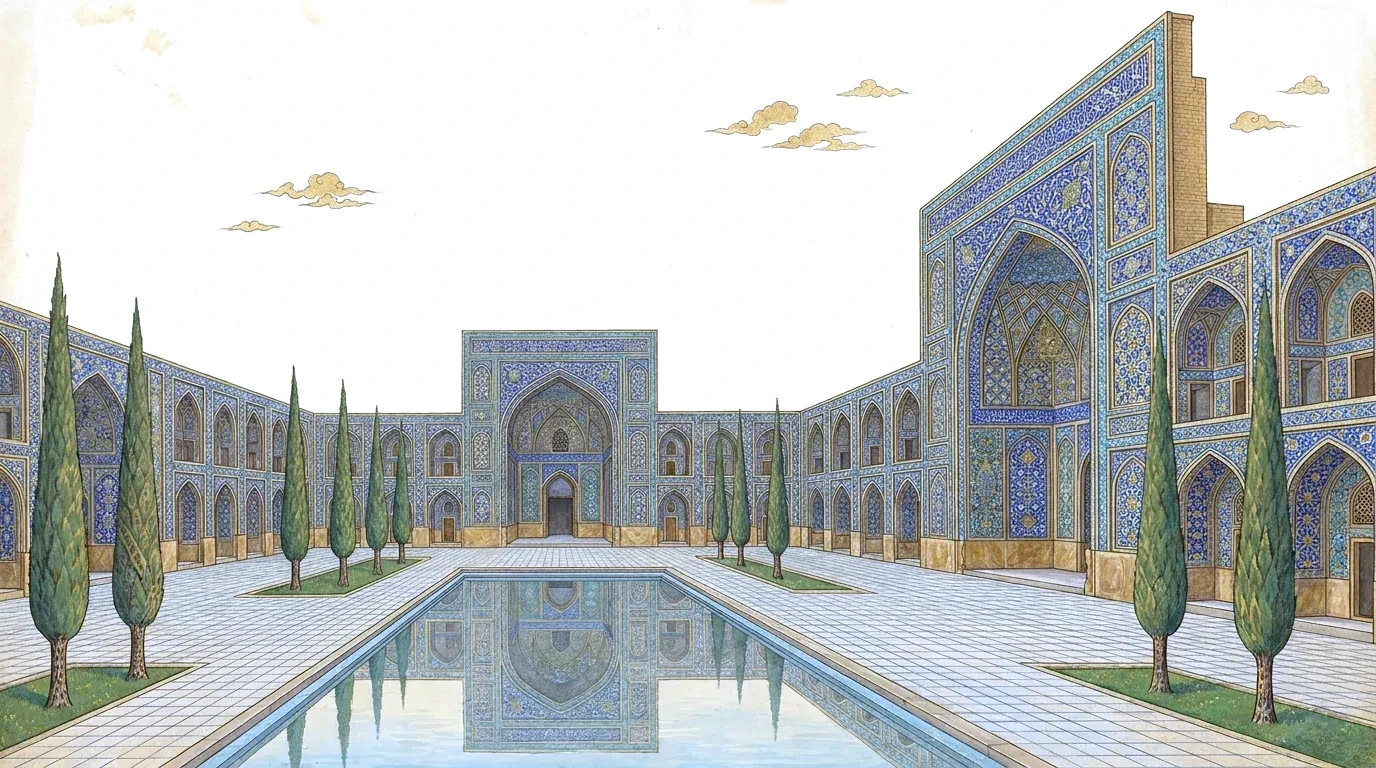
The pattern appears on the facades of mosques, madrasas, and palaces across Iran and Central Asia, drawn at scales ranging from a single decorative panel to the entire surface of a building. It is a pattern that rewards close looking and rewards standing back: the local geometry is clear at arm’s length; the long-range structure only becomes visible when you step away.
In jewellery, girih works best at scale. A broad pendant or a statement band gives the geometry room to develop before the eye reaches the edge. At the smaller scales of most everyday pieces, the pattern risks reading as texture rather than structure. The way we use it is on the reverse of solid pendants: a gallery of interlocking lines on the surface that faces the body. Geometry that the wearer knows is there and no one looking at them can see.
Boteh
Boteh is the teardrop form with a curving tip. It is the shape that became paisley in the eighteenth century, when trade brought Persian textiles into European markets and European manufacturers copied the pattern without the Persian word for it. The form appears in Safavid textiles and Mughal miniature paintings, where it stands variously for a leaf, a flame, or a droplet of water, depending on the period and the context.
In contemporary goldwork, boteh is the most immediately legible of the Persian motifs to a Western wearer, because of its paisley history. The challenge for a designer is keeping the original form rather than sliding toward the British commercial version, which softened the curves and filled the interior with smaller repeated elements until it bore little relationship to its source.
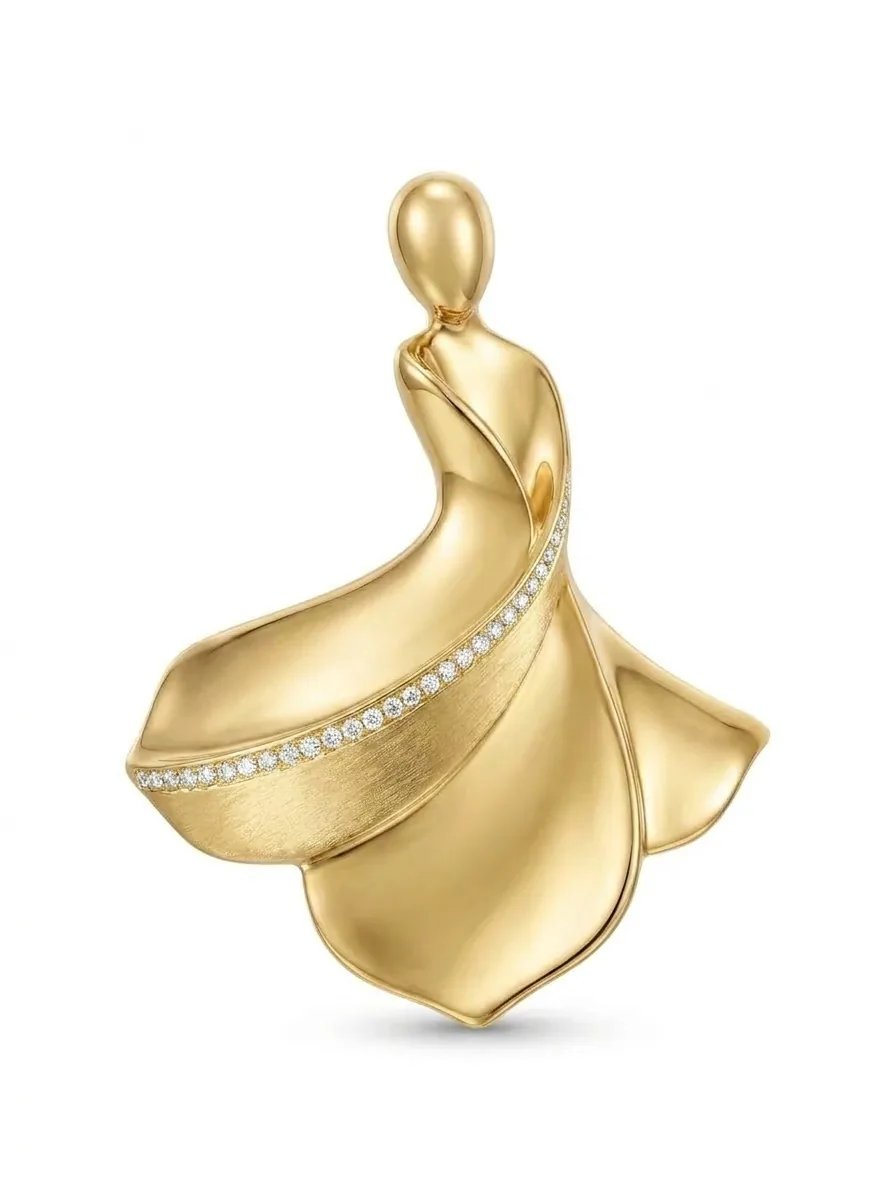
The Silux interpretation uses boteh as a volume rather than a surface decoration: the form of the stone outline, or the shape of the setting itself, rather than an engraved motif applied over an otherwise unrelated object. A boteh that IS the ring, rather than a boteh that is drawn ON a ring.
The garden
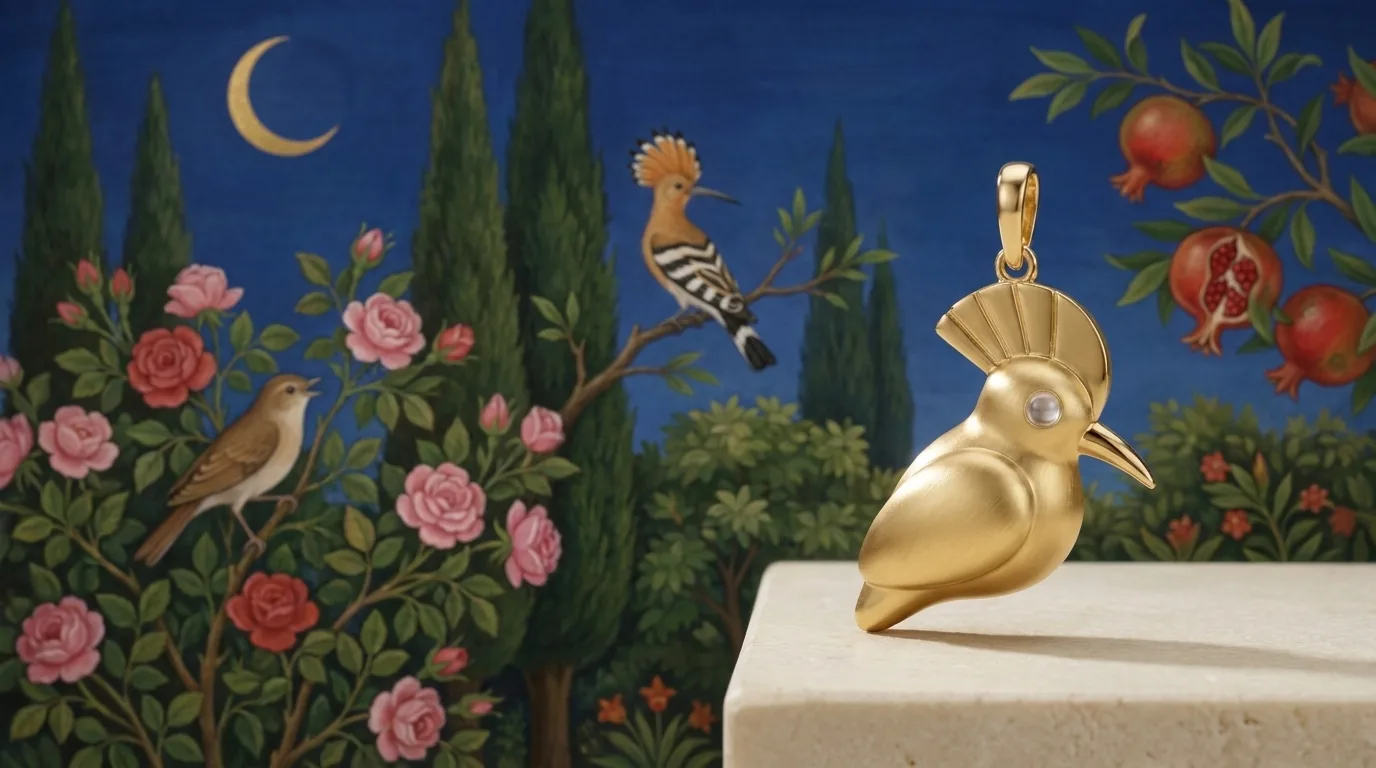
The Persian garden, the chahar bagh or four-part garden, is paradise made physical: four channels of water dividing a walled enclosure into symmetrical quadrants, a central pavilion or pool at the crossing. The word golestan means garden of flowers. Gol alone means flower or rose. The garden vocabulary runs through Persian poetry, tilework, carpet design, and miniature painting, and carries connotations of sanctuary, abundance, and beauty ordered by human intention.
In a jewellery collection, the garden works as a framing vocabulary rather than a literal image. Pieces named for elements of the garden (flowers, water, night blooms, morning light) rather than pieces that represent the garden as a thing. The literalness is a trap: a piece that looks like a garden looks like a brooch from sixty years ago.
What the garden gives a designer is not images but themes. Growth. Enclosure. The contrast between the formality of the walled geometry and the living, seasonal things inside it. A garden is a controlled wildness. That tension, between precision and organic life, is the same tension a well-made piece of goldwork holds.