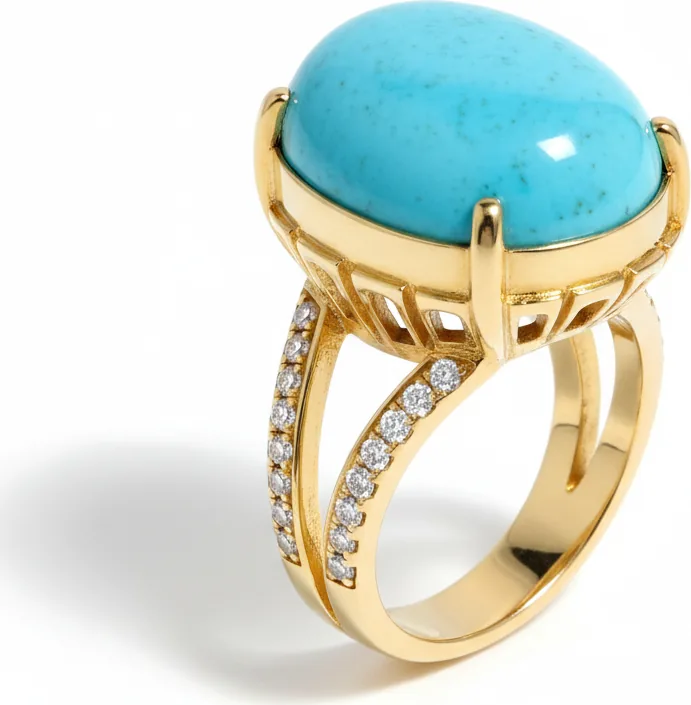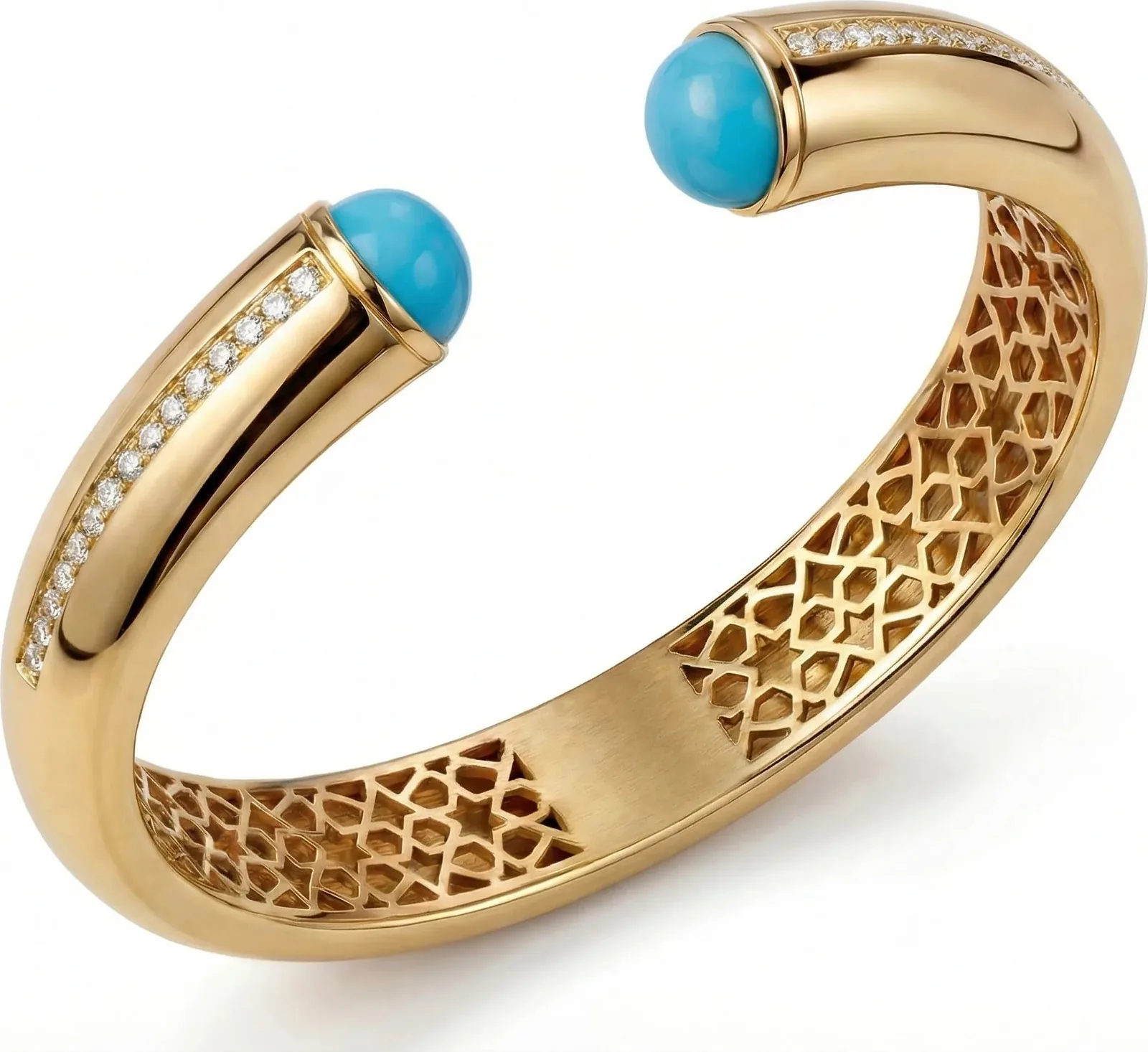
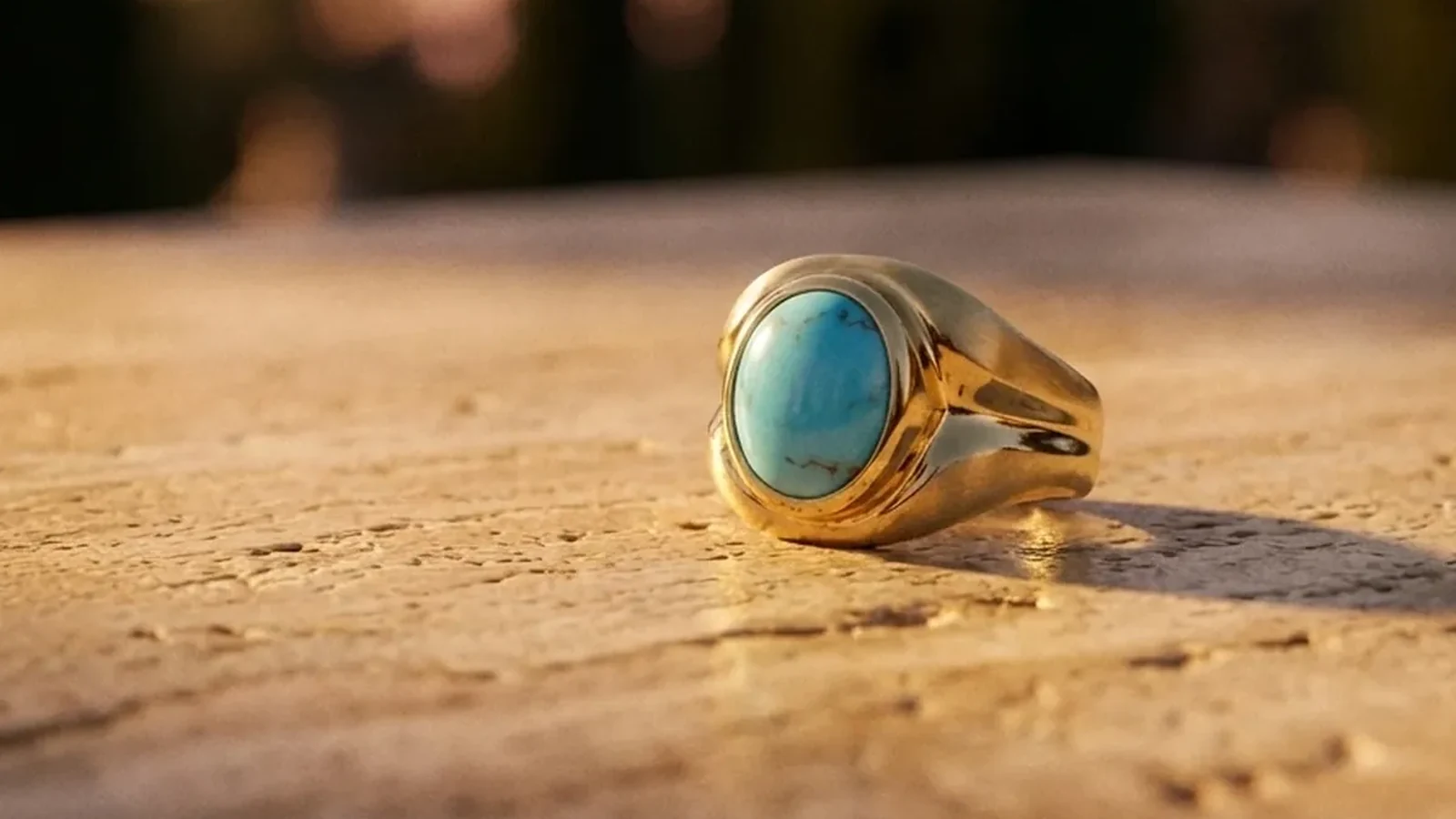
Turquoise is one of the few stones that took its English name from the route it travelled rather than from the ground it came out of. The word arrives through Old French, pierre turquoise, the Turkish stone, because that is how it reached European markets. It was not Turkish. A great deal of it had come a long way further east, out of Khorasan, in what is now north-eastern Iran, where turquoise has been worked for thousands of years.
In Persian the stone is fīrūzah, and the word sits close to the vocabulary of victory and good fortune. That is not a decorative aside. It is the reason turquoise ended up on the domes.

The stone that decided what Persian architecture looks like
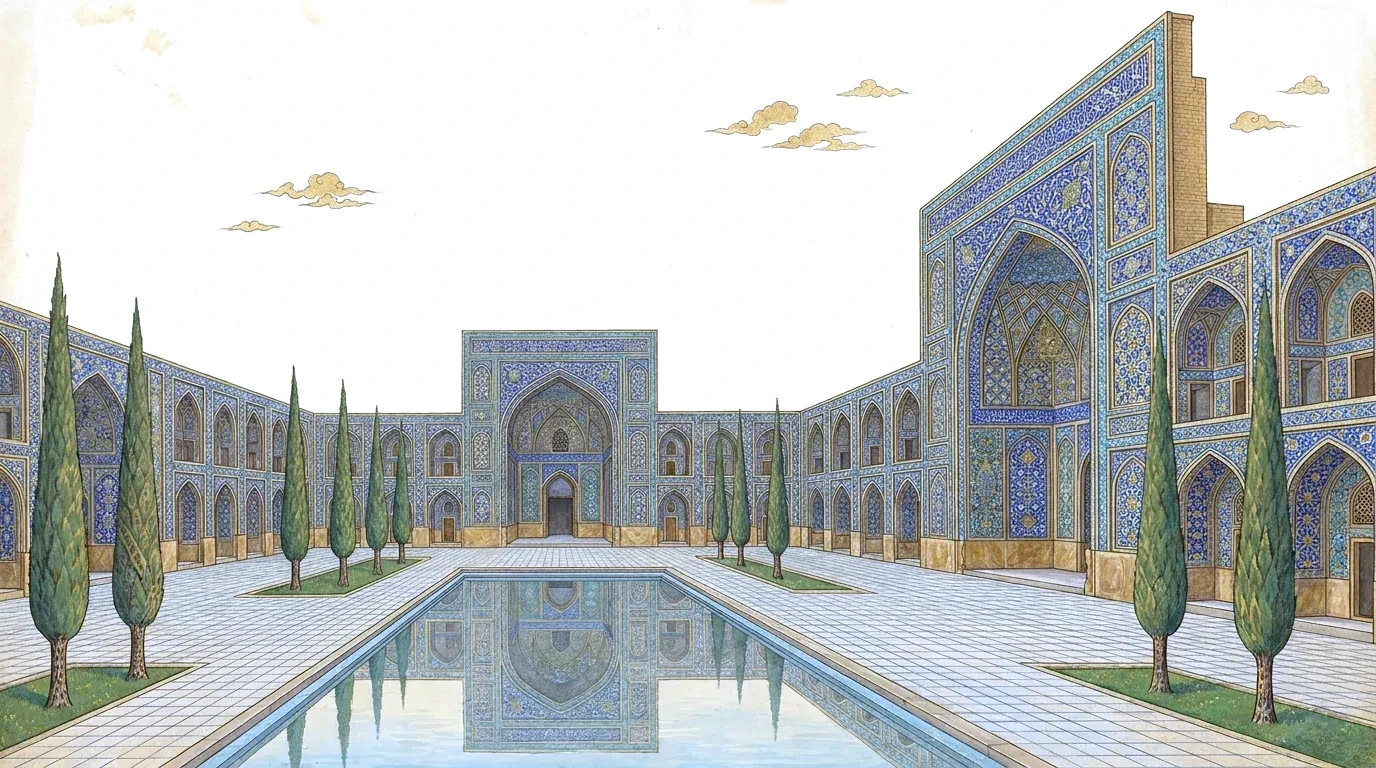
If you picture a Persian mosque, you are almost certainly picturing turquoise. The blue that covers the domes of Isfahan and the shrines of Mashhad is glazed tile rather than stone, but the colour being copied, and the reason it was chosen, is the mineral. A whole architectural palette grew outward from a stone.
That matters for jewellery for one specific reason. Turquoise in the Persian tradition is rarely asked to behave like a gemstone in the Western sense. It is not faceted, it does not refract, and it is not trying to throw light. It is a surface of colour, and it is used the way a glaze is used: in fields, in panels, set against gold rather than competing with it. A Persian setting tends to frame turquoise. A Western setting tends to elevate a diamond.
What “Persian grade” actually means, and what it does not
The trade still uses “Persian” as a quality description, and it is worth knowing that the term has drifted away from geography. It is generally used to describe an even, saturated sky blue with very little visible matrix, whatever country the stone was dug in. So a piece described as Persian turquoise may be a statement about the material’s origin, or only about its appearance. The two are not the same claim, and a buyer is entitled to ask which one is being made.
Matrix is the veining: the remnant of the host rock the turquoise formed in. Western taste has swung back and forth on it. A fine web of dark matrix, sometimes called spiderweb, is prized in some markets and discounted in others. Persian material is traditionally valued for having little of it. None of this is a hierarchy of quality so much as a hierarchy of fashion, and it is one of the few places in the stone trade where you can simply choose what you prefer without paying a penalty in integrity.
The one thing worth checking, always, is treatment. Turquoise is porous, and a large share of what is sold has been stabilised: impregnated with resin to harden it and hold its colour. Stabilised turquoise is a legitimate material and it is more durable than untreated stone. It is also worth considerably less. The distinction should be stated in writing, not implied.
The part most guides leave out: it is a soft stone
Turquoise sits at roughly 5 to 6 on the Mohs scale. Sapphire is 9. Diamond is 10. That gap is larger than it looks, because the scale is not linear.
Three practical consequences, and none of them is a reason to avoid the stone. They are reasons to design around it.
It scratches. A turquoise ring worn daily on the hand you use will not look the way it did, and no setting prevents that. It reacts. Being porous, turquoise can absorb oils, perfume, hand cream and cleaning products, and the colour can shift over years of contact. And it cannot take heat, so any future work near the stone means the setter works around it rather than through it, which is a real constraint on resizing and repair rather than an inconvenience.
So the honest advice is unglamorous. Turquoise is superb in a cuff, in earrings, in a statement ring worn by choice rather than by default. In an everyday engagement ring worn on the knuckle-side of the hand for forty years, it is a stone that will need looking after and will still change. Anyone who tells you otherwise is selling.
What the softness asks of the setting
A soft stone does not want pressure and it does not want a mounting that traps what it reacts to.
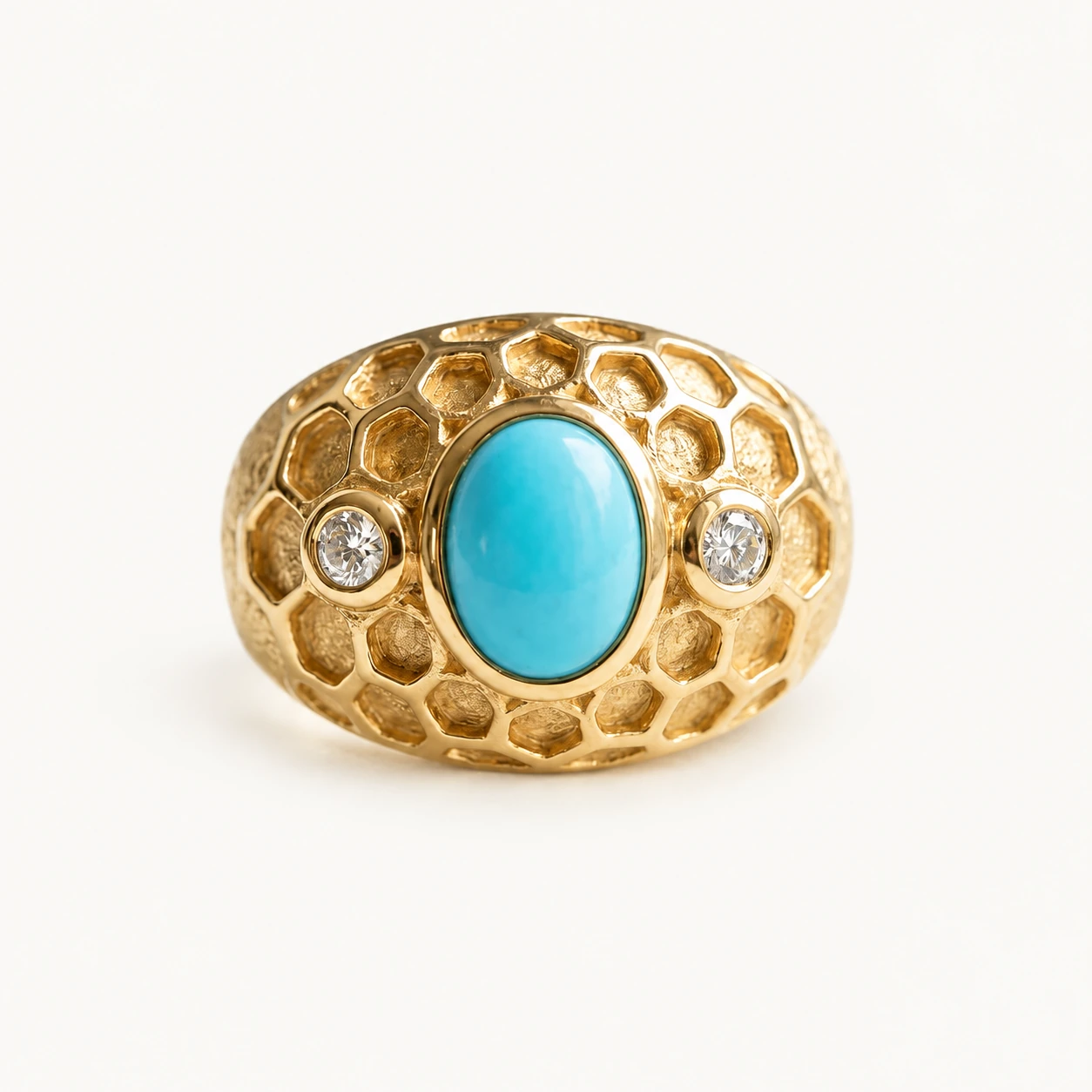
Pressure first. Turquoise is usually cut as a cabochon, a domed surface with no facets, and it is set in a bezel: a wall of gold closed over the edge of the stone. A bezel spreads the load around the whole girdle instead of concentrating it at four points, which is exactly what a soft stone needs. It also protects the edge, which is where a chip starts.
Then geometry. A setting that puts a deep, narrow, unreachable void beneath a porous stone is a setting that collects everything the stone should not be in contact with. The rule is about the shape of the space, not the style of the setting: a seat you can flush out is fine, a cavity you cannot reach is not. That single test governs more of a design than any decision about which stone goes in it.
Where this lands in our own work
The Firouzeh pieces are named for the stone rather than for a motif, which is unusual for us. In most of the collection the pattern leads and the stone answers to it. Here the material came first, and the geometry was drawn around what turquoise can actually take: bezels rather than claws, flat gold fields for the colour to sit against, and no closed pockets under the stone.
The bridal piece in that family is the exception that proves the point above. It is built as a muqarnas dome, the honeycomb vaulting that turns a square room into a circular ceiling, which is architecture the same tradition produced. Turquoise on a dome is not a coincidence of taste. It is the same idea, at two very different scales.
If you are considering turquoise for a commission, the questions worth asking before anything is drawn are: is it treated, how will the piece actually be worn, and can the seat be cleaned. Those three answers shape the design more than the colour does.