People looking for Persian jewellery often meet the term “Islamic geometric pattern” as well, and the two are used as if they mean the same thing. They don’t quite. Here is the distinction, stated plainly, because it is one we rely on to describe our own work honestly.
“Islamic geometric pattern” is the umbrella term. It covers a decorative tradition that runs from Moorish Spain to Mughal India, a thousand years and more, many dynasties, courts, and craft guilds, all working from a shared root: patterns built with compass and straightedge, tiled from a small set of simple shapes into designs that can extend, in principle, without limit. The tradition is real and it is genuinely shared. A carved wooden ceiling in Marrakesh and a stone screen in Agra are drawing on the same geometric grammar.
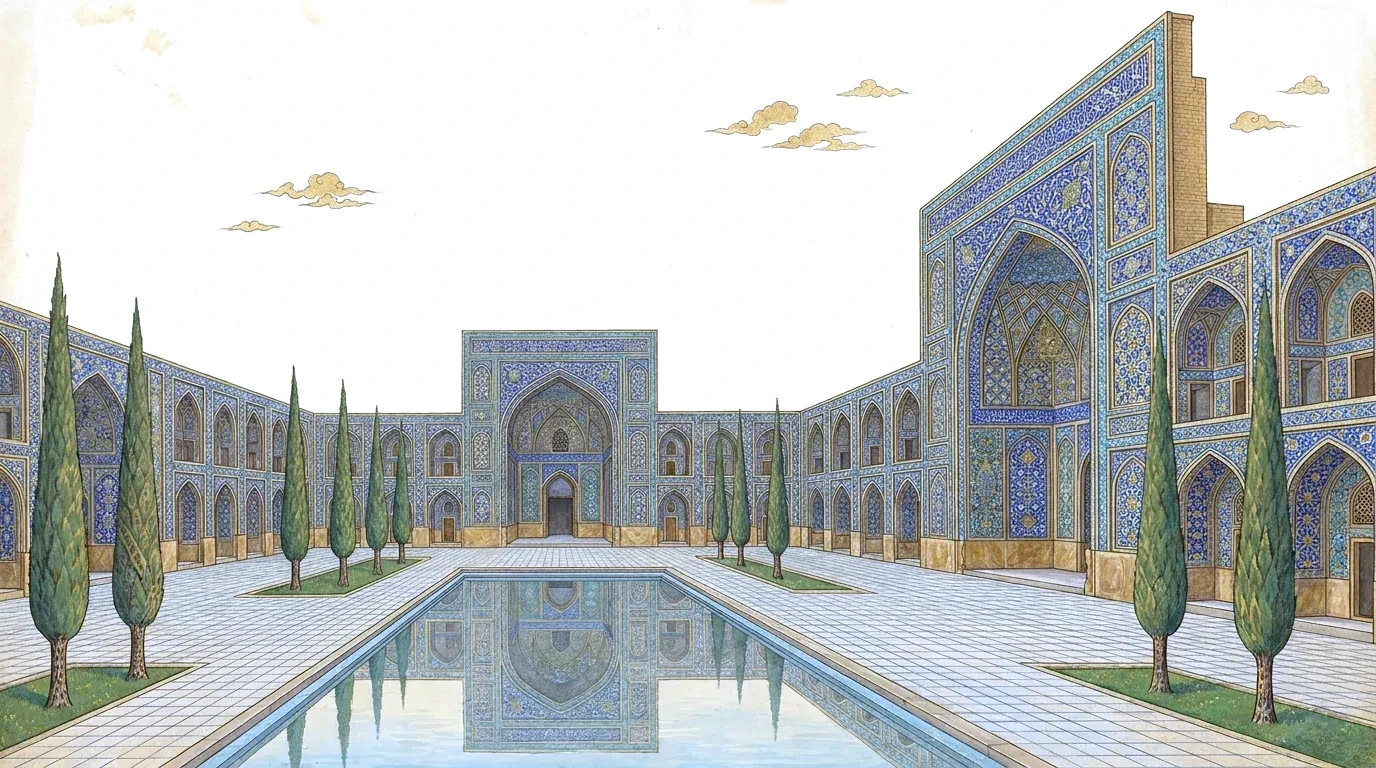
“Persian” is narrower. It names a specific lineage within that wider tradition: the architecture and courtly design of successive dynasties of Persia, most visibly the Safavid building programme centred on Isfahan, where geometric strapwork (girih) and honeycombed vaulting (muqarnas), both far older than the Safavids, were refined to an exceptional degree, alongside a distinct colour language and a body of decorative convention that is recognisably its own within the broader family.

Why the distinction matters to us
Girih is the straight-line geometric tradition: patterns that can be built from a small set of tile shapes with fixed angles between them, arranged so the pattern reads clearly close up and can resolve into a larger structure at a distance. Muqarnas is the three-dimensional cousin: tiers of small niche-like cells, stacked and projected, that turn a flat ceiling or a doorway into something that looks like it is dissolving into honeycomb or stalactite form. Both appear across the wider Islamic architectural world. Both reach a particular refinement in Persian building, and that geometry carries through, in different form, into Persian metalwork and manuscript illumination, which is the visual line our own pieces draw from.
We do not work from the Moorish tradition, or the Mamluk, or the Ottoman, however closely related they are, and however much a general reader might reasonably call all of them “Islamic geometric pattern” without being wrong. We work from one thread inside that larger weave: the specific visual and historical lineage that runs through Persian architecture, courtly design, and decorative art. Calling that thread “Persian” rather than “Islamic” is not a stylistic preference. It says where the pattern is drawn from, rather than gesturing at a far larger tradition.
What that looks like in a piece
In practice, this means a girih gallery cut into the reverse of a pendant is drawn from the geometry of a specific architectural tradition, not sampled loosely from decorative motifs across the wider Islamic world. It means a dome or setting silhouette that references muqarnas is doing so with the tiered, cell-built logic of that specific form, not a generic honeycomb texture borrowed for effect. The precision is the point. A house that says “Persian” and means it is making a claim it can stand behind: this pattern, this lineage, this history, rather than a broad gesture at a shared tradition we have not made our own.
The next time you see the two words used as if they were interchangeable, they are not quite. One names a whole family. The other names the branch we actually work from.