Almost every piece of gold jewellery sold in Britain carries a row of very small marks, usually inside a ring shank or on a clasp. Most people never look at them, and the ones who do generally cannot read them. They are worth reading, because they are the only part of a piece of jewellery whose accuracy does not depend on trusting the person selling it.
A hallmark is struck by an assay office, which is independent of the maker and the shop and has no interest in the sale. It is a legal requirement under the Hallmarking Act 1973, whose section 1 makes it an offence for any person who, in the course of a trade or business, applies to an unhallmarked article a description indicating that it is wholly or partly made of gold, silver, platinum or palladium, or supplies such an article. The qualifier matters and is worth reading twice: it binds the trade. A private individual selling a ring they have owned for years is not caught by it, which is one reason second-hand pieces turn up unmarked.

The three marks that must be there
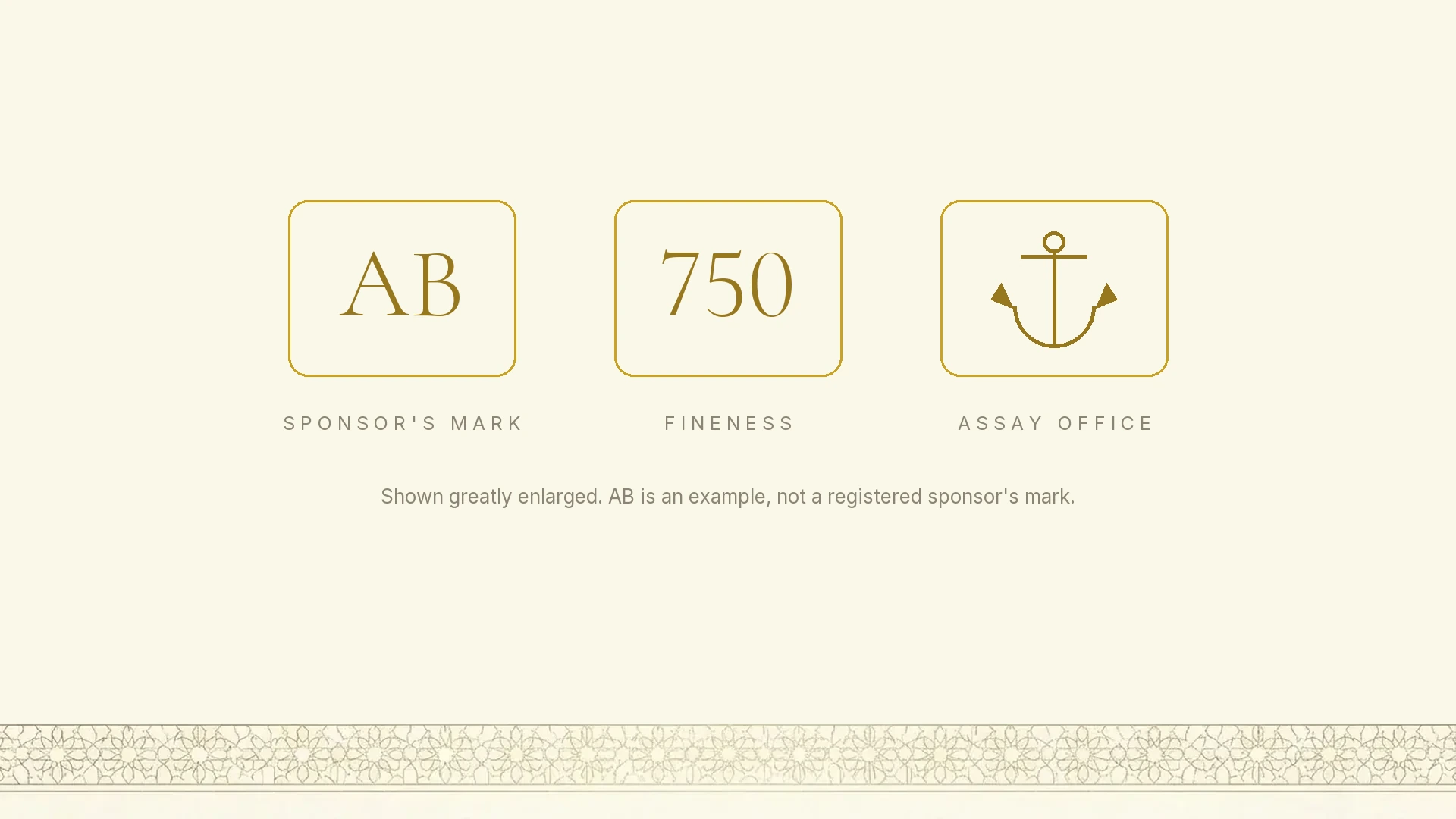
Since 1999, a UK hallmark has three compulsory parts.
The sponsor’s mark. Two or more letters in a shaped surround, registered to whoever submitted the piece for testing. It identifies who is responsible for the article, which is not always the same person as whoever designed it.
The millesimal fineness mark. A number, not a word, stating how much precious metal is in the alloy, in parts per thousand. This is the mark worth learning to read, because it is the one that actually answers “how much gold is this”.
The assay office mark. A symbol showing which of the UK’s assay offices tested and struck the piece.
Before 1999, a full hallmark also carried two further elements as standard: a traditional fineness symbol, such as the crown for gold or the lion passant for sterling silver, and a date letter recording the year of testing. Assay Office London confirms both became optional rather than compulsory at that point. Plenty of pieces still carry a date letter voluntarily, which is worth knowing before assuming its absence means anything.
The number, and what it means
Precious metal is almost never used pure in jewellery, because pure metal is too soft to hold a stone or survive years of wear. It is alloyed with other metals, and the fineness mark states how much of that alloy is the precious metal itself, in parts per thousand.
The UK strikes these standards, per Assay Office London:
- Gold: 375, 585, 750, 916, 999
- Silver: 800, 925, 999
- Platinum: 850, 900, 950, 999
- Palladium: 500, 950, 999
For gold, four of those numbers map onto figures most people actually recognise:
| Mark | Carat | Gold content |
|---|---|---|
| 375 | 9ct | 37.5% |
| 750 | 18ct | 75% |
| 916 | 22ct | 91.6% |
| 999 | Fine gold | 99.9% |
It is worth being precise about what is actually struck on the metal: the number is the legal mark, not the carat word. “Ct” is a convenience of conversation. 375 is what an assay office puts on the piece, and it is that number, not a carat figure, that has legal standing.
The four offices, and what each one is called
Four assay offices currently operate in the United Kingdom, each with its own symbol rather than a shared one.
London marks with a leopard’s head, the oldest of the four town marks. The Goldsmiths’ Company’s own history page records that in 1822 “the leopard’s head [townmark] lost its crown”, leaving the plain leopard’s head that London still strikes today.
Birmingham marks with what the office itself calls “our iconic anchor mark”.
Sheffield struck a crown for its town mark, empowered to do so under the 1773 Act, and kept it for two centuries. In the office’s own words, “after 200 years, Sheffield lost its Crown mark for silver and used the Rose on both gold and silver”, which is what it strikes today.
Edinburgh marks with a three-towered castle, introduced in 1485. Edinburgh Assay Office describes it as representing “a guarantee of quality and confidence in the item marked and sold”.
As Edinburgh Assay Office puts it plainly, “each of the four UK Assay Offices has a separate mark, denoting the location where the item was tested and marked.” It tells you only where the testing happened, not how good the piece is.
How to actually check one
Take the piece somewhere with good light and use magnification. A jeweller’s loupe is ideal, though the macro setting on a phone camera works well enough, particularly if you enlarge the photograph afterwards rather than squinting at the piece itself.
Look inside a ring shank, along the edge of a pendant bail, or on the clasp of a chain, which is where there is usually enough room to strike a full set of marks. They are deliberately small, and worn marks on an older ring that has been resized or polished many times over the years are common rather than a cause for concern on their own.
If you cannot find any marks at all, that is not proof of anything by itself. Some jewellery genuinely falls under the weight at which hallmarking becomes compulsory, which is covered next.
Date letters, and the chart nobody gives away free
The date letter is the mark most people assume is still compulsory, and it has not been since 1999. As Edinburgh Assay Office states plainly, “Until 1999 the Date Letter was compulsory. This is no longer the case, but it can be applied voluntarily”, and where it is applied, “The date letter changes once per year on 1st January”.
Here is the genuinely useful part, and it is the reason this page exists in this much detail. There is no free, official chart anywhere that lets you look up a date letter and read off a year. Birmingham Assay Office holds “a copy of every date letter mark applied by Birmingham Assay Office since we opened in 1773”, and access to it is sold rather than published: “Unlock our date letter archive. Just £2 for lifetime access.” London offers something similar in shape, a paid “Trace a Hallmark” lookup service, rather than a chart anyone can browse for nothing.
That is worth knowing before you go looking for a free official date-letter chart, because you will not find one, and an hour spent searching for something that does not exist is an hour wasted. Charts do circulate outside the assay offices, on antique-dealer and collector sites, and they are not official and not guaranteed accurate. Treat any of them as a rough guide at best, and go to the paid, official archive if the year genuinely matters to you.
When a piece does not need a mark at all
The Hallmarking Act 1973 sets weight thresholds, in Schedule 1 of the Act itself, below which an article does not have to be hallmarked at all. Below these weights, an unmarked piece can still be genuinely gold, silver, platinum or palladium. It has simply fallen under the legal floor for compulsory testing, not failed a test.
- Gold: 1 gram
- Silver: 7.78 grams
- Platinum: 0.5 gram
- Palladium: 1 gram
Palladium is the newcomer on that list. It was not part of the original 1973 Act at all: palladium articles only became subject to UK hallmarking, with this same 1 gram exemption, from 22 July 2009.
These weights explain a lot of jewellery that looks unmarked at a glance. Fine chain, small stud earrings and delicate settings frequently sit under a gram of gold and are exempt by weight rather than by any oversight. An absence of marks on a light piece is normal. An absence of marks on a substantial ring or bangle is worth asking about.
Convention marks, and selling across borders
Some hallmarked pieces carry a further symbol alongside the standard three: the Common Control Mark. It comes from the Convention on the Control and Marking of Articles of Precious Metals, signed in Vienna in 1972, and it was recognised into UK law by the Hallmarking (International Convention) Order 2002.
An article struck with the Common Control Mark can be sold in another country belonging to the same Convention without being tested and marked again on arrival. It is a mark built specifically to let a hallmark travel, rather than one that adds new information about the metal itself: the fineness figure behind it is exactly the same one already covered above.
What a hallmark is actually telling you
It is worth being precise about the question a hallmark actually answers, because it is not always the one people assume.
The British Hallmarking Council, which oversees the assay offices, puts the purpose plainly on its own gov.uk page: “Assay Offices test the purity of precious metals, to protect consumers from buying fake items. If an item conforms with the legal requirements for purity, the Assay Office marks it with the appropriate hallmark.” That is the whole job: an independent check on metal content, carried out by people with no stake in the sale.
Reading the scope of the Hallmarking Act 1973 the same way is useful too. It is an Act about articles of gold, silver, platinum and palladium, and what it regulates is the metal. It has nothing to say about a stone in the piece, whether that stone is natural or laboratory-grown, how it was cut, or how skilfully the piece around it was made. A hallmark cannot tell you any of that, and it was never built to.
Which answers the other question people often arrive here asking: whether hallmarked gold is “pure”. It is not, and it was never meant to be. A hallmark is not a purity certificate for the piece as a whole. It is a statement of fineness, an independent confirmation that the alloy contains at least the proportion of precious metal the struck number claims.
Which fineness is “best” has no answer in the abstract either. Higher gold content gives a warmer, deeper colour and a softer metal. Lower gold content gives a harder, more scratch-resistant metal at a paler colour. Neither is a superior metal. They are different decisions, and the hallmark’s job is only to confirm which one you actually have.
What it means when a piece is made for you
A hallmark can only be struck on a finished article, which is why it sits at the end of a commission rather than the beginning. A piece is cast, set and finished, then sent away to be tested by people who have never met the client and do not know or care what it cost.
That is the entire point of it. Everything else about a piece of jewellery, before that final test, is somebody’s account of their own work. The hallmark is the one line written by somebody with nothing to gain from what you decide to believe.
The studio works from Birmingham’s Jewellery Quarter, home to one of the four assay offices named above.