You have worked out the shape, thought hard about the stone, maybe even settled on a setting. Then you hit the one detail that decides whether any of it fits: her actual ring size, taken accurately, without her ever knowing you were trying to find out. You cannot ask. Asking is the whole thing you are trying to avoid. Everything else about choosing a ring is something you can research alone in an evening. This is the one part that depends on somebody else’s finger, measured properly, while she thinks nothing is happening.
It helps to know upfront that this is genuinely hard, not just fiddly. UK ring sizes move in small steps, smaller than most people expect, so a size guessed by eye is very often wrong by more than it looks. What follows is the honest order of how well each method actually works, not the order people usually try them in.

Get someone else to do the asking
The most reliable route to a real size is rarely a clever measuring trick. It is a person she already trusts, doing something you cannot: asking outright, under a plausible reason, or taking her to be sized “for fun” as part of an ordinary errand. A sister, a close friend, someone she talks to freely. This works because it can end in an actual professional measurement, using proper sizing rings, rather than anyone guessing from a distance. The only real requirement is a cover story that holds up, which is a people problem, not a jewellery one, and it is worth solving before you try anything else on this list.
Borrow a ring she already wears
If involving someone else is not possible, the next best thing is a ring she already owns, worn on the correct finger. Take it somewhere it can be measured properly rather than guessing from it yourself, and get the internal diameter in millimetres, not just a letter someone reads off a chart, since letters can round slightly differently between systems. The condition that matters here is not optional: it has to be a ring she wears on that specific finger. Fingers on the same hand are rarely the same size as each other, so a ring borrowed from the wrong one can be confidently, precisely wrong, which is worse than an honest guess because it looks like certainty.
Tracing, paper and string
Tracing the inside of a ring onto paper, then measuring the circle you drew, is a reasonable fallback if borrowing the ring itself is not an option. It depends on a steady hand, and small slips matter more than you would think at this scale.
Wrapping a strip of paper or string around the actual finger is the method you are most likely to see suggested, and it is also the least dependable of the group. Paper and string compress slightly under the pressure a person naturally applies while wrapping them, so the reading tends to come out smaller than the finger really is, and there is no good way to explain the right amount of pressure to someone who does not know why you are asking. Treat anything from this method as a rough starting point, never as the number a design gets built around.
The knuckle changes the answer
Even a careful measurement can mislead you, because a ring does not simply sit at the base of the finger. It has to travel over the knuckle to get there, and the knuckle and the base are often different widths. Where they are close, this barely matters. Where they differ more, you land in a genuine bind: a ring sized to pass the knuckle comfortably can be loose enough at the base to spin, and a ring sized snugly at the base can be a real struggle to get past the knuckle at all. There is no trick that removes this. It is one more reason a proper in-person measurement, taken by someone who does this regularly, beats any number pulled from paper or an old ring.
Finger size also genuinely shifts with warmth, cold, the time of day and how much exercise or salt has been involved, so treat any single reading as a snapshot rather than a fixed fact, however it was obtained.
How UK sizes actually work
Britain sizes rings by letter, and the steps between letters are small: roughly 0.4mm of internal diameter, around 1.2 to 1.25mm of circumference. To see how tight that is, H sits at 14.8mm inside diameter, N at 17.1mm, R at 18.7mm, T at 19.4mm and Z at 21.7mm. Two adjacent letters can differ by well under half a millimetre. That is why eyeballing a size, or guessing from how a ring “looks”, goes wrong so easily. It is not a failure of judgement. It is a scale that punishes judgement.
The decision that matters more than the guess
Here is the point worth sitting with, because it changes what “getting it wrong” actually costs. A first resize, once a ring has been tried on, is completely ordinary. Most rings can have their size adjusted without much trouble: a jeweller cuts a small section of plain metal at the back of the band, opens or closes the gap, and rejoins it.
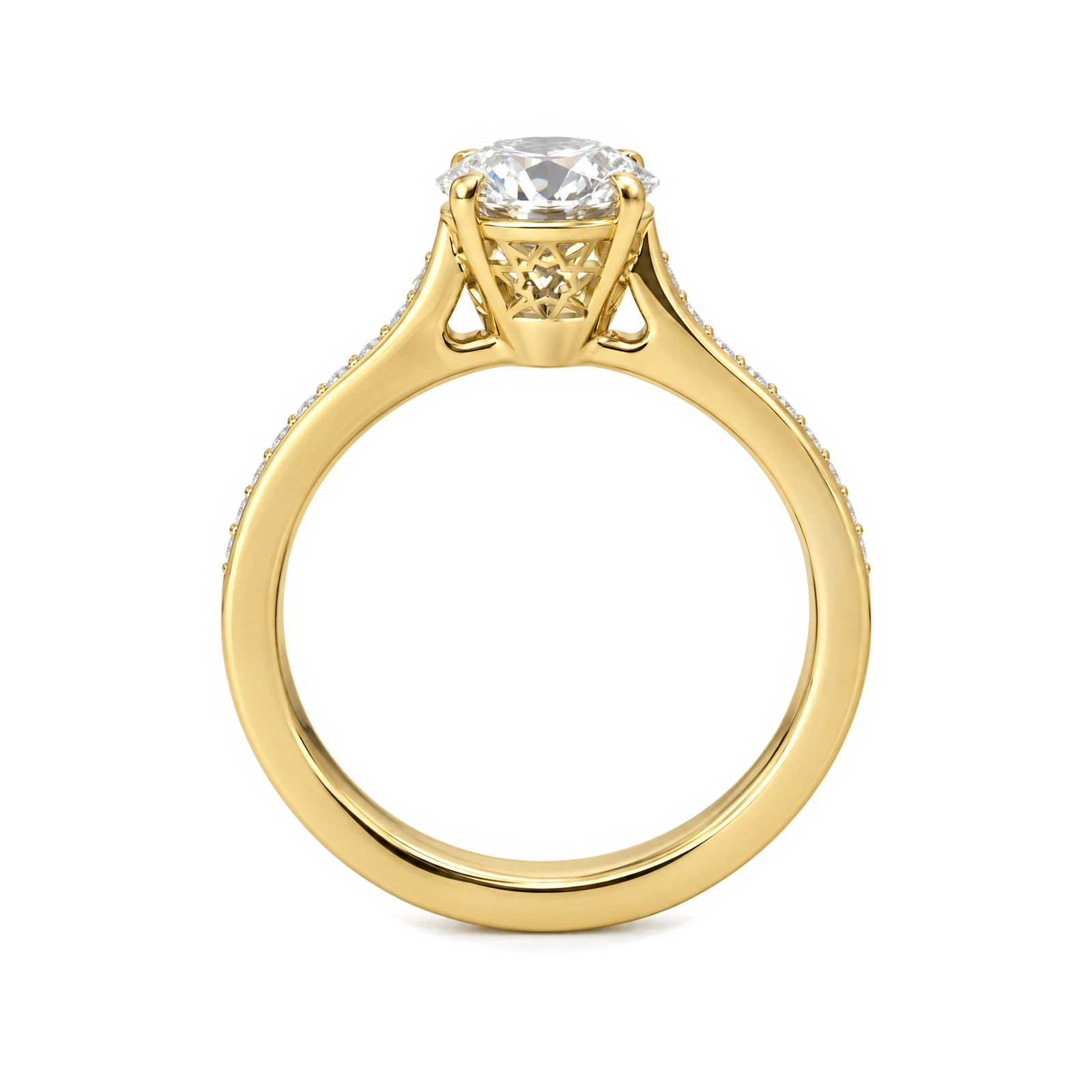
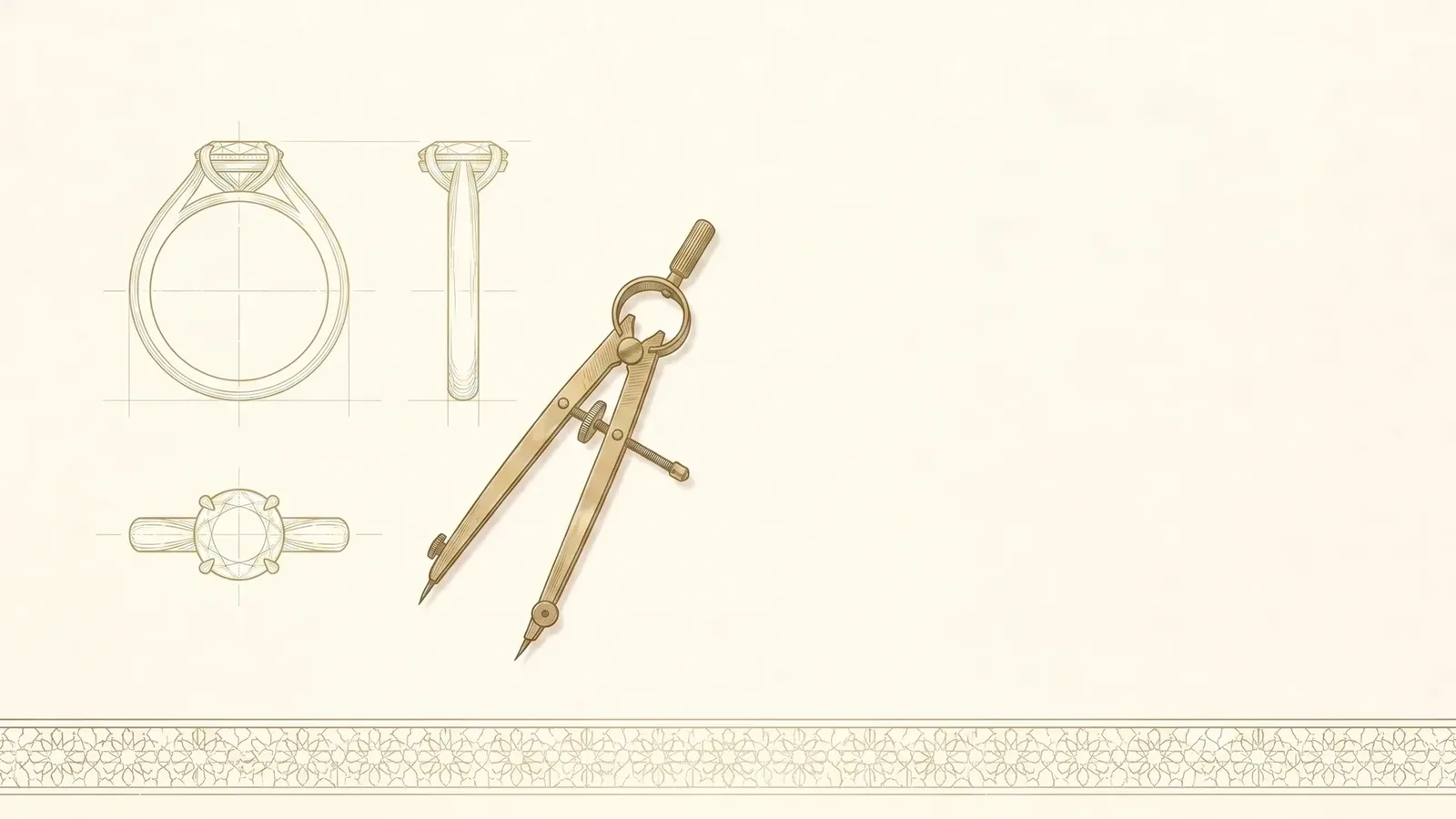
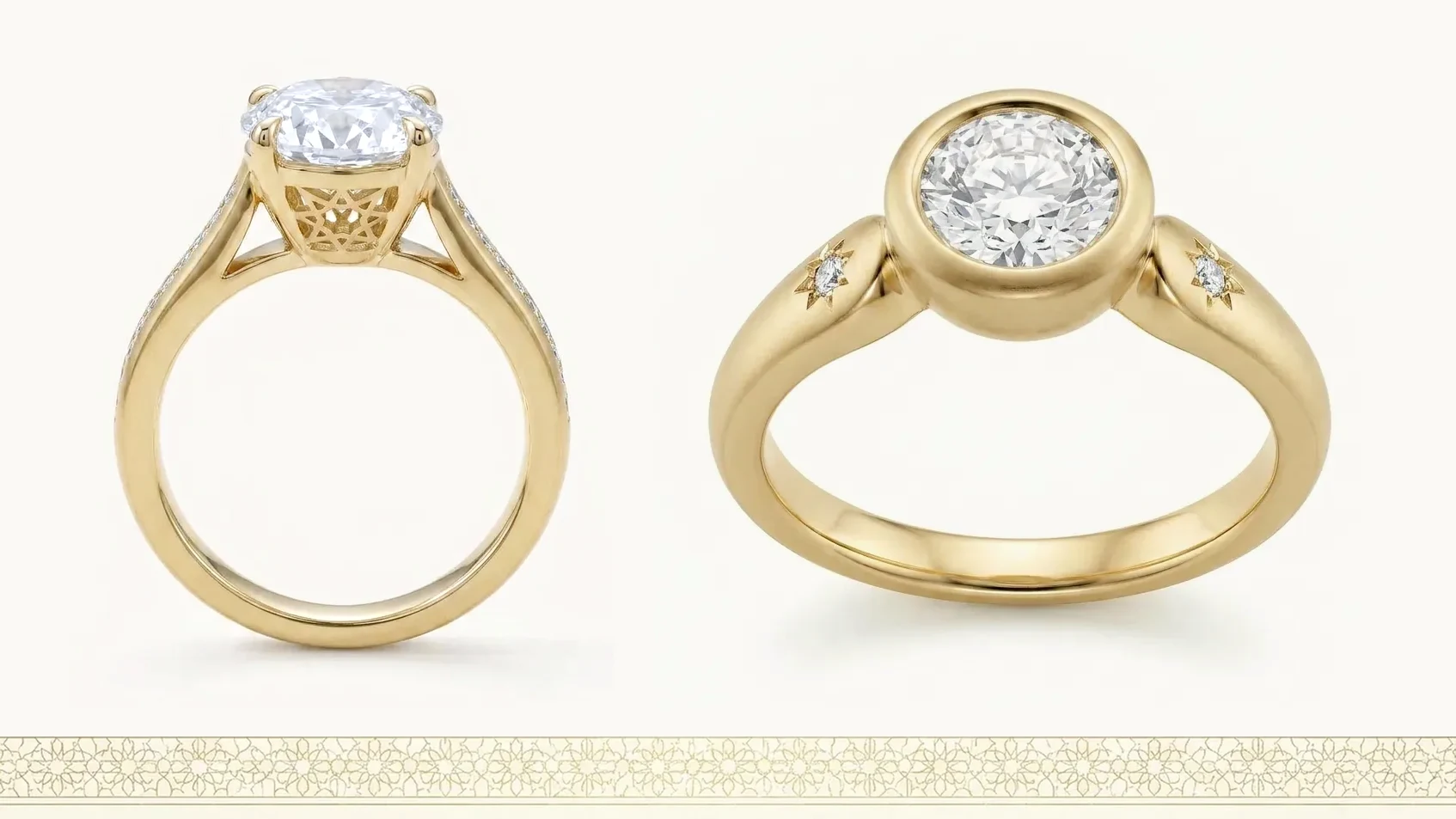
That routine job needs plain metal to work with, and some designs do not have any. A full eternity band, pavé that runs the entire way round the shank, and tension settings all remove the plain section a resize depends on, either because stones sit edge to edge with nothing bare to cut, or because the whole setting relies on the exact spring of the metal at its current size. None of these are unusual choices. They are some of the most popular styles there are, which is exactly why this is worth knowing before a design is chosen, not after a ring turns up too tight. You can read more on how a piece actually comes together, from the first design to the finished object, at how a bespoke ring is made.
If you genuinely cannot find out
If none of the above gets you anywhere close, the honest move is not to guess harder. It is to choose differently. A plain shank, with a claw or bezel centre and no stones running the whole way round, keeps a straightforward resize available whatever the eventual size turns out to be. That single decision at the design stage does more to protect you than any measuring method on this list, because it turns an unavoidable uncertainty into a minor follow-up appointment rather than a problem on the day itself.
If you are working with a maker directly rather than buying off a shelf, this is worth raising early. What made to order actually means is that decisions like this one are still open when you start the conversation, not locked in before you arrive. Say plainly that the size is uncertain, and ask what that means for the design in front of you. A maker who can build with that uncertainty in mind, rather than around it, is the one worth talking to. You can read more about how that conversation usually goes at bespoke.