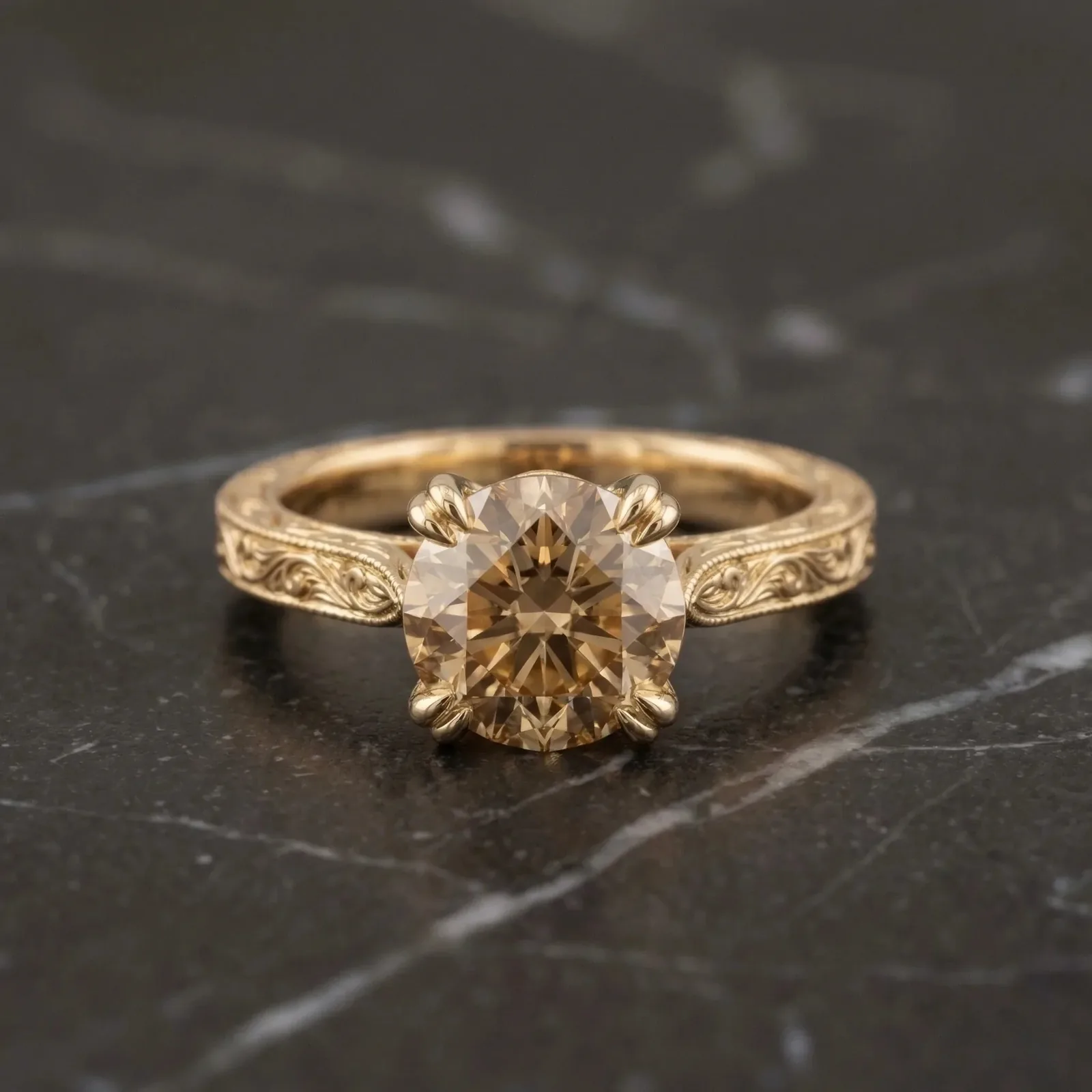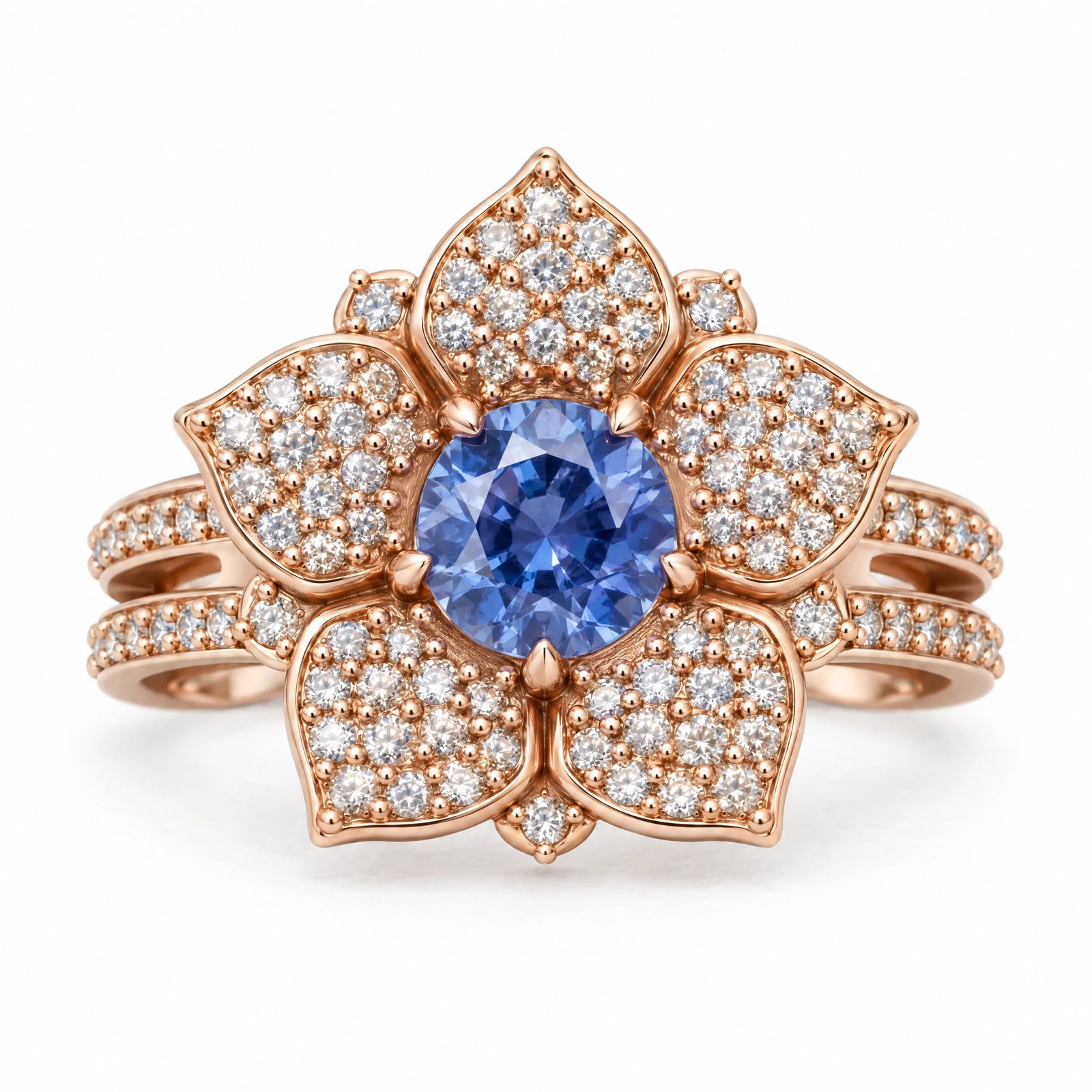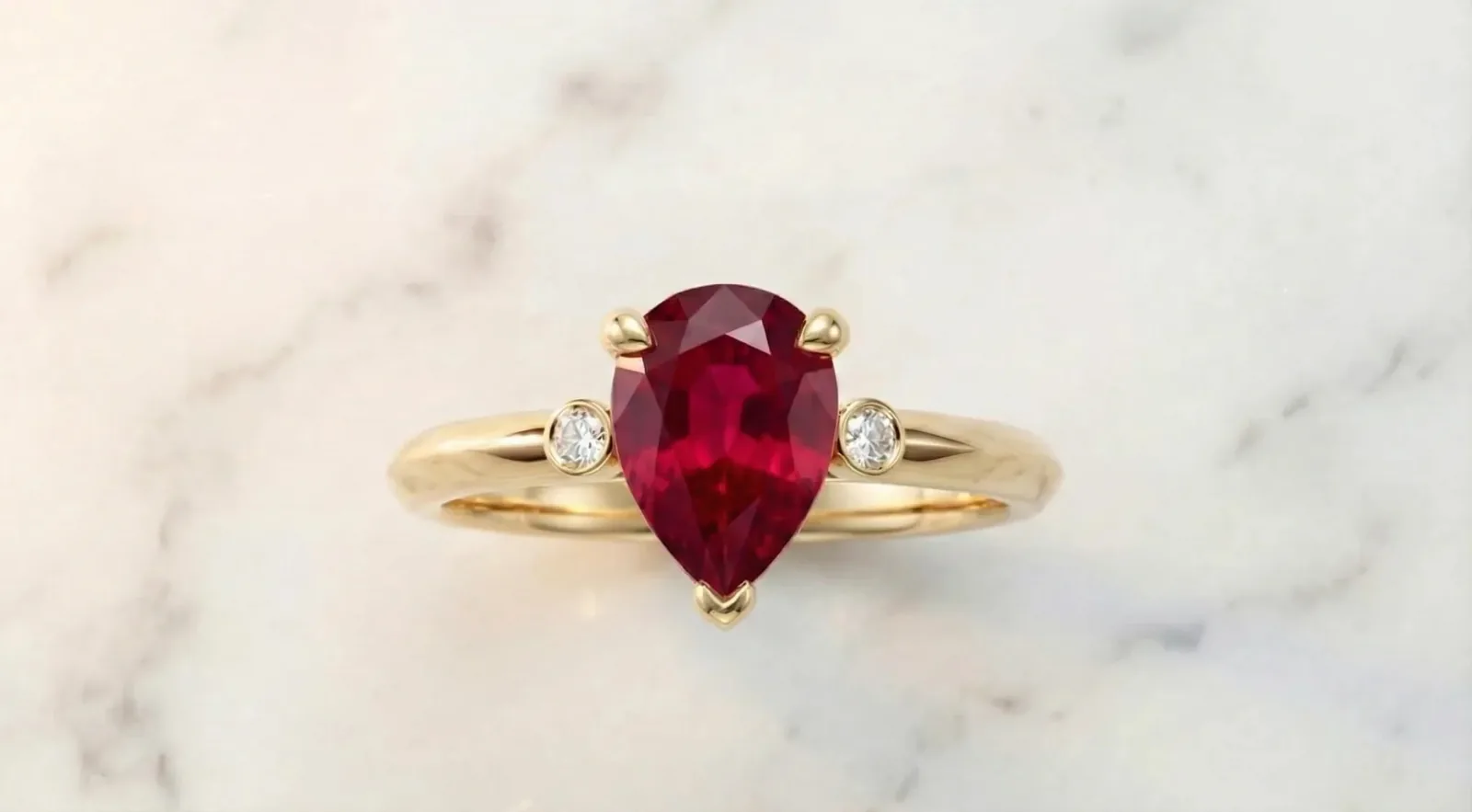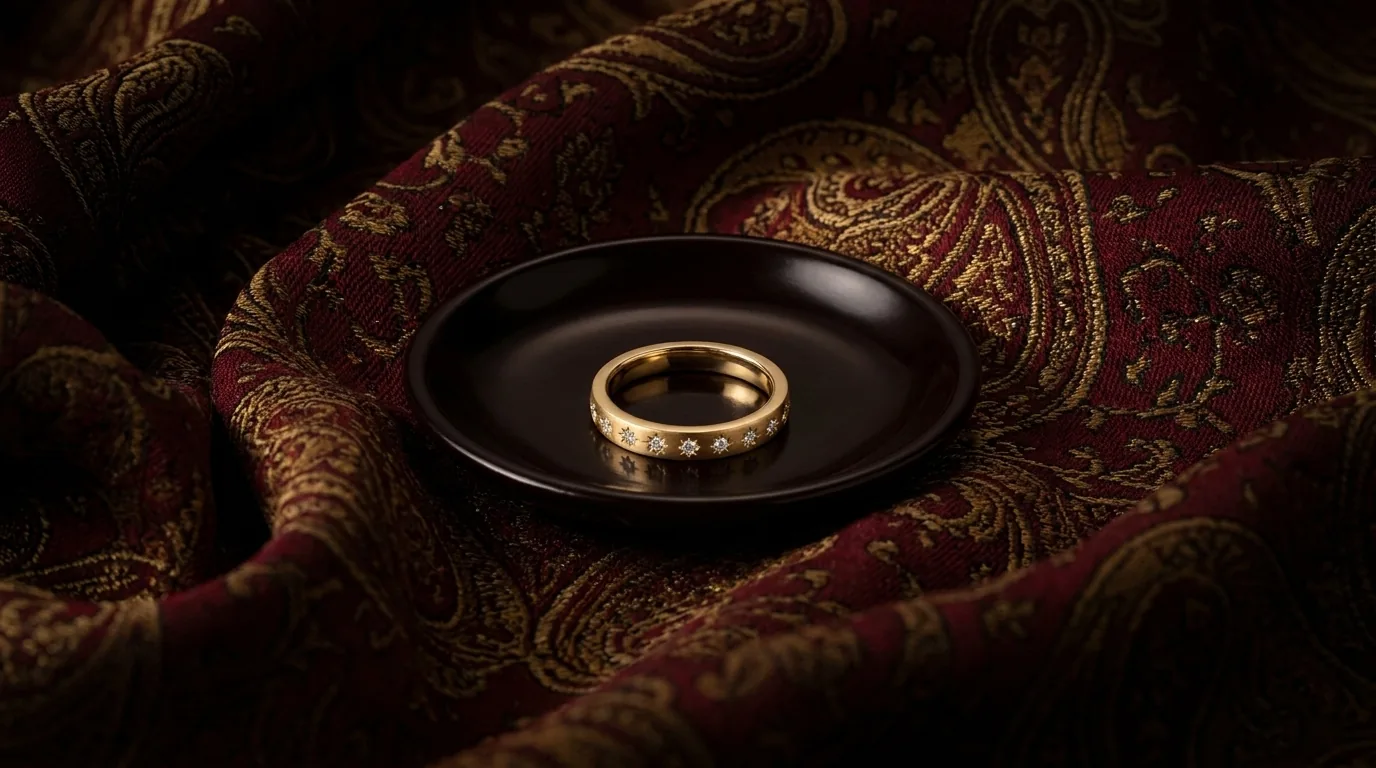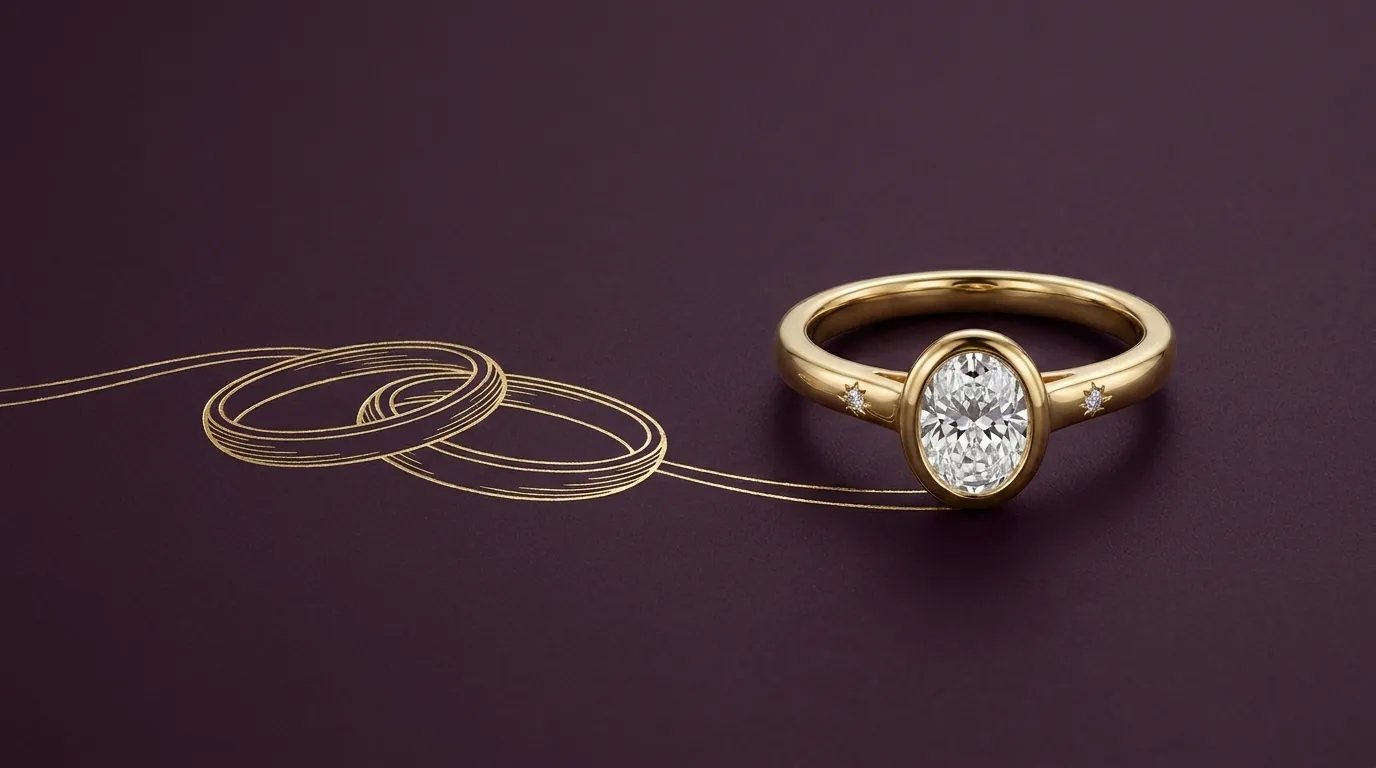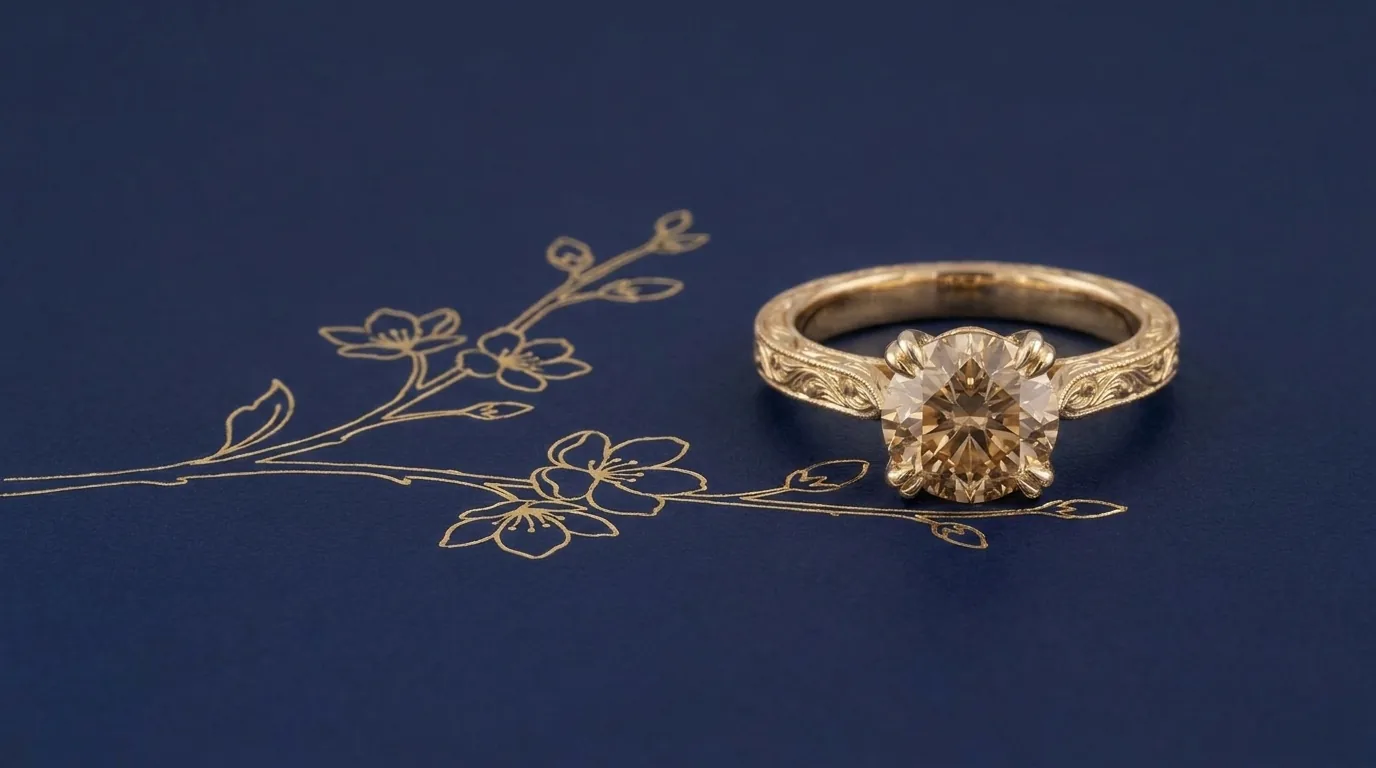
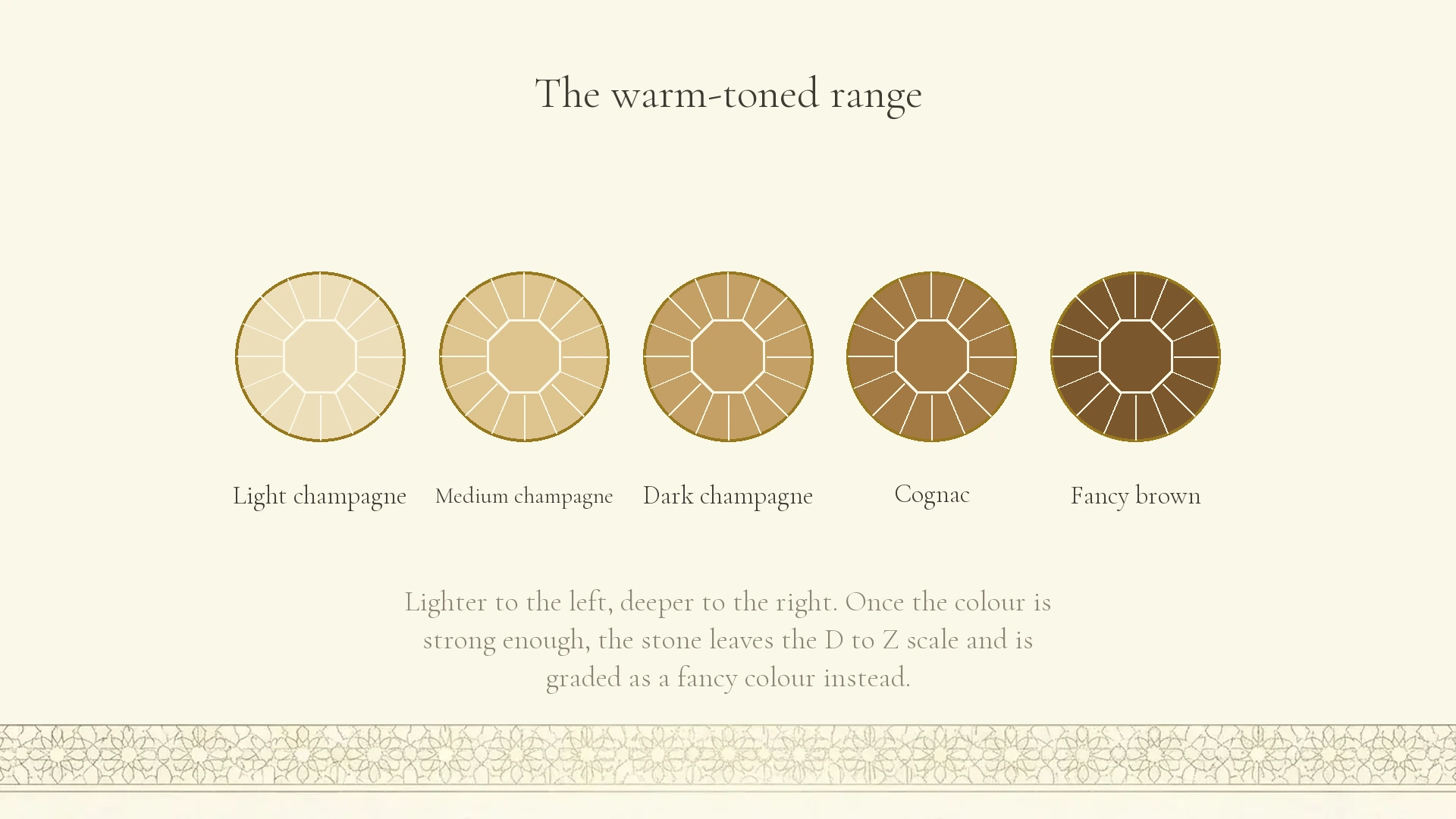
A champagne diamond is a natural diamond with a warm brown or golden tone. The industry coined the name to describe the lighter end of the brown range, roughly the colour of sparkling wine, honey or warm caramel. At the deeper end the same stones are usually called cognac.
For most of the last century the trade sold colourlessness as the only thing worth wanting, and treated warmth as a fault to be discounted. That is a commercial position rather than an aesthetic one, and it is the reason these stones are still priced below their appeal.

Where the colour actually comes from
This is the point most guides get wrong, including one I have read this week.
Yellow in a diamond comes from nitrogen sitting in the carbon lattice. Brown does not. The warm tones in a champagne diamond come mainly from plastic deformation: the crystal was put under enormous pressure and heat as it moved, its lattice slipped along internal planes, and those distortions absorb light in a way that reads as brown. Under magnification the effect often shows as fine parallel lines running through the stone, called graining.
That distinction matters practically, because it is also why brown is the most abundant of the fancy colours. Deformation is common. Pink and blue are not.
One question worth asking, and it follows directly. Brown diamonds are among the more commonly treated stones, because high-pressure high-temperature treatment can lift a brown diamond several grades toward colourless, and the same technology can push colour the other way. A natural champagne diamond gets its colour from its own history, and a treated one does not. The two are not equivalent and they should not be priced as though they are. Ask whether the stone is natural in colour, and ask for it in writing on the certificate.
How the grading works
The GIA colour scale most people know runs from D, meaning colourless, to Z, meaning noticeably tinted. Champagne diamonds typically sit toward the lower end of it, in the K to Z range.
Once colour becomes strong and distinct enough, the stone leaves that scale entirely and is graded as a fancy colour instead: Fancy Light Brown, Fancy Brown, Fancy Dark Brown, Fancy Deep Brown.
The logic inverts at that boundary and it is worth being clear about it. On the D to Z scale, the absence of colour is what is being measured, and further down the alphabet means less desirable. On the fancy scale, the presence and quality of colour is the point, and more of it is generally worth more. A stone described as K on one scale and a stone described as Fancy Brown on the other are not being assessed by the same standard at all.
There is a trap in the middle. A low-colour white diamond in the K to M range can look faintly warm without having any champagne character: it reads as a slightly tired white rather than as a deliberate brown. A true champagne diamond has a consistent, intentional warmth all the way through. The difference is obvious side by side and almost impossible to judge from a photograph.
What it costs relative to a colourless stone
Materially less, and the reason is preference rather than quality. The trade built its pricing around colourlessness, brown is the most abundant fancy colour, and the two together keep the price down.
I am not going to put a percentage on it, because the figures quoted around this move with the market and with fashion, and a number written today would be quietly wrong within a year. What is durable is the shape of the saving: for the same budget, a champagne diamond generally buys either a noticeably larger stone, a better cut, or a more considered setting than a colourless equivalent would.
Cut is where I would spend the difference. Colour and clarity can drop a little without the eye noticing. A poorly cut stone looks dull whatever else is done to it, and in a warm-toned diamond a good cut is doing more work than usual, because it has to carry brilliance and colour at once.
Warm metal, warm stone
The metal changes the stone more than people expect.
Yellow gold shares a tonal family with a champagne diamond, so the stone appears to emerge from the metal rather than sit on it. The whole piece glows rather than flashes. This is the pairing that reads as intentional, and it is the classic choice in Persian and Middle Eastern design, where warm gold is the default rather than a decision.
Rose gold brings a pink copper warmth that sits slightly apart from the stone’s golden brown. The small contrast adds interest without clashing, and it tends to make a lighter champagne read richer than it does alone.
White gold or platinum is the deliberate contrast. A cool metal pushes the warm stone forward and makes the colour the focal point. It is less common and it suits a spare, contemporary design where the stone is meant to be the only warm thing in the piece.
None of these is correct in the abstract. They are three different intentions, and the only reliable way to choose is to see the same stone against more than one metal.
Why it suits the work here
Persian visual culture is built on warmth: the golden domes of Isfahan, the amber and saffron of miniature painting, the honey-coloured wood of khatam marquetry, the terracotta of desert architecture. Warm gold has been the metal of that tradition for millennia because it belongs to the same palette as everything around it.
A champagne diamond sits inside that palette in a way a colourless stone does not. It is not a compromise or a budget substitute. It is a different intention, and a quieter one.
The Simin ring is the clearest expression of it in the collection: a round brilliant champagne diamond held in four wide petal-shaped claws above a pointed-arch open gallery, with an islimi arabesque vine engraved around the band.
If you are considering one
The design conversation starts with the stone rather than the setting, because a warm stone changes what the metal around it should do. Renders of the model are produced and revised until the design is signed off, and nothing is made until it is. Solid pieces are hallmarked at a UK assay office where the Hallmarking Act 1973 requires it, before dispatch.
The full commission process, including what happens at each stage, is set out here.
Champagne diamonds reward looking past a convention that was never really about beauty. They are warmer, more individual, and considerably better value than the market has decided they should be.