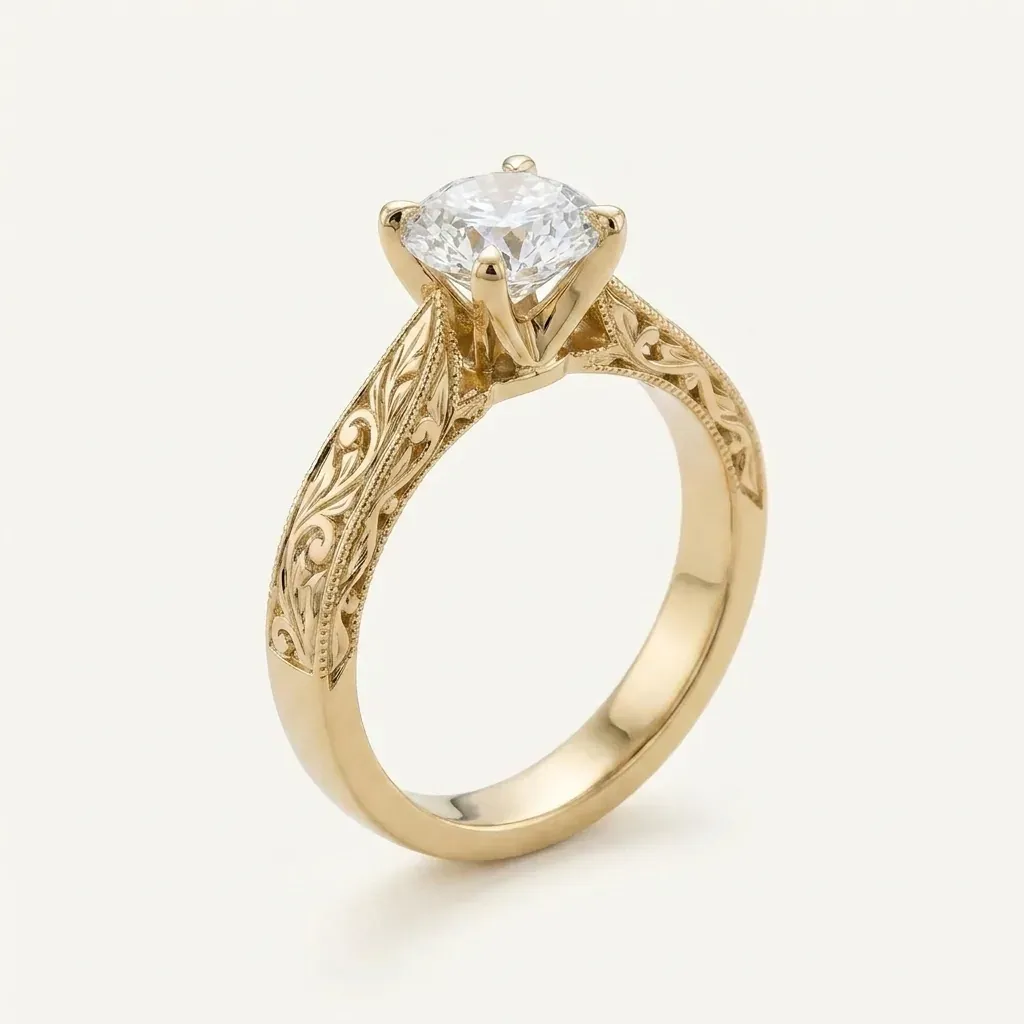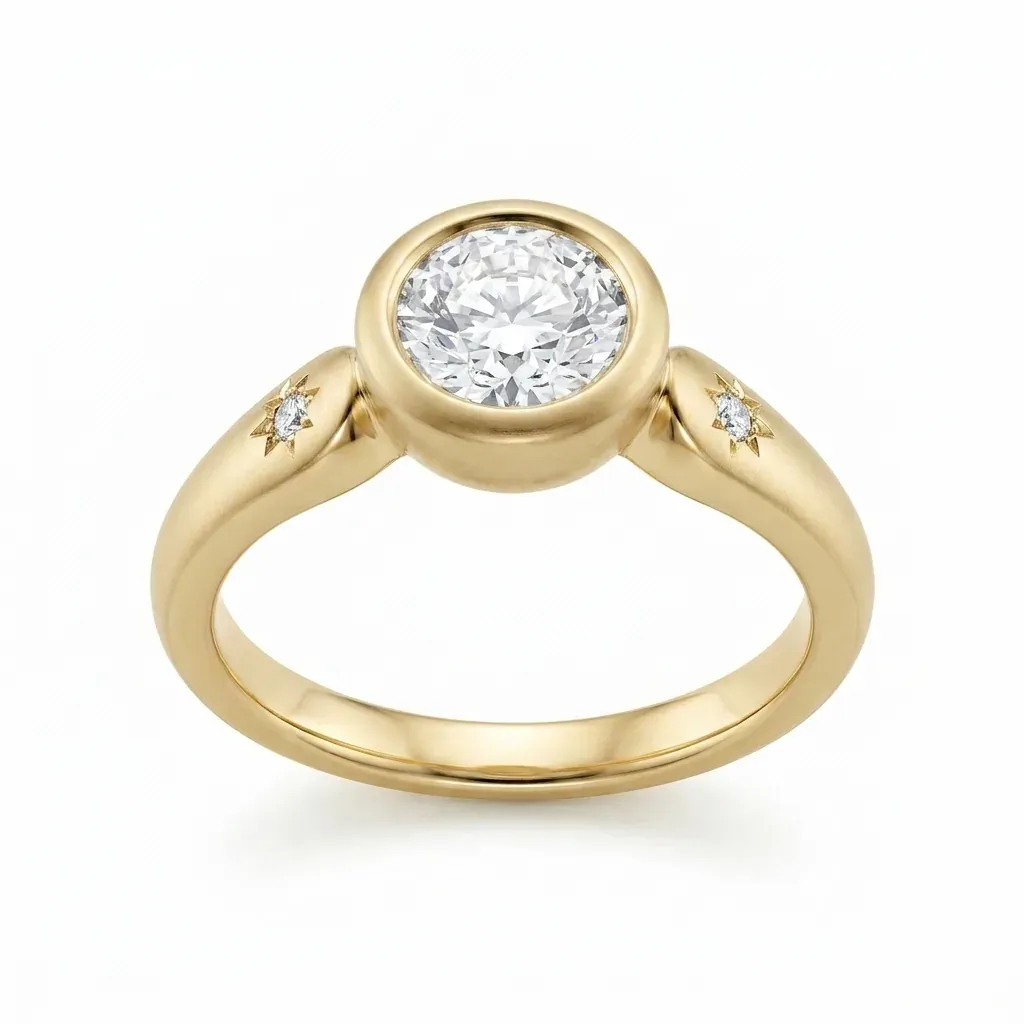
Ask three people which metal to choose for an engagement ring and you will get three confident, different answers. Ask why, and most cannot tell you. That is not because the question is hard. It is because almost nobody explains what genuinely separates platinum, white gold and yellow gold beyond the obvious: colour, and not much past that.

The number inside the ring
Turn a gold ring over and, somewhere inside the band, you will usually find a small stamped number: 375, 585, 750, occasionally 916. These are UK fineness marks, and they state how many parts in every thousand of the alloy are actually gold. 375 is what is commonly called 9ct. 585 is 14ct. 750 is 18ct, the figure most fine jewellery is made in. 916 is 22ct, and it turns up far less often in rings than the others, because that much gold makes the metal too soft to hold a stone reliably through daily wear.
Here is the collision that catches almost everyone out at least once: a carat measuring metal purity and a carat measuring a stone’s weight are entirely different units that happen to share nothing but a name. A stone’s carat is a measure of weight, 0.2 grams each, and it has nothing to do with the metal it sits in: a diamond that size could be set in 9ct, 18ct or platinum, and its carat weight would not change by a single decimal. For the full detail on marks, assay offices and what a hallmark actually proves in law, that ground is covered properly in how to read a UK gold hallmark. Here, the number on the metal is enough.
Why gold is never used alone
Pure gold is too soft for a ring that gets worn every day. Left unmixed, it would dent, thin and lose its shape faster than anyone buying it would expect. So it is alloyed: blended with other metals, typically copper, silver, zinc or palladium, until it is strong enough to hold a stone through years of ordinary contact.
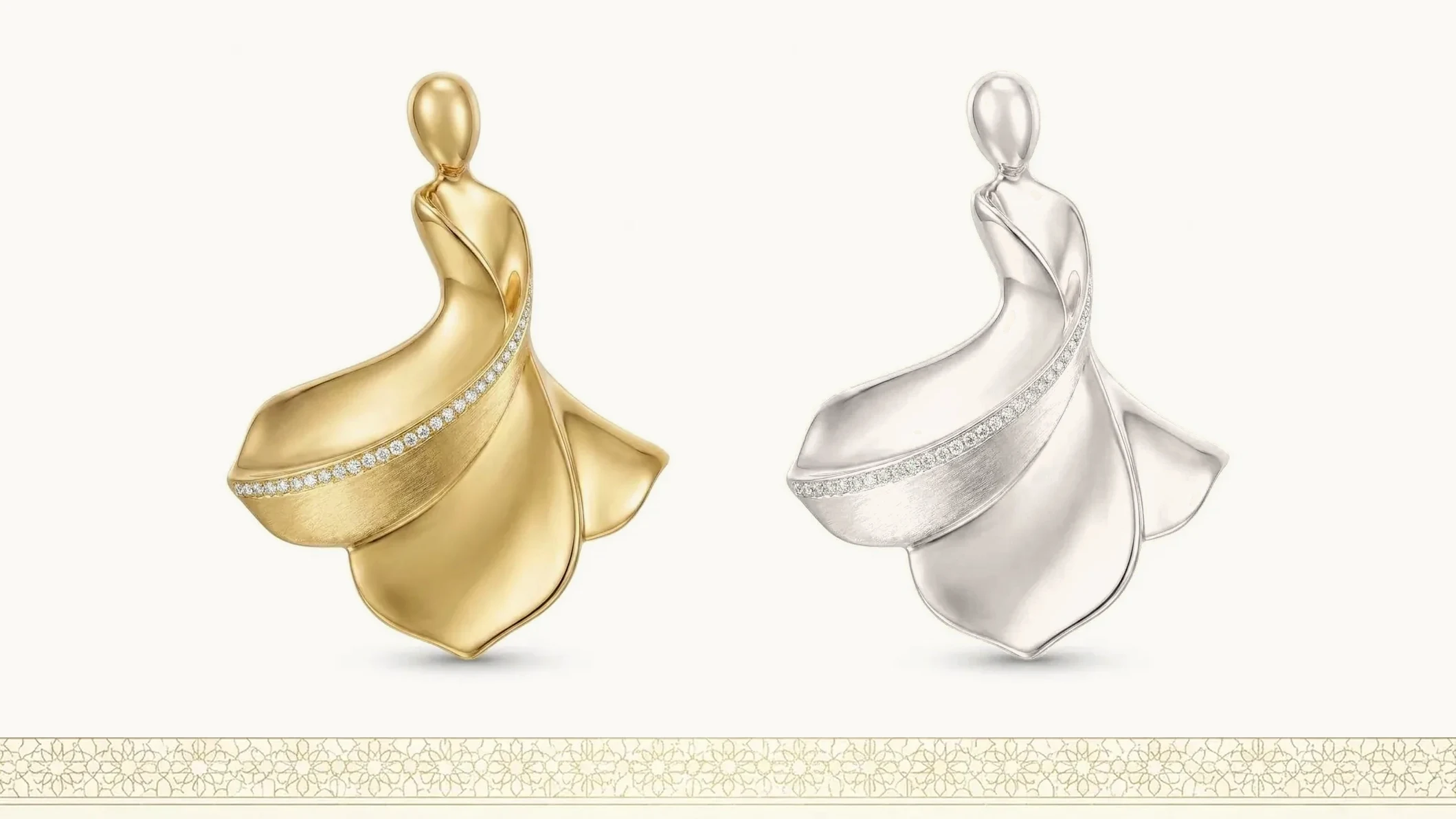
Take three rings, one yellow, one white, one rose, all stamped 18ct, and every one of them holds precisely 750 parts of gold in a thousand: identical, gram for gram. What tells them apart is not the gold. It is everything mixed in around it. Lean the mix towards copper and the colour warms towards rose. Lean it towards silver or palladium and it cools towards white.
The part of white gold nobody mentions until later
Left alone, white gold rarely looks like the bright white most people picture. The metals mixed in to strengthen it also tend to leave a slight warmth, sometimes a faint grey, in the base colour, so most white gold jewellery gets a final finish of rhodium plating: a much harder, brilliantly white metal from the platinum family, laid on as a thin surface layer to give that clean, cool look.
That layer does not last forever. Ordinary contact wears it thin over time, and it typically needs redoing every year or two, sooner on something worn constantly than on a piece kept for occasions. None of this is a fault in the metal. It is simply part of owning it, and worth knowing before you choose rather than finding out later as an unplanned trip to a jeweller. Ask what replating actually involves and roughly how often it comes round, so you know exactly what you are taking on.
The question we will not answer with a ranking
This is the question everyone eventually asks, one way or another: which of these metals will actually hold up. We are not going to give you a ranking, and it is worth being honest about why not.
Measured by scratch resistance in a laboratory, one widely repeated ranking puts palladium hardest of the three and platinum softest, with the various golds falling somewhere between depending on the alloy. A different, equally serious argument says that laboratory measure misses what actually happens to a ring worn for decades. Rather than resisting a knock, platinum tends to absorb it: the metal moves sideways under an impact instead of being sheared off, so a platinum piece can end up weighing close to what it did when new even after many years, whilst a harder, more brittle metal takes the same knocks by losing tiny amounts of itself each time, gradually. Both arguments are made seriously by people who know metal. Neither has won, and this guide is not going to pick a side it cannot actually settle.
A better question than any ranking: forget which metal supposedly wins, and ask instead how you want your ring to look in twenty years. Bright and mirror-finished, because you bring it in for the occasional polish. Or quietly changed by two decades of being worn without much thought, settling into a duller, warmer sheen closer to how old silver looks in a piece handed down through a family. Neither is the wrong choice. Choosing the first means occasional appointments with a jeweller for the rest of its life. Choosing the second means mostly forgetting about it, which some people love and others find strangely sad.
The weight nobody warns you about
Here is a property almost nobody asks about before choosing a metal, and almost everyone comments on once a ring is actually being worn: how heavy it feels. Denser metals put more mass into an identical design, so two rings cut to the same dimensions in different metals are not the same weight, even though every measurement on paper matches. Platinum sits noticeably denser than any of the golds, which is the clearest case of this, but the same effect exists to some degree between any two metals of differing density.
Some people love the feel of it: a heavier ring reads as solid, deliberate, unmistakably there. Others find that same weight distracting within a day, particularly if they are not used to wearing a ring at all. No photograph or written description settles which one you will be. Try the actual metal on, at its actual weight, before deciding anything else.
Three things that actually matter
Set the ranking question aside, and three practical questions do most of the real work.
First, how much fuss you want to deal with, long after the ring is bought. Rhodium replating every year or two, or dropping a piece in now and then for a polish, is nothing to somebody who does not mind the errand. To somebody who would rather never think about it again, a metal that changes on its own with wear, and needs nothing done to it, is the better fit.
What it will sit beside. If daily jewellery is already part of the picture, a watch, existing rings, a bracelet worn without fail, the colour already on that hand tends to steer the decision more than people first assume. Two whites that almost match but not quite, a warmer white gold beside a cooler platinum, become obvious the moment they sit side by side day after day, in a way neither does alone. If a stack of rings is on the cards, how to stack gold jewellery is worth a read before settling on a metal.
And, finally, taste, which has no clever answer at all. Warm skin can make yellow gold glow and leave platinum looking faintly flat by comparison, or the reverse can be true for someone else entirely, and nothing predicts in advance which way it goes for any particular person. Screens and photographs are the worst way to judge this, since lighting shifts metal colour constantly. There is only one test that actually works, and it is the same one already given for weight: put the metal on the actual hand and look, because nothing else has ever settled this honestly. If you want to talk any of it through against a real design, that is exactly where a bespoke conversation starts.