Paisley is a teardrop or comma-shaped motif named after the Scottish town whose looms copied Kashmir shawls from about 1800. Museum pages call the shape boteh; other sources say buta. They disagree about where it began, and none of the pages opened for this piece defines the word.

What is the paisley pattern?
Britannica says the shape most people recognise as paisley resembles an enlarged comma, and that this form is well known in Mughal decorative art (S1).
Why is it called paisley?
The name comes from the shawls made at the town of Paisley (S1). About 1800, patterned shawls woven from Kashmir goat fleece began to arrive in Britain from India, and Paisley wove machine-made equivalents to meet the demand (S1).
The Met says Paisley became the main centre for machine-woven reproductions, and that its shawls were so prominent that the style and its boteh form have been called paisleys ever since (S7).
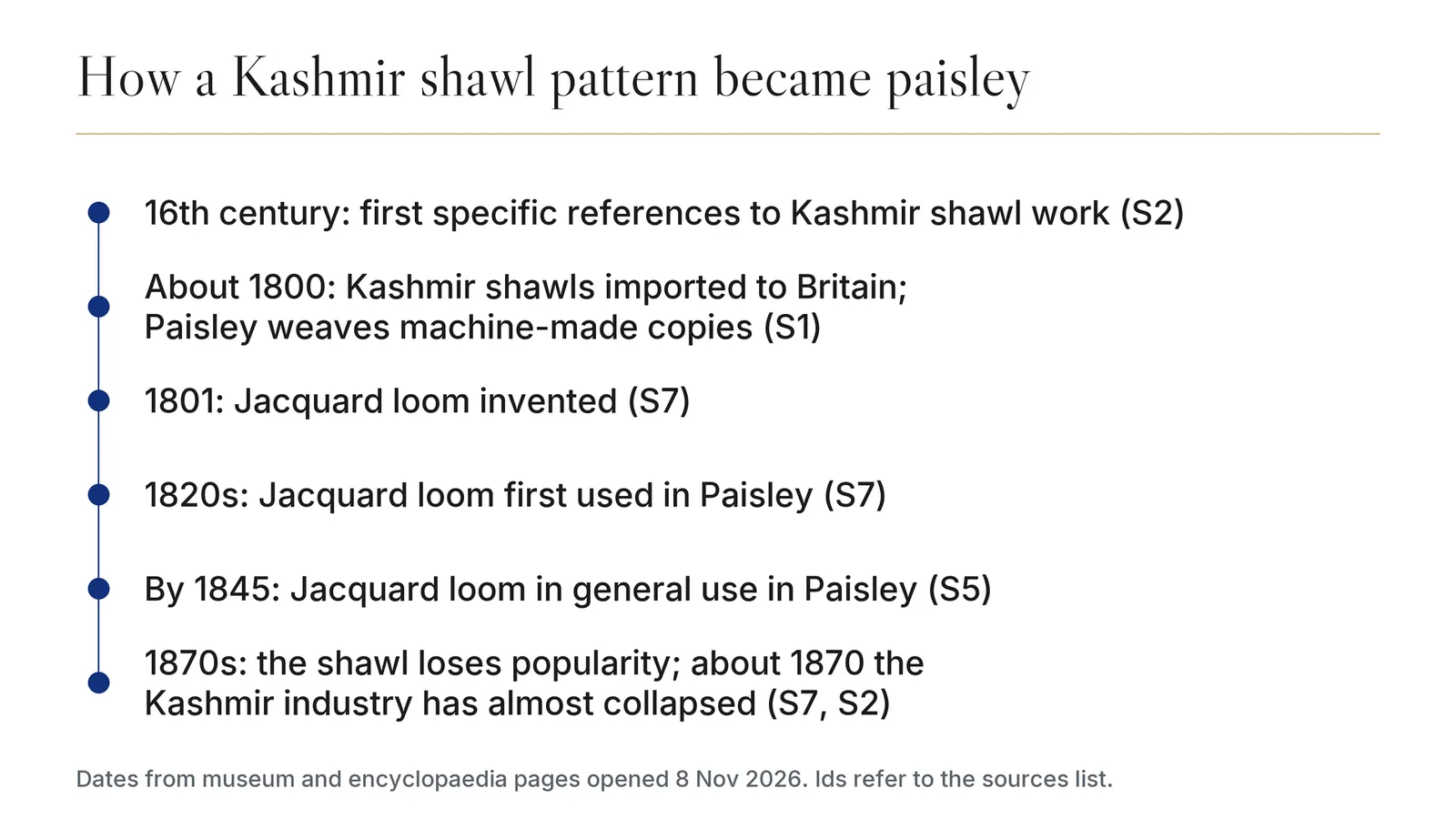
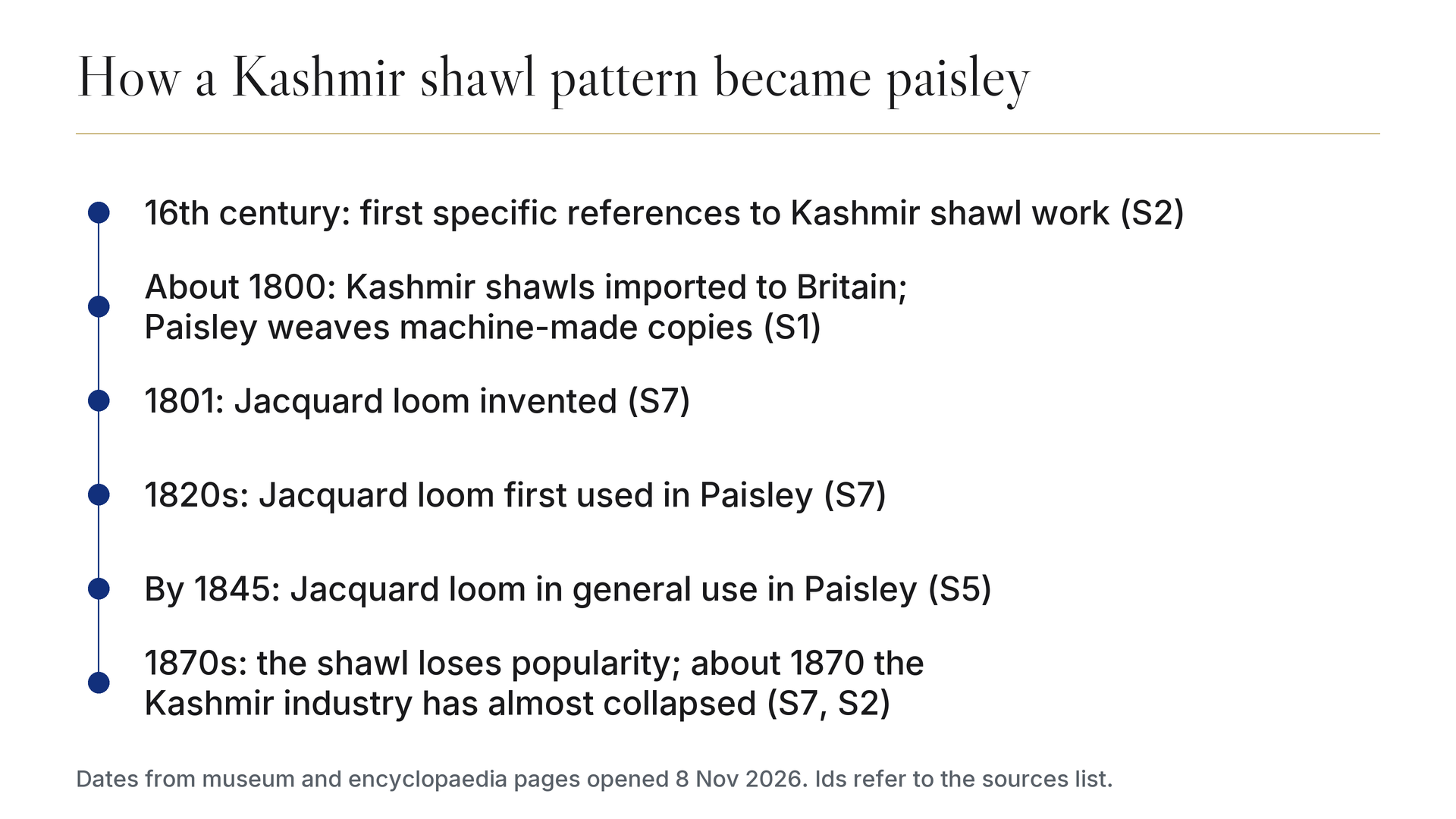
The Met says the Jacquard loom was invented in 1801 and first used in Paisley in the 1820s (S7). The V&A says it was in general use there by 1845 (S5). The Met says the shawl lost popularity in the 1870s (S7), and Britannica says the Kashmir shawl industry had almost collapsed by about 1870 (S2).
What does boteh mean?
Museums use the word without explaining it. The V&A describes the borders of a 19th-century Kashmir shawl as carrying a large floral design called boteh, and says no more (S3). The Met writes of “the boteh form” in its record of a shawl, probably Scottish, dated 1830-50 (S7).
Other names turn up. A short read on the National Museums Scotland site, written by members of South Asian community groups supported by Networking Key Services, calls the same motif buta, ambi or kalga (S6). Encyclopaedia Iranica spells it bota or buta (S4).
None of these pages gives a meaning for the word, so this piece gives none.
Where did the shape begin?
The sources disagree. Who says what:
- The Met’s record calls the form an ancient Persian design, and says the boteh is adapted from the Indian and Persian form (S7).
- Britannica says the Paisley patterns, adapted from Kashmir ones, derive ultimately from Mughal art (S1).
- The National Museums Scotland community authors trace the design to the valley of Kashmir (S6).
- The V&A says the elongated pine-cone forms on a Paisley shawl were based on Indian patterns (S5).
The Met and V&A pages are records of single objects, not a vote among scholars.
Dates are thinner still. Britannica’s Kashmir shawl article says woollen shawls were mentioned in writings of the 3rd century BC and the 11th century AD, and that specific references to Kashmir work first appear in the 16th century (S2). That is the shawl, not the motif. No page opened gives a first date for the motif itself.
What did the shape stand for?
Readings, each with its holder:
- The Met’s record links the form to the tree of life, and to buds, cones and palm fronds (S7).
- Encyclopaedia Iranica, in its entry on the cypress, says some scholars believe the motif is a stylised pyramid-shaped cypress with its top bent by the wind (S4).
- The National Museums Scotland page says many believed the design was inspired by a Zoroastrian design standing for life and fertility. It does not say who believed it (S6).
The pages do not choose between these readings.
What does this mean for a piece of jewellery?
A piece of jewellery that uses this shape cannot honestly claim one history for it. The motif carries several pasts at once: Persian, Kashmiri, Mughal and Scottish, depending on which page you trust. Where the shape began is the very question the sources above leave open.
For more motifs, read what Persian jewellery symbols mean. For a related comparison, see Persian and Islamic geometric patterns in jewellery. For the designer and the house behind this journal, there is the story of Silux London.
How we measured
- The figure is a dated list, drawn for this piece.
- Each row is a date that a museum or encyclopaedia page states. None is estimated.
- Rows with two sources show both, and where a source says “about”, the figure says “about”.
When this does not apply
This is a history of a motif, not a way to date, authenticate or value a shawl or any other textile. The origin is disputed, a motif’s meaning varies by period and place, and museums revise their catalogue wording.
Sources
Numbers match the ids S1 to S7 used above and on the figure.
- Encyclopaedia Britannica, “Paisley (textile pattern)”, revised and updated by Amy Tikkanen, no date shown on the page, opened 8 November 2026, https://www.britannica.com/art/paisley-textile-pattern
- Encyclopaedia Britannica, “Paisley shawl” (page carrying the article “kashmir shawl”; only that article is used), published 1 July 2026 (the date in the page header; the article itself is undated), opened 8 November 2026, https://www.britannica.com/topic/Paisley-shawl
- Victoria and Albert Museum, “Kashmir Shawl (IS.2000-1883)”, published not stated (record created 25 June 2009), opened 8 November 2026 (2026-11-08), https://collections.vam.ac.uk/item/O478533/kashmir-shawl/
- Encyclopaedia Iranica Foundation, “Cypress” by Houshang Alam, published 15 December 1993, last updated 28 August 2013, opened 8 November 2026 (2026-11-08), https://www.iranicaonline.org/articles/cypress-sarv-cupressus-tourn/
- Victoria and Albert Museum, “Shawl (T.111-1977), made in Paisley 1851-1855”, published not stated (record created 27 March 2003), opened 8 November 2026 (2026-11-08), https://collections.vam.ac.uk/item/O78729/shawl-unknown
- National Museums Scotland, “Stories about the South Asian origins of Paisley pattern”, no date shown on the page, opened 8 November 2026, https://www.nms.ac.uk/discover-catalogue/stories-about-the-south-asian-origins-paisley-pattern
- The Metropolitan Museum of Art, “Shawl, probably Scottish, 1830-50 (2009.300.2963)”, no date shown on the page, opened 8 November 2026, https://www.metmuseum.org/art/collection/search/157846
Last checked: 8 November 2026.