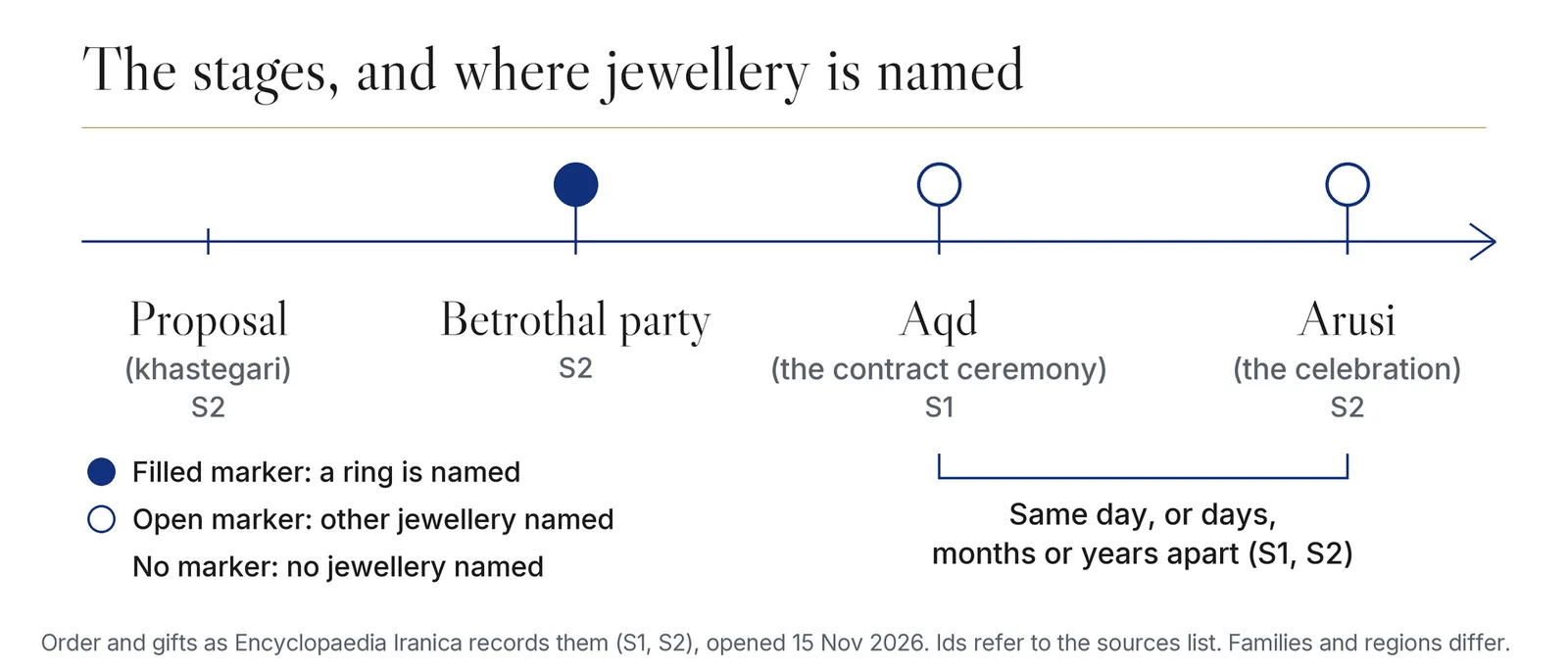
As Encyclopaedia Iranica records it, a Persian wedding runs in stages: proposal, betrothal, the aqd and the arusi. The aqd, the contract ceremony, gives legal and religious recognition (S1). The arusi, the celebration, can fall on the same day or years later (S2). Jewellery is named at three points, a ring only at the betrothal (S1, S2).

What are the stages of a Persian wedding, and in what order?
A proposal, khastegari (the entry writes khvast(a)gari), starts the process. Women of the groom’s family often visit the girl’s family. If they are served only tea, the family is understood to be opposed; sweets, and perhaps a cooling drink, show interest (S2). Betrothal, the aqd and the arusi follow (S1). Most arusi observances are the groom’s family’s responsibility (S2).
The aqd and the arusi may be days, months or years apart (S2). A daughter of Naser al-Din Shah reported that her aqd took place in 1890 and her arusi a few years later (S1).
The arusi entry says it is chiefly concerned with traditional Persia and where its traditions are kept (S2). Practice varies by region and by a family’s means (S1, S2). For the house behind this journal, see the story of Silux London.
What is the betrothal party, and what is given?
Friends and relatives gather at the bride’s home and the betrothal is announced (S2). The groom’s family sends gifts, which “may include” trays of candied sugar, shawls, a ring and perhaps other jewellery, scaled to the groom’s family’s means (S2). In simpler versions the groom’s mother may bring a gold ring, sweets and sugar-coated almond slivers; in the Kalhor example she gives the ring to the bride (S2).
Traditionally elder representatives of both families also settle the terms of the marriage contract, including the mahriya, explained below (S2).
What is the aqd, and what is the sofreh?
The aqd is the ceremony at which the contract is read, formally agreed and signed (S1). It takes place at the bride’s home, and men and women gather separately for traditional celebrations (S1). Tribal groups keep it simply (S1).
A prominent feature is the sofreh (the entry writes sofra-ye aqd), a cloth spread with symbolic objects, among them a mirror and two candlesticks, both gifts from the groom, and a Quran on a prayer cloth. Each region has its own customs for what goes on it (S1).
The contract is read three times. After the third the bride gives a barely audible “yes”. The groom then sits beside her. She receives a present of jewellery from him, and may give him a gift in return (S1).
What is the mahriya?
The recitation of the contract lists the gifts the groom has promised the bride, the mahriya and any other agreed conditions (S1). One entry glosses the mahriya as bridewealth (S1), the other as the marriage portion settled on the bride (S2). Neither entry says that jewellery counts toward it.
What happens at the arusi?
The day and evening before are given to preparation: the bride and groom each visit the public bath, and henna is applied. The bride’s dowry is sent to the groom’s house in trunks before the celebration. On the day the groom’s relatives and friends fetch the bride in a procession to his home. In the bridal chamber the groom gives a gift of jewellery before the veil is lifted. The couple often make their first public appearances afterwards at dinners sponsored by relatives (S2).
Where is jewellery given, and where is a ring named?
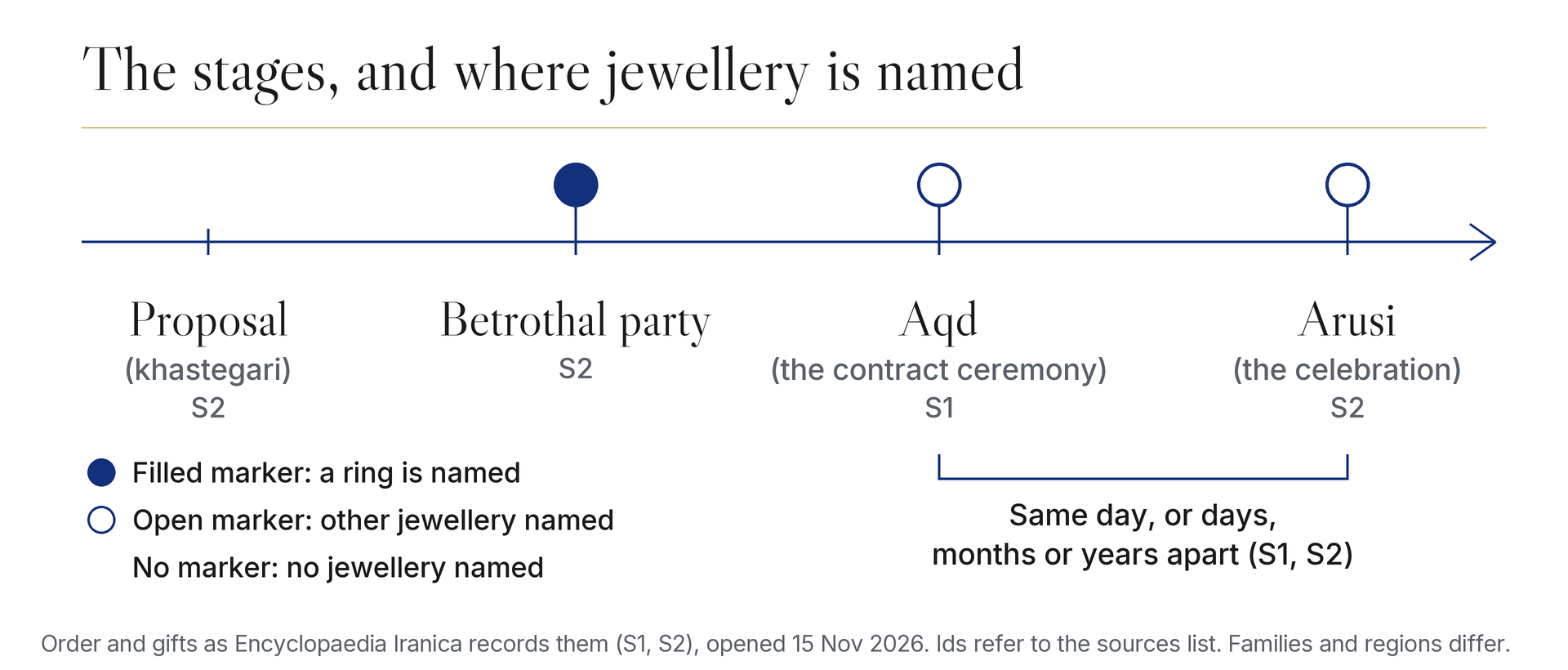
| Stage | Jewellery named | Ring named? | Source |
|---|---|---|---|
| Betrothal party | Gifts “may include” a ring and perhaps other jewellery | Yes | S2 |
| Aqd, after the bride’s assent | A present of jewellery from the groom (she may give a gift in return) | No | S1 |
| Arusi, bridal chamber | A gift of jewellery, the rugosha or runama (“displaying the face”), before the veil is lifted | No | S2 |
Only the betrothal row names a ring, and it says the gifts “may include” one. The entries do not say which hand or finger a ring goes on; for that, see which hand a wedding ring goes on.
What should a partner do?
This part is our advice, not the entries’. Practice varies, so do not assume one script. Ask the family which stages they keep and what is customary at each.
For the ring itself, read what makes a Persian engagement ring Persian; for the patterns, what Persian jewellery symbols mean. If jewellery is part of your plan, a design session with the designer is the place to talk it through. It is free, in the Jewellery Quarter or by video, and nothing is cut until you have approved the design. Once you know which stages the family keeps, book a design session.
How we measured
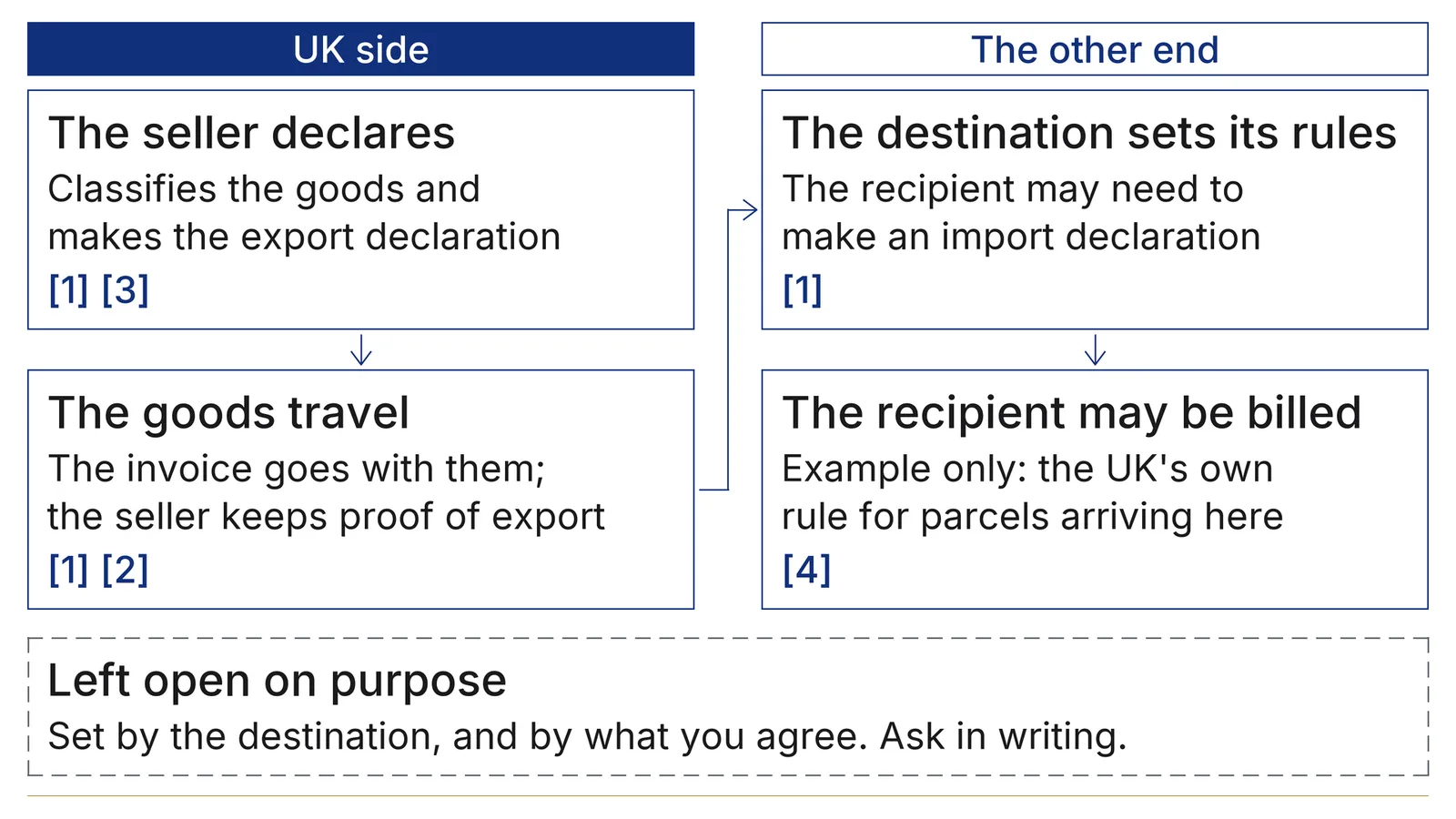
The figure is an ordered list of four stages, with no measurements and no duration drawn to scale. Each node carries the id of the source that states it, S1 or S2. A filled marker means a ring is named, an open marker other jewellery named, no marker no jewellery named; a bracket marks the wait between aqd and arusi.
When this does not apply
Both entries are scholarly accounts of customs as recorded, drawing on earlier travellers’ and ethnographers’ reports. They are chiefly about traditional practice, with a few notes on change, such as a car for the procession (S2). In the jewellery passages they are written as a groom who gives and a bride who receives, and say nothing of other couples. They do not cover diaspora practice or marriage among Iranian minorities (S2 points to a separate entry, Marriage, which was not opened). This is not legal advice, and neither entry says whether a Persian ceremony has legal effect in the UK.
Sources
Numbers match the ids S1 and S2 used above and on the figure.
- Encyclopaedia Iranica, “AQD” by Anne H. Betteridge and Hassan Javadi, published 15 Dec 1986, updated 1 Mar 2013, opened 15 Nov 2026, https://www.iranicaonline.org/articles/aqd
- Encyclopaedia Iranica, “ʿARŪSĪ” by Anne H. Betteridge, published 15 Dec 1986, updated 20 Oct 2015, opened 15 Nov 2026, https://www.iranicaonline.org/articles/arusi-the-secular-wedding-celebration-which-follows-the-wedding-contract-ceremony-aqd-q/
Last checked: 15 November 2026.