A ring does not become Persian because the person who designed it is Persian. That is not a high enough bar, and it is not really what anyone typing “Persian engagement ring” into a search box is asking for. What they are asking for, whether they know it or not, is a piece that carries something real: a pattern with a history, a meaning that survives being explained, a reason the design looks the way it does beyond looking nice.
That is the standard the Vasl collection is built to. Vasl means union, and every piece in it is built around the idea that a bridal ring should hold its architecture inside itself, not borrow it from somewhere else afterward.
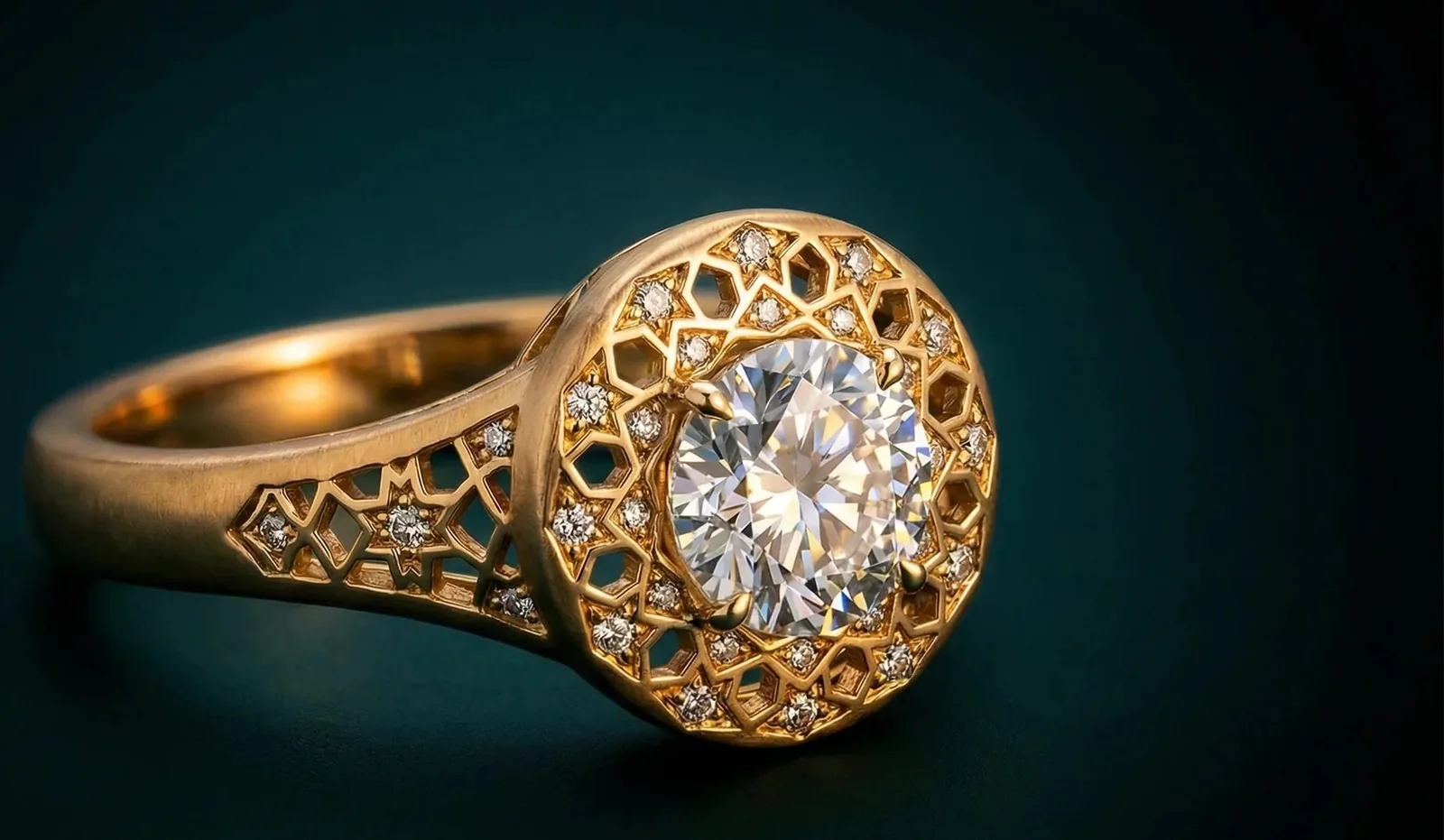
The Azar ring is where that standard is easiest to see plainly. Azar means fire, and it is named for the sacred flame that has burned in Zoroastrian tradition for millennia, long before it became a metaphor anyone reaches for casually. Around the centre diamond sits a halo of girih lattice, the geometric interlocking pattern that tiles the mosques of Isfahan. Girih is mathematics before it is decoration: a small number of tile shapes, repeated and interlocked, producing patterns that look infinite because in principle they are. Setting that same geometry around a stone, at finger scale, is the whole design argument in one sentence: the same logic that built a dome can hold a diamond.
The ring itself is 18ct yellow gold, built around a 1.00ct centre diamond, made to order. What makes it Persian is not the gold and not the diamond. It is that the lattice is doing real work, both structurally and as a story, rather than sitting on the ring as a flourish borrowed from somewhere else because it looked appropriately exotic.
That is the test we hold every piece in this family to before it is allowed to call itself Persian. Not “does it look like it could be,” but “does the pattern mean something, and would it still mean that thing if nobody ever asked.”