At the studio, bespoke jewellery means a piece designed for one person from their brief, rather than chosen from a range or remade from an existing design. The word describes a route, not a guarantee, so ask what the commission includes and where you approve it. Nothing is cut until you have approved the design model.

How does bespoke differ from made to order, custom and personalised?
These words are sometimes used loosely. At the studio they are kept apart, because each promises something different.
| Word | What it promises at the studio | What to ask |
|---|---|---|
| Bespoke | Designed from nothing, for you specifically | Is the design new, or adapted from one that exists? |
| Made to order | Made only once commissioned; it may come from an existing design | Which design, and what changes? |
| Custom, personalised | An existing design changed: metal, stone, size, proportions, engraving, a name | What stays the same as the original? |
| Made to measure | Nothing fixed: it can mean a new design or an adapted one | Is the design new or adapted? |
The difference that matters most is between the first two. Made to order says when a piece begins to exist. Bespoke says where the design came from. A piece can be one without the other. The sibling post on what made to order jewellery means takes made to order in full.
Who decides what, and when?
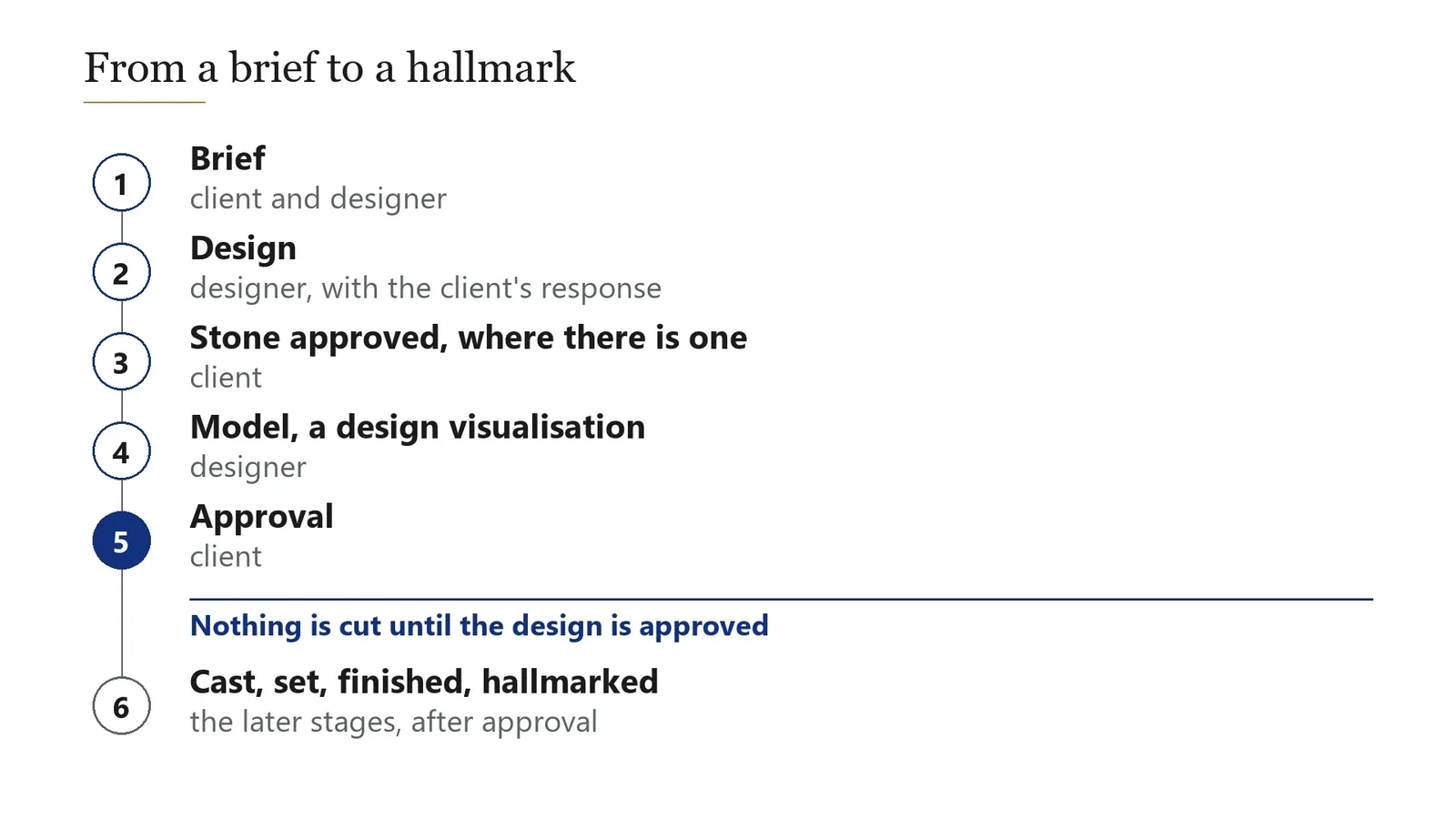
A commission is a series of decisions, and they are not all yours. You bring the brief, respond to the design, approve the stone where the piece has a centre stone, and approve the design model. The designer talks the brief through, develops the design and builds the design model. After approval the later stages follow: the ring is cast, stones are set, the piece is finished and it is hallmarked.
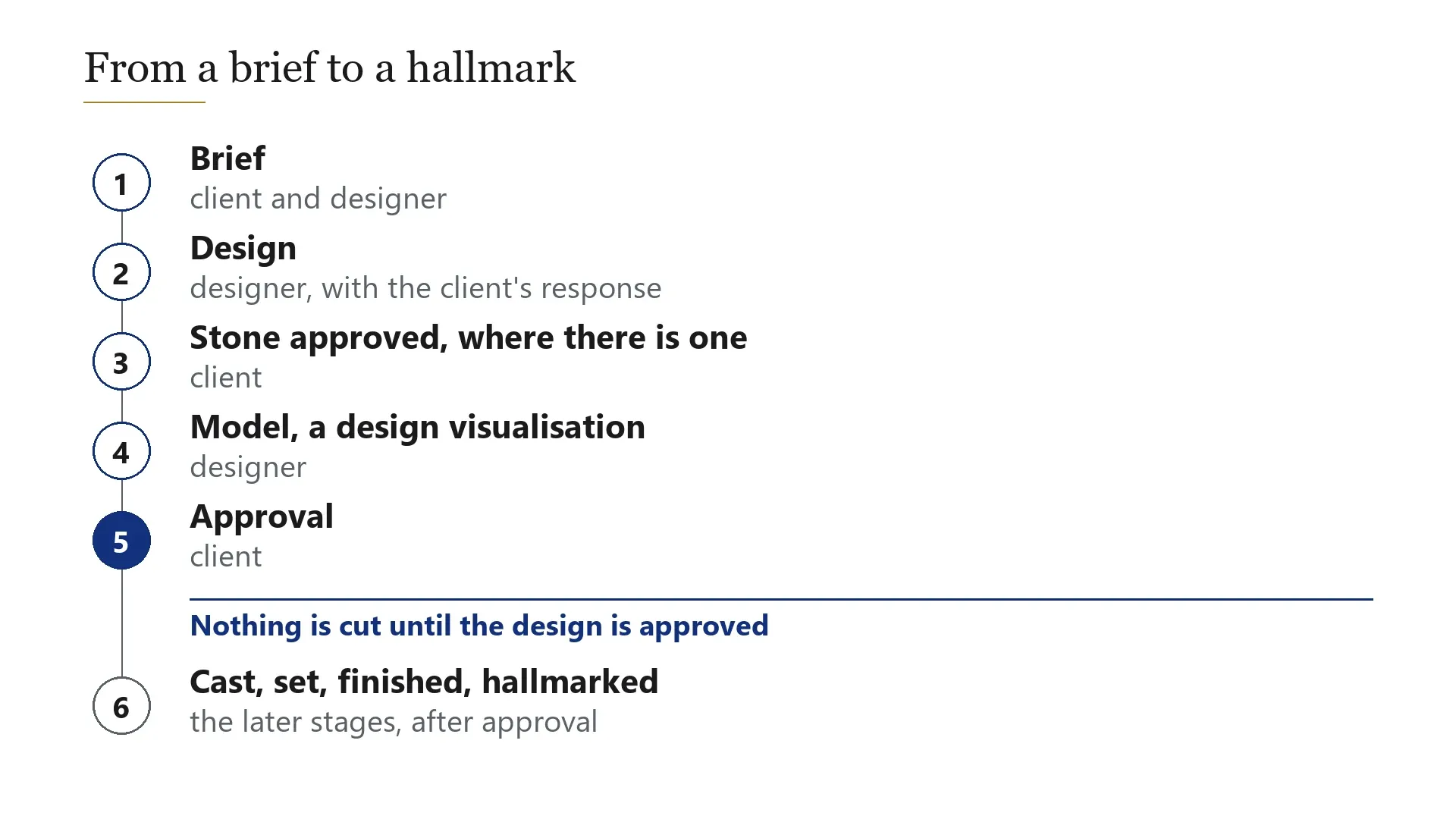
The figure marks one line: nothing is cut until you approve, at step five. That is the studio’s own claim about its approval stage, and it is what the rest of this piece turns on. For each stage in turn, see how a bespoke ring is made.
How we measured
This is a step route, not a measured chart. It has no measurements, durations or prices. Each step is a stage from the studio’s bespoke page, and the order and names of the stages come from that page and from the studio’s published house description: design, model, approval, casting, setting, finishing and the UK hallmark. The “who” tags are the studio’s own.
Why does approval come before anything is cut?
Because the studio treats approval as the last point at which proportion, spacing or scale can change. After it, the ring is cast.
A bespoke commission gives you more than a new design. It gives you a point at which you can look at the design model and say yes, or say change this. Ask any jeweller where that point falls.
What does the word not promise?
At the studio, the word bespoke fixes no price, lead time or metal. Those are set in the quotation, and they are what to compare between jewellers.
One piece of law uses similar words. Regulation 28 of the Consumer Contracts (Information, Cancellation and Additional Charges) Regulations 2013 lists exceptions to the right to cancel. On legislation.gov.uk the list includes “the supply of goods that are made to the consumer’s specifications or are clearly personalised” [1].
That is the wording, quoted and not interpreted. Whether a particular commission falls within it depends on the facts, and this piece gives no legal advice. Read the source, and see your rights when buying an engagement ring for how cancellation sits beside an agreed piece.
What should you ask in a first conversation?
Five questions cover most of it:
- Is the design new, or an existing design adapted?
- What do I approve, and at what point?
- Who designs it?
- What is in the quotation, and what is not?
- What happens if I do not approve?
You can put them to any jeweller. The studio’s design session is where the brief is talked through.
When this does not apply
The words in this piece are used as the studio uses them. That is a house usage, not a standard, and no trade body or standards page was opened for it. Other jewellers may use the same words differently, and other jewellers order the stages differently from the route shown here. The regulation is quoted for its wording only. Nothing here is legal advice.
Sources
- legislation.gov.uk (The National Archives), The Consumer Contracts (Information, Cancellation and Additional Charges) Regulations 2013 (SI 2013/3134), regulation 28, exceptions to the right to cancel, published latest revised version, up to date to 10 November 2026, opened 12 November 2026, https://www.legislation.gov.uk/uksi/2013/3134/regulation/28
Last checked: 12 November 2026.