Moissanite is not a diamond. It is silicon carbide, made in a laboratory, and it shows more rainbow colour than a natural diamond. A natural diamond is harder, 10 on the Mohs scale against 9.25, though GIA calls moissanite “very hard and durable”. The choice comes down to the look, wear and paperwork.

What is moissanite, and is it a diamond?
In this piece, “diamond” on its own means a natural diamond. A laboratory-grown diamond is never called just “diamond”: UK advertising guidance asks for a clear qualifier such as “laboratory-grown”, and this piece writes it in full.
- Natural diamond. Carbon that formed in the earth.
- Laboratory-grown diamond. Not a substitute. GIA says it has the same crystal structure as a natural diamond, so nearly the same chemical, optical and physical properties. Laboratories such as GIA use advanced instruments to show how it grew.
- Moissanite. A different material: silicon carbide, a compound of silicon and carbon, not pure carbon. The moissanite used in jewellery is made in a laboratory (GIA calls it synthetic). GIA files it among the simulants, materials that look like a diamond without being one.
How do the three compare side by side?
| Natural diamond | Laboratory-grown diamond | Moissanite | |
|---|---|---|---|
| What it is | Carbon, formed in the earth | Carbon, grown in a laboratory | Silicon carbide, made in a laboratory |
| Mohs hardness | 10 | Nearly the same as natural | 9.25 |
| Refractive index | 2.42 | Nearly the same as natural | 2.648 and 2.691 |
| Fire | The yardstick | Nearly the same as natural | More than twice a diamond’s |
| How it is told apart | Advanced instruments | Advanced instruments | Fire may give it away from a carat up; doubled back facets |
| Paperwork | GIA Diamond Grading Report (natural diamonds only) | GIA Laboratory-Grown Diamond Report | None cited here: ask the seller |
The table has no prices: a fair figure has to be worked out for your own design.
Refractive index is a measure of how a stone bends light. Moissanite is doubly refractive, so it has two values.
Will I see the difference?
Sometimes. Brilliance is the white light a stone returns to your eye. Fire is the rainbow colour it splits that light into.
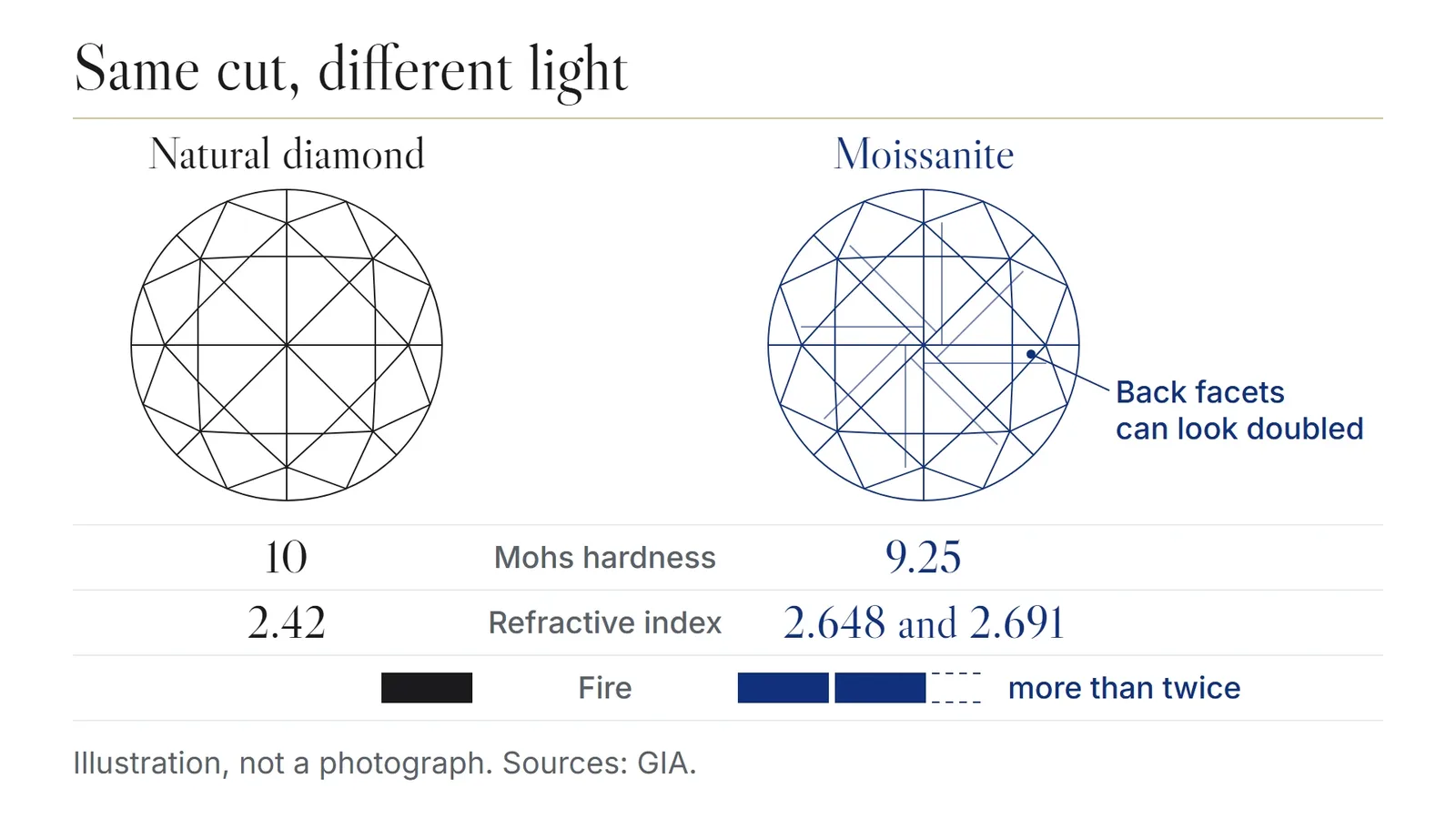
GIA says moissanite has more than twice a diamond’s fire and slightly more brilliance. From one carat up, the fire can give a moissanite away. Because it is doubly refractive, its back facets can look doubled and the inside may look blurry.
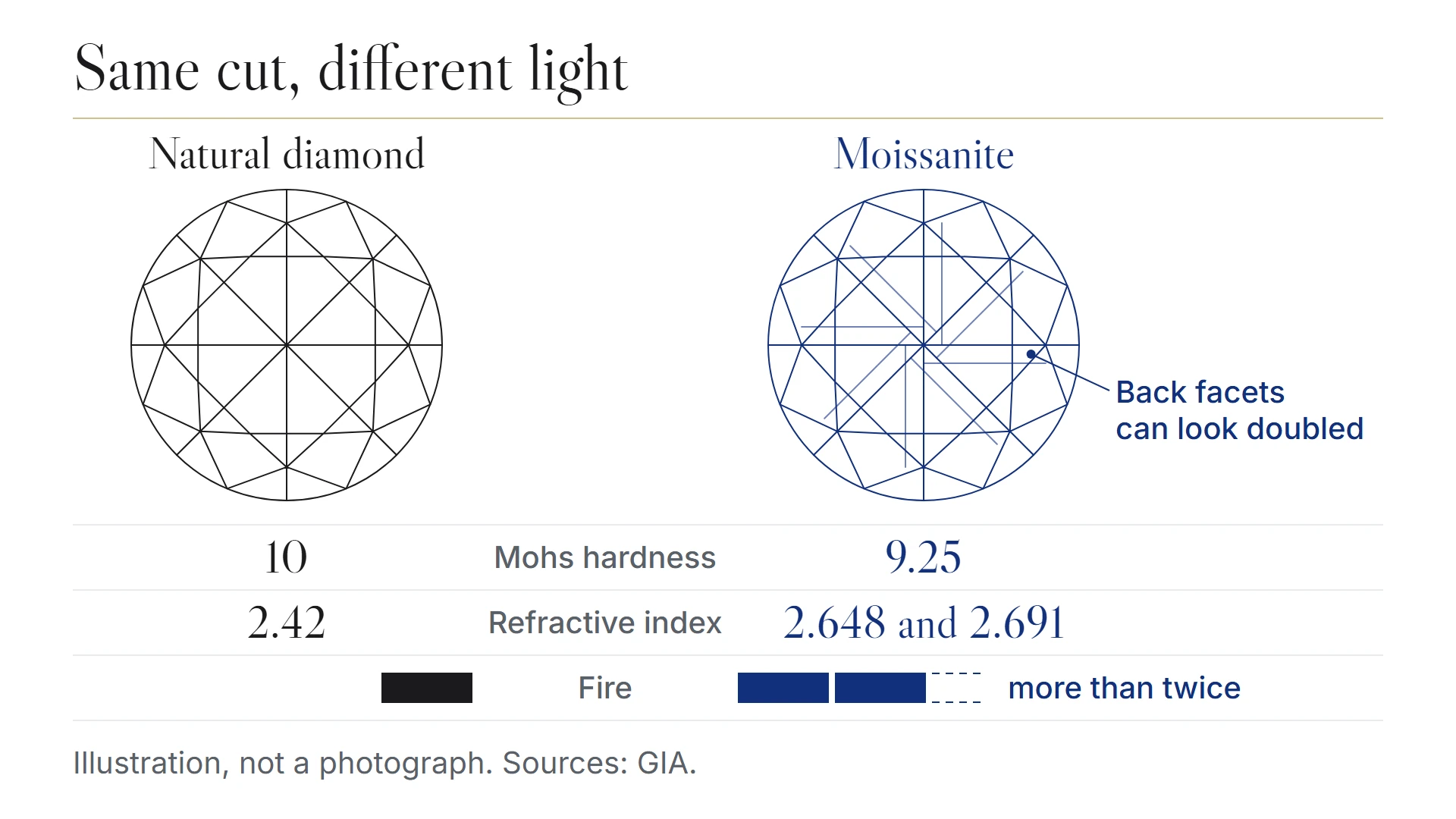
A laboratory-grown diamond has nearly the same optical properties as a natural one, so the drawing’s diamond stands for both. GIA calls moissanite colourless to near colourless, and says some moissanite looks slightly yellow or grey at certain angles. Judge the actual stone, in daylight and indoors, beside the alternative.
Is moissanite hard enough for an engagement ring?
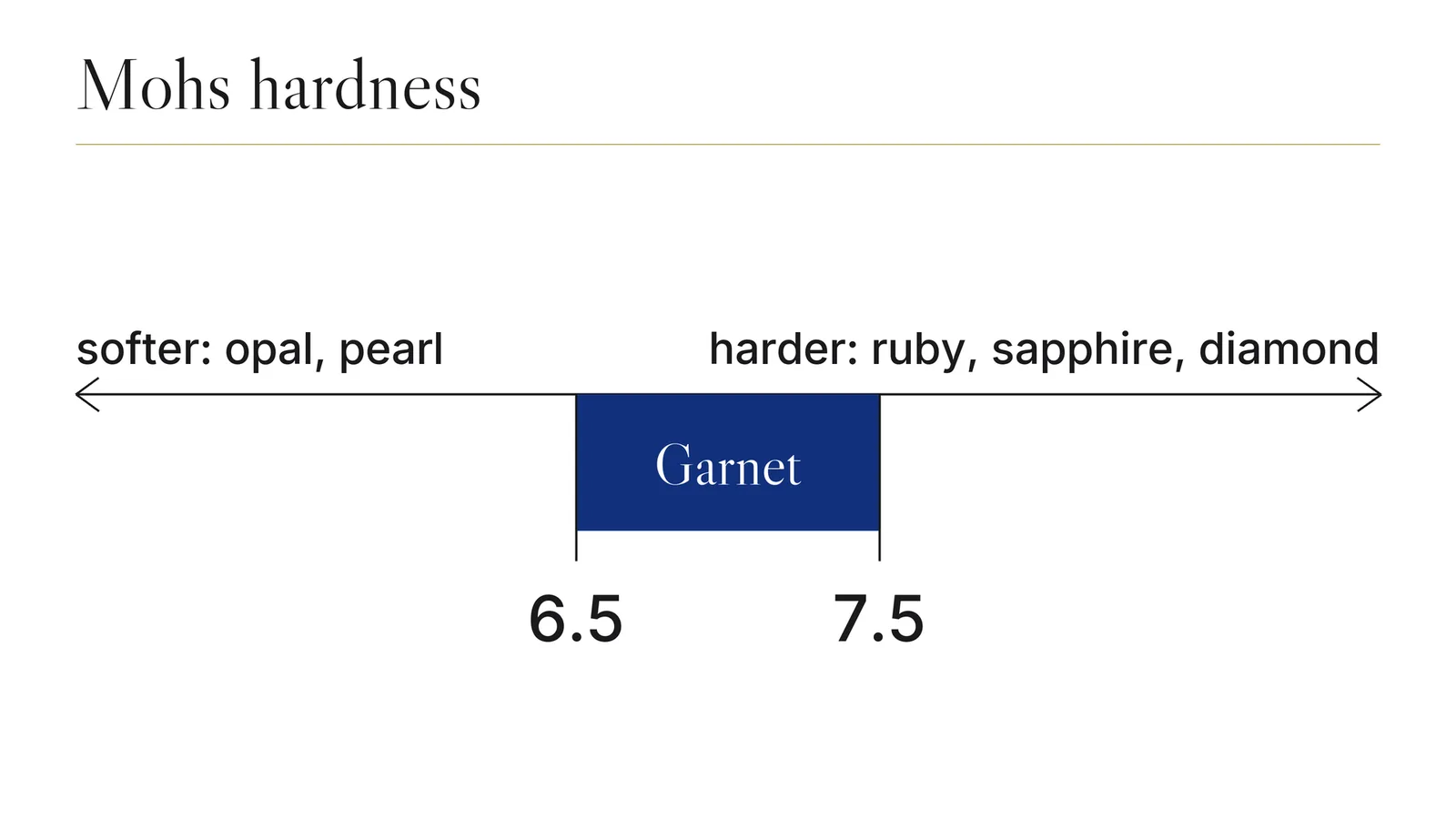
Mohs hardness is the figure GIA gives for each stone; higher is harder. A natural diamond is 10 and moissanite 9.25. A laboratory-grown diamond has nearly the same physical properties as a natural one, so both sit above moissanite.
GIA calls moissanite “very hard and durable” and says it is not as hard as a diamond. This piece cites no test of chipping or of scratching over years of wear, so it makes no claim on either.
What paperwork comes with each?
GIA grades natural diamonds in a Diamond Grading Report and laboratory-grown diamonds in a separate Laboratory-Grown Diamond Report. For a laboratory-grown diamond, GIA laser-inscribes the stone’s edge (its girdle) with “Laboratory-Grown” and a GIA number.
For moissanite, this piece cites no grading standard and does not say whether one exists. Ask the seller to put in writing what the stone is and what a laboratory has said about it, if anything. The difference between natural and laboratory-grown diamonds and what a hallmark, a grading report and a valuation each tell you cover the rest.
How should I choose?
- Start with the look. GIA says moissanite shows more than twice the fire of a diamond. Whether you want more rainbow flash or less is a matter of taste.
- Then daily wear. A natural diamond is 10 on the Mohs scale, a laboratory-grown diamond nearly the same, moissanite 9.25.
- Then paperwork. GIA issues a report for each kind of diamond, as above. For moissanite, ask what comes with it, in writing.
See also the studio’s page on how to choose a diamond for a bespoke engagement ring. To talk through natural or laboratory-grown diamond for your design, book a free design session: a private hour in the Jewellery Quarter in Birmingham or by video call, with no obligation.
How we measured
We measured no stone. Every number in the table and the drawing is GIA’s.
- Hardness. 10 for a natural diamond (GIA Gem Encyclopedia); 9.25 for moissanite (GIA, 1997; GIA simulants page).
- Refractive index. 2.42 for a natural diamond. 2.648 and 2.691 for moissanite, which is doubly refractive (GIA, 1997).
- Fire. Moissanite’s bar is drawn more than twice as long because GIA says it has more than twice the fire. It illustrates that sentence; it is not a measurement.
- Drawn, not measured. Both stones are round brilliants at one size. The lighter second lines on moissanite’s back facets illustrate GIA’s statement that they can look doubled.
When this does not apply
Stones vary, so none of this describes the particular stone you are shown. It compares materials from published sources and does not rank them. The studio does not offer moissanite; this is for a reader weighing the materials. It gives no prices or resale values: no source behind it supports one.
Sources
- GIA, Gems & Gemology, Nassau, McClure, Elen and Shigley, Synthetic Moissanite: A New Diamond Substitute (abstract page), published Winter 1997, vol. 33 no. 4, checked 7 Nov 2026, opened 7 Nov 2026, https://www.gia.edu/gems-gemology/winter-1997-synthetic-moissanite-nassau
- GIA, An Introduction to Simulants or Imitation Gem Materials, Robert Weldon, no publication date shown (copyright 2002 to 2026), checked 7 Nov 2026, opened 7 Nov 2026, https://www.gia.edu/gem-imitation
- GIA, Diamond, Gem Encyclopedia, no publication date shown (copyright 2002 to 2026), checked 7 Nov 2026, opened 7 Nov 2026, https://www.gia.edu/diamond
- GIA 4Cs, Simulants, Moissanite and Laboratory-Grown Diamonds, no publication date shown (copyright 2002 to 2026), checked 7 Nov 2026, opened 7 Nov 2026, https://4cs.gia.edu/en-us/simulants-moissanite-and-lab-grown-diamonds/
- Committee of Advertising Practice (CAP News, on the ASA site), From rough idea to radiant execution: how to make your laboratory-grown diamond advertising dazzle, published 23 Oct 2025, opened 7 Nov 2026, https://www.asa.org.uk/news/from-rough-idea-to-radiant-execution-how-to-make-your-laboratory-grown-diamond-advertising-dazzle.html
- GIA 4Cs, Diamond Cut, no publication date shown, checked 7 Nov 2026, opened 7 Nov 2026, https://4cs.gia.edu/en-us/diamond-cut/
- GIA 4Cs, GIA report types, no publication date shown, checked 7 Nov 2026, opened 7 Nov 2026, https://4cs.gia.edu/en-us/types-gia-reports/
Last checked: 7 Nov 2026.