The January birthstone is garnet, a group of several minerals rather than one stone. Its hardness is 6.5 to 7.5 on the Mohs scale. GIA says not all garnets are good candidates for daily wear, so the range alone does not settle whether garnet suits an everyday ring.

Which stone is the January birthstone?
Garnet. GIA names it as the birthstone for January and as the gem for the second anniversary, and Britannica’s month table lists it as January’s traditional stone. GIA says the name comes from the medieval Latin granatus, meaning pomegranate, for the likeness to the red colour.
Who chose the list, and is it fixed?
Britannica names no body and no date for the modern list, so this piece names none either. Britannica says the stones now tied to each month have only a slight relationship to ancient beliefs, because the list is tempered by availability and cost. Originally, it says, the stones were considered to be those of the breastplate of the Jewish high priest. It adds that in the 20th century the list was supplemented with laboratory-made alternatives, and the natural list was widened to be more acceptable to both sexes. January gets no 20th-century expansion of the natural list: garnet is its only traditional stone. The table does list a laboratory-made supplement for January, dark red laboratory-grown corundum, with the trade name garnet.
Is garnet one stone?
No. GIA and Britannica agree that garnet is a group of related minerals, which Britannica describes as silicates. GIA names five as important gems. The colours below follow GIA’s descriptions.
| Species | Colour range | Gem name (GIA) |
|---|---|---|
| Pyrope | purple to red | none named |
| Almandine | purple to red | none named |
| Spessartine | orange and yellow | none named |
| Andradite | mostly yellow to green | demantoid |
| Grossular | colourless through yellow to reddish orange and orangy red, and a vivid green | tsavorite (the green) |
Britannica adds two more: rhodolite (two parts pyrope to one part almandine) and essonite or hessonite (a grossular). It words some colour ranges differently, so the table follows GIA alone.
How hard is garnet?
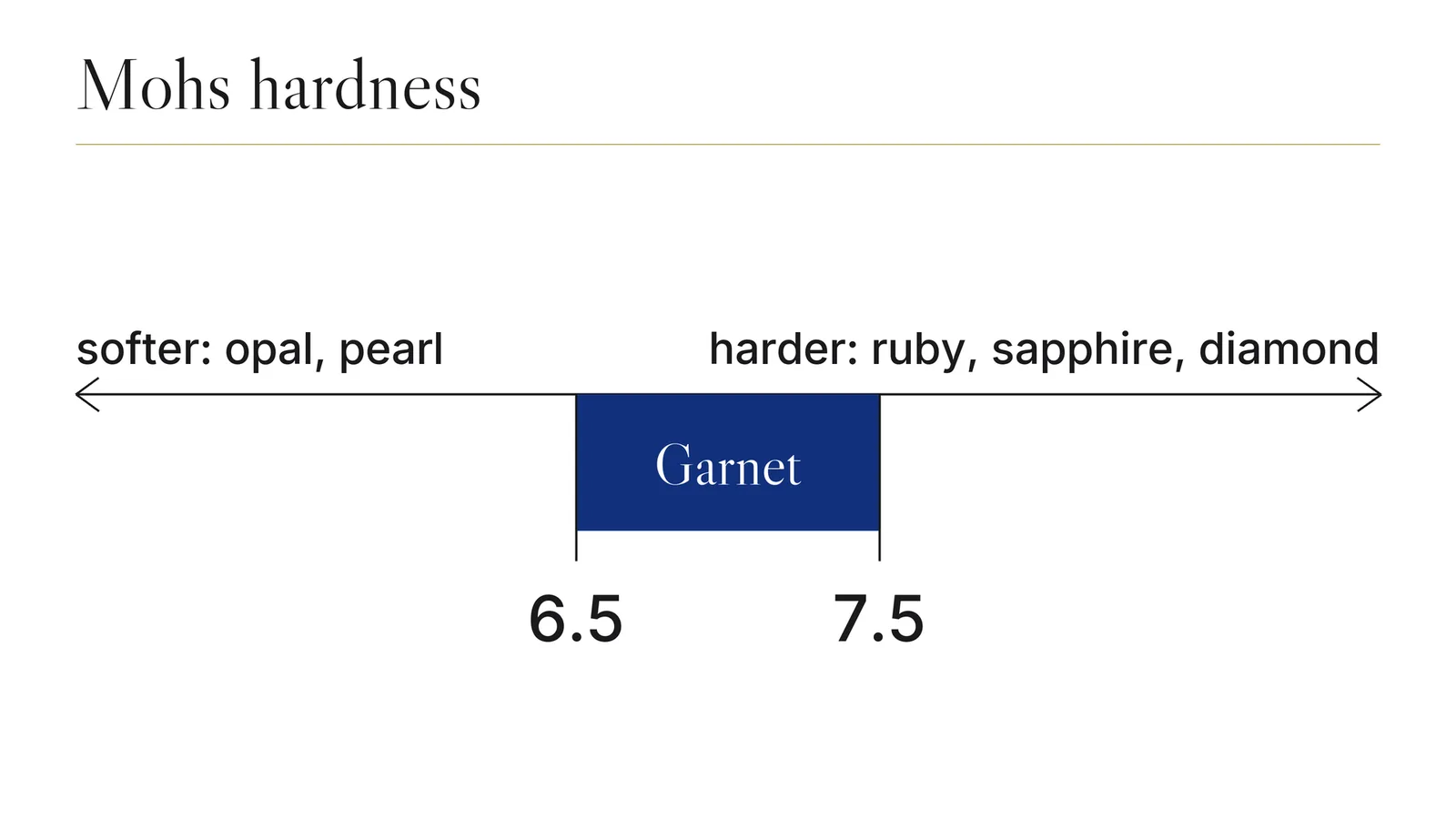
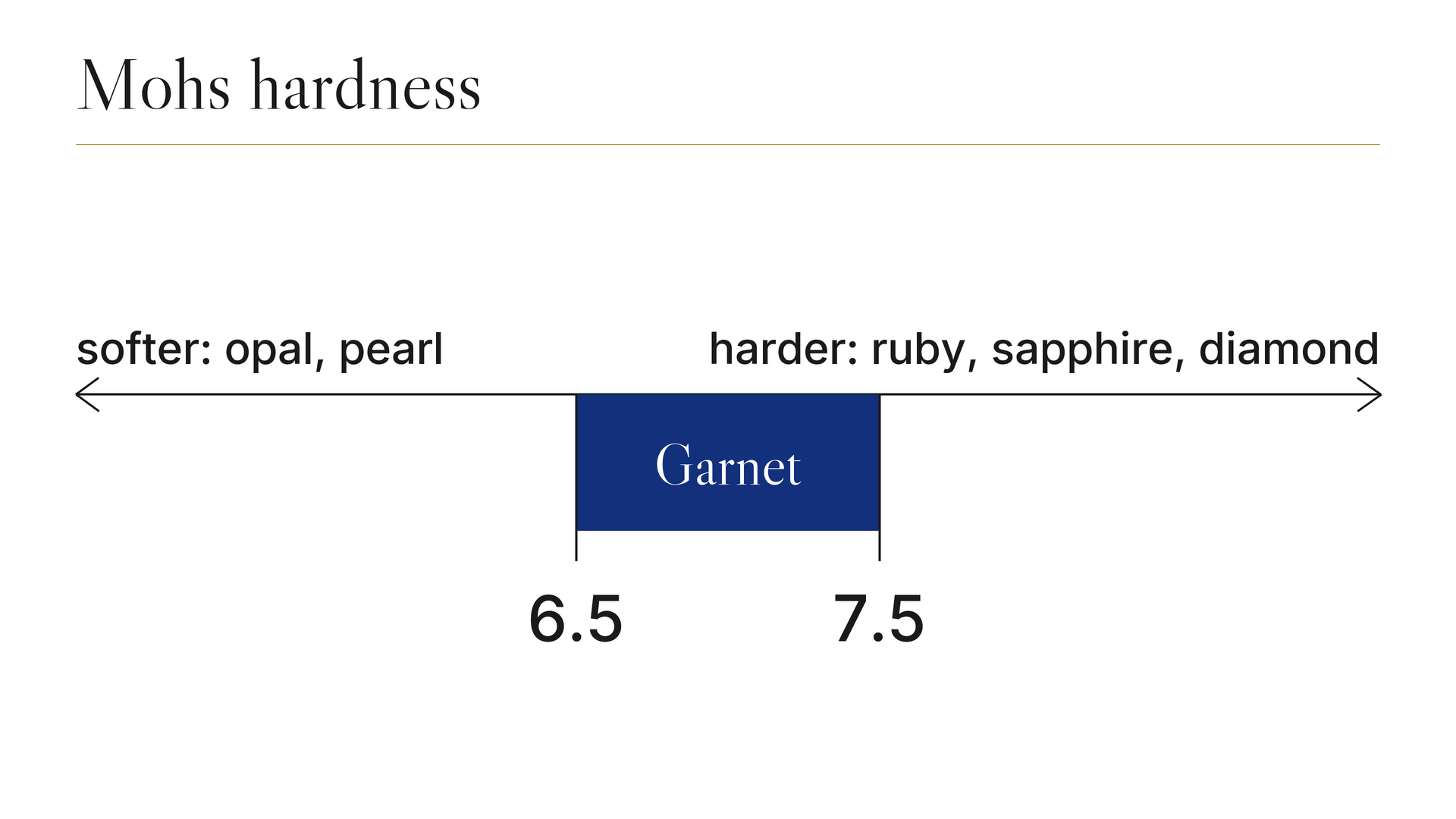
GIA and Britannica both give the group’s hardness as 6.5 to 7.5 on the Mohs scale. Neither page gives a figure for one variety, so none is given here.
From the range, GIA concludes that garnet is more susceptible to damage than ruby, sapphire and diamond. It also says garnet can scratch softer gems, such as opals or pearls. The ruler above shows only that, and puts no number on any other stone.
What do GIA and Britannica say about wear?
- GIA says not all garnets are good candidates for daily wear, and that garnets are ideal for earrings, brooches and pendants.
- Britannica gives no verdict on rings. It says garnets lack cleavage but tend to be brittle, and that properties that make them rather durable and relatively easily worked explain their widespread use as gemstones.
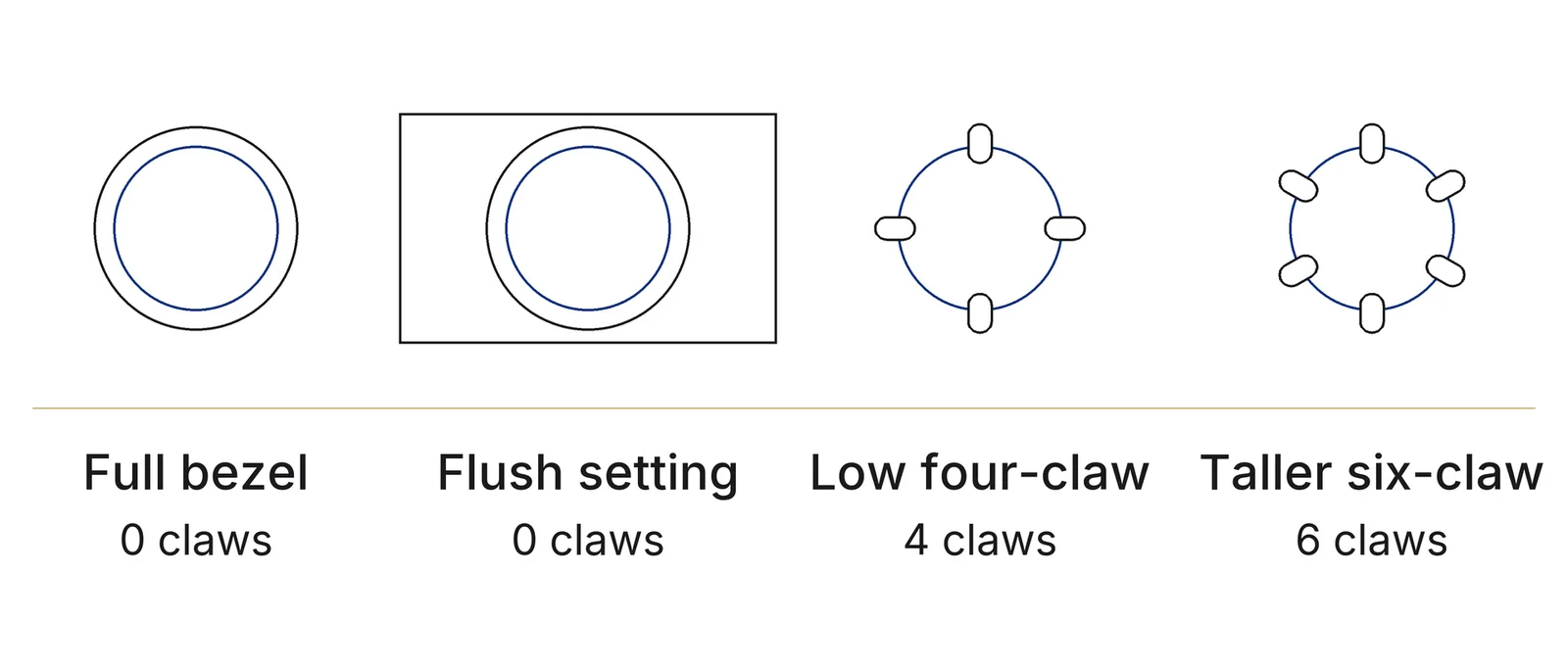
Neither page says whether garnet suits a ring, names a mount style such as a claw or a bezel, or says how a ring is worn. This piece adds no verdict of its own.
So does garnet suit an everyday ring?
The range alone does not settle it. A ring is a stone in a setting, worn by one person in one way. How a stone is set is a separate question from how hard it is. Our guide to old cut diamonds shows what setting involves for a different stone.
If you commission a ring with a garnet in it, it begins with a design session, a conversation with the designer, in the Jewellery Quarter or by video call. You can put the wear question to the designer there. Every piece is made to order and nothing is held in stock. Nothing is cast, set or cut until you have seen the piece modelled in three dimensions and confirmed it is right. For the wider question of how to weigh one stone against another, start with choosing a stone. For looking after a ring once it is worn, see how to care for an engagement ring.
How we measured
The ruler plots Mohs hardness and shows only what the pages state. The garnet band is marked at 6.5 and 7.5 and nowhere else, and its width is not to scale. GIA (sources 1 and 2) and Britannica (source 4) each print that range. The labels “harder: ruby, sapphire, diamond” and “softer: opal, pearl” take the stones from GIA (source 1), in the order of its first mention; GIA ranks none of them. No other stone is plotted at a number, and the axis does not run from 1 to 10, because neither page gives the scale’s span or any other stone’s number.
When this does not apply
Garnet is several minerals, and no page used here gives a hardness for any one of them. A hardness range is not a verdict on one stone in one ring: GIA says only that not all garnets are good candidates for daily wear, and Britannica adds that garnets tend to be brittle. This piece does not decide the question for you. Britannica’s month table and GIA’s January page both give garnet for January. Other birthstone lists are not compared here, so this piece does not say how they differ.
Sources
- GIA, January Birthstone, published no date shown on the page, opened 16 Nov 2026, https://www.gia.edu/birthstones/january-birthstones
- GIA, Garnet Gemstone, published no date shown on the page, opened 16 Nov 2026, https://www.gia.edu/garnet
- Encyclopaedia Britannica, Birthstone, published 20 Jul 1998, opened 16 Nov 2026, https://www.britannica.com/topic/birthstone-gemstone
- Encyclopaedia Britannica, Garnet, published 26 Jul 1999; updated 1 Oct 2026, opened 16 Nov 2026, https://www.britannica.com/science/garnet
Last checked: 16 November 2026.