A no-fuss ring has few parts to catch, loosen or check. Look for a low or enclosed setting, one stone, a smooth band that is comfortable all day and a metal you can confirm by its hallmark. Hold it, run a finger over it and ask to see the hallmark. A very light ring may legally carry none.

What does “no fuss” mean for a ring?
It is a wish about how the ring behaves on the hand: the wearer should not have to think about it. That gives three tests.
- Nothing to catch: no part that snags a sleeve, a glove or hair.
- Nothing to check: as few small parts as possible that need a look.
- Nothing to doubt: the metal is what it is described as, and you can confirm it.
These are the studio’s tests, not a rule for every ring. The Before You Propose guide is the wider place to start.
Which setting asks least of the wearer?
The setting holds the stone, so it decides most of the first two tests. Engagement ring settings explained gives the full tour; four plain settings follow.
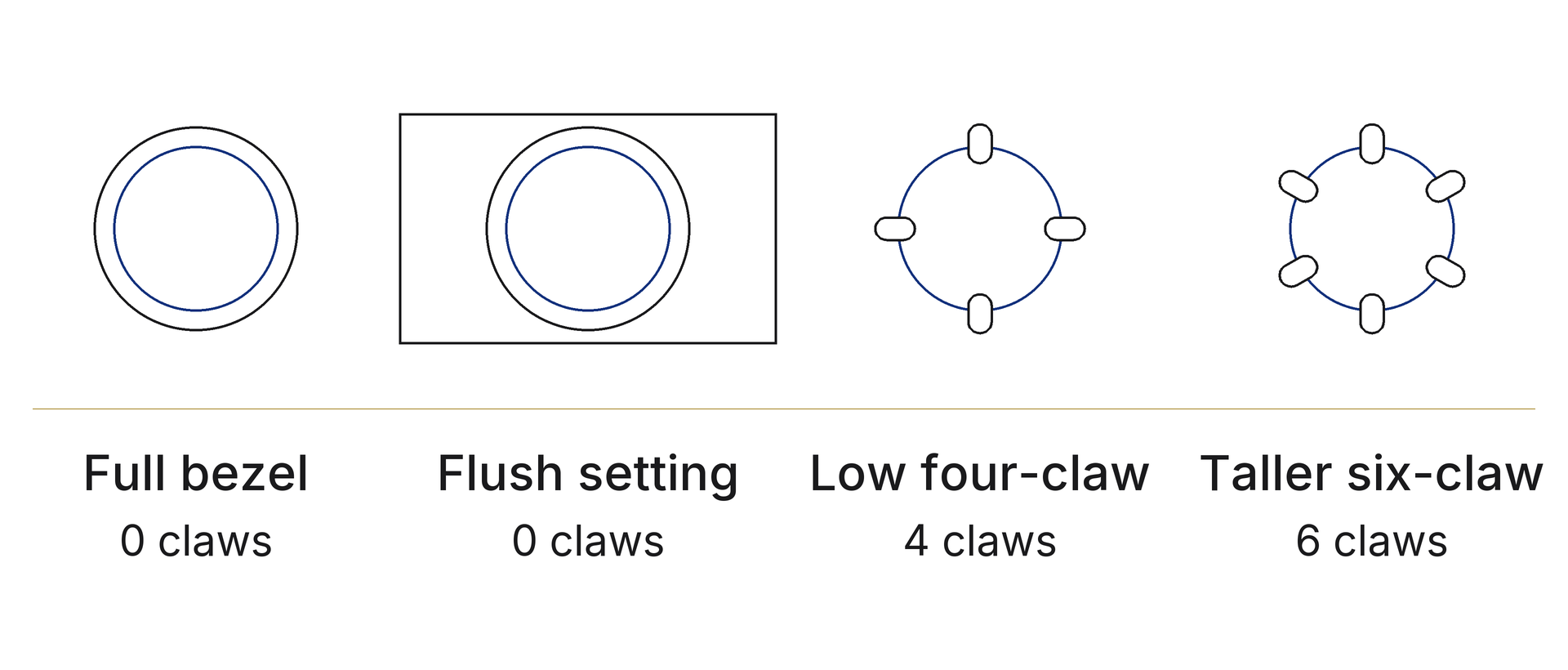
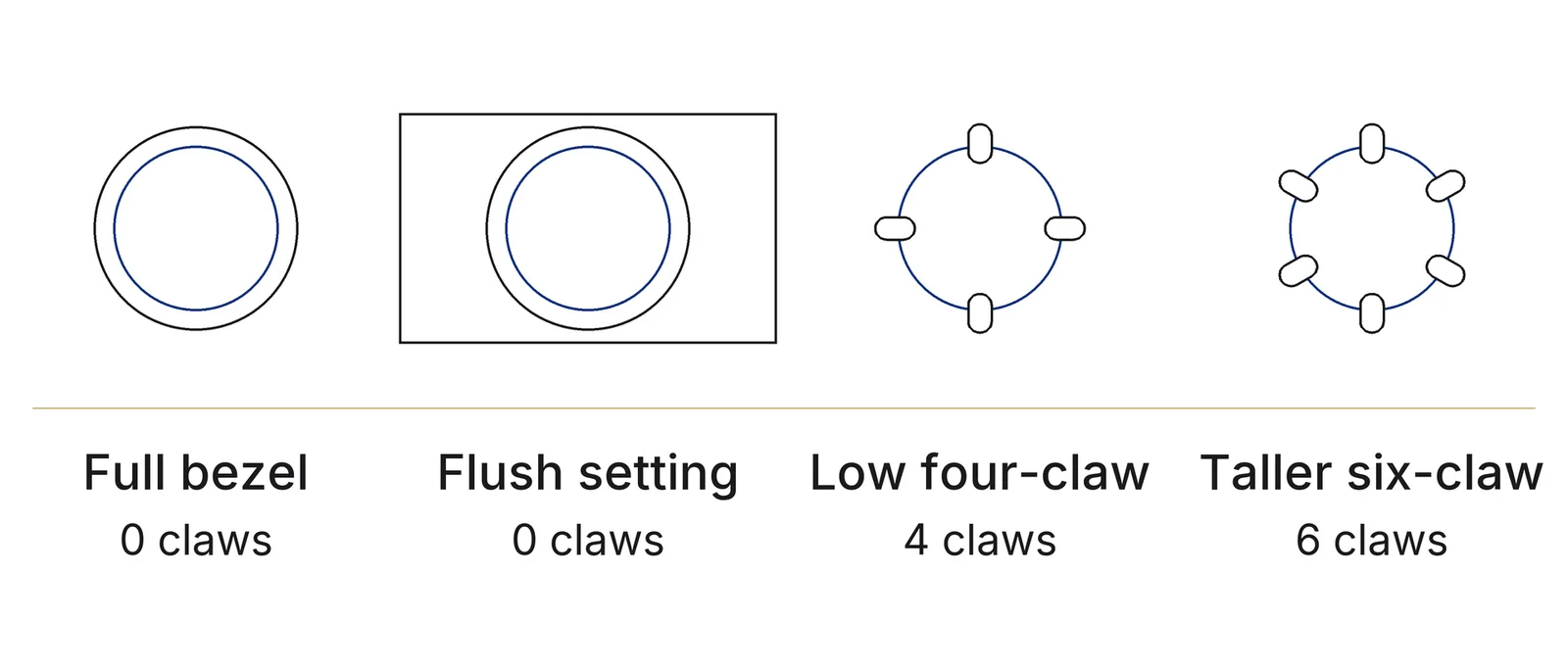
The same four, in words:
| Setting | Separate points holding the stone | Continuous rim round the edge | The studio’s reading |
|---|---|---|---|
| Full bezel | 0 | Yes | Little to catch |
| Flush setting (stone sunk into the band) | 0 | Yes, set into the band | Close to the finger |
| Low four-claw | 4 | No | Four points to check; set low |
| Taller six-claw | 6 | No | Six points to check; set taller, so more stands proud |
In the studio’s view, an enclosed rim is a calmer choice for a wearer who does not want to think about the ring. That is a reading, not a promise that a stone will not be damaged.
The trade, in the studio’s view: a rim also hides some of the stone’s side view and lets in less light from the side. What it gives back is less to catch and fewer separate points to check.
What should the band be like?
In the studio’s view, a good band is smooth inside, with no sharp edges, and comfortable all day. It is easy to test.
Run a fingertip along the inside and over each edge: nothing should drag or bite. If you can try a ring on, notice how it sits against the next finger.
Metal is a separate choice: see choosing a metal.
How do you check what you are buying, quickly?
Ask to see the hallmark. The Assay Office says the metal cannot be told by eye, and that the hallmark is the guarantee of what the metal contains (source 2). For the marks, the numbers and private sellers, see how to read a UK gold hallmark.
Under section 1 of the Hallmarking Act 1973, a person acting in the course of a trade or business commits an offence by describing an unhallmarked article as wholly or partly gold, silver, platinum or palladium, or by supplying or offering one so described (source 1). So it is a trader’s duty: a trader selling a ring as gold or platinum must have it hallmarked, unless an exemption applies. The main one for a new ring is weight (below); Schedule 1 lists others, such as some gold and silver articles from before 1950 and platinum articles from before 1975 (source 3).
Schedule 1 of the Act sets the metal weights below which no hallmark is needed: gold under 1 g, platinum under 0.5 g, silver under 7.78 g and palladium under 1 g (source 3). The Assay Office gives the same figures and does not count stones in the weight (source 2). So a ring below those weights can legally have no hallmark; if a heavier ring has none, ask why.
What should you ask the jeweller?
Four questions follow from the three tests:
- How many separate parts hold the stone, and which will want a look?
- How does the ring sit against the next finger, and could anything on it catch?
- Where is the hallmark, and if there is none, is the ring exempt, and why?
- What will the ring ask of me in care, and how often?
The wider decisions are in what to settle before buying a proposal ring; your position as a buyer is in your rights when buying an engagement ring.
A design session is where the design of a ring begins: a private conversation with the designer, in the Jewellery Quarter or by video call. To have a ring designed around these three tests, start there.
How we measured
Nothing was measured for this piece. The counts and the rim answers in the figure and the table come from how each setting is defined here: a four-claw setting has four claws, a six-claw setting six, and a bezel or flush setting a rim and no claws. The notes on how each wears are the studio’s view.
When this does not apply
This suits a wearer who wants a quiet ring. It does not suit someone who loves detail or wants a ring seen from every side: what is a sculptural engagement ring covers that taste. In the studio’s view, no setting is maintenance-free, so every ring is worth a look now and then, as how to care for an engagement ring explains. Hard physical work or sport may need advice this page does not give.
Sources
- legislation.gov.uk (The National Archives), Hallmarking Act 1973, section 1, published revised version; latest dated version entry 6 April 2025 (the page lists amendments from 1 February 1991), opened 20 Nov 2026, https://www.legislation.gov.uk/ukpga/1973/43/section/1
- The Assay Office (Birmingham), Understanding Hallmarks and your jewellery, published no date shown on the page, opened 20 Nov 2026, https://www.theassayoffice.co.uk/understanding-hallmarks-and-your-jewellery/
- legislation.gov.uk (The National Archives), Hallmarking Act 1973, Schedule 1, published revised version; latest dated version entry 6 April 2025 (the page lists amendments from 1 February 1991), opened 20 Nov 2026, https://www.legislation.gov.uk/ukpga/1973/43/schedule/1
Last checked: 20 Nov 2026.