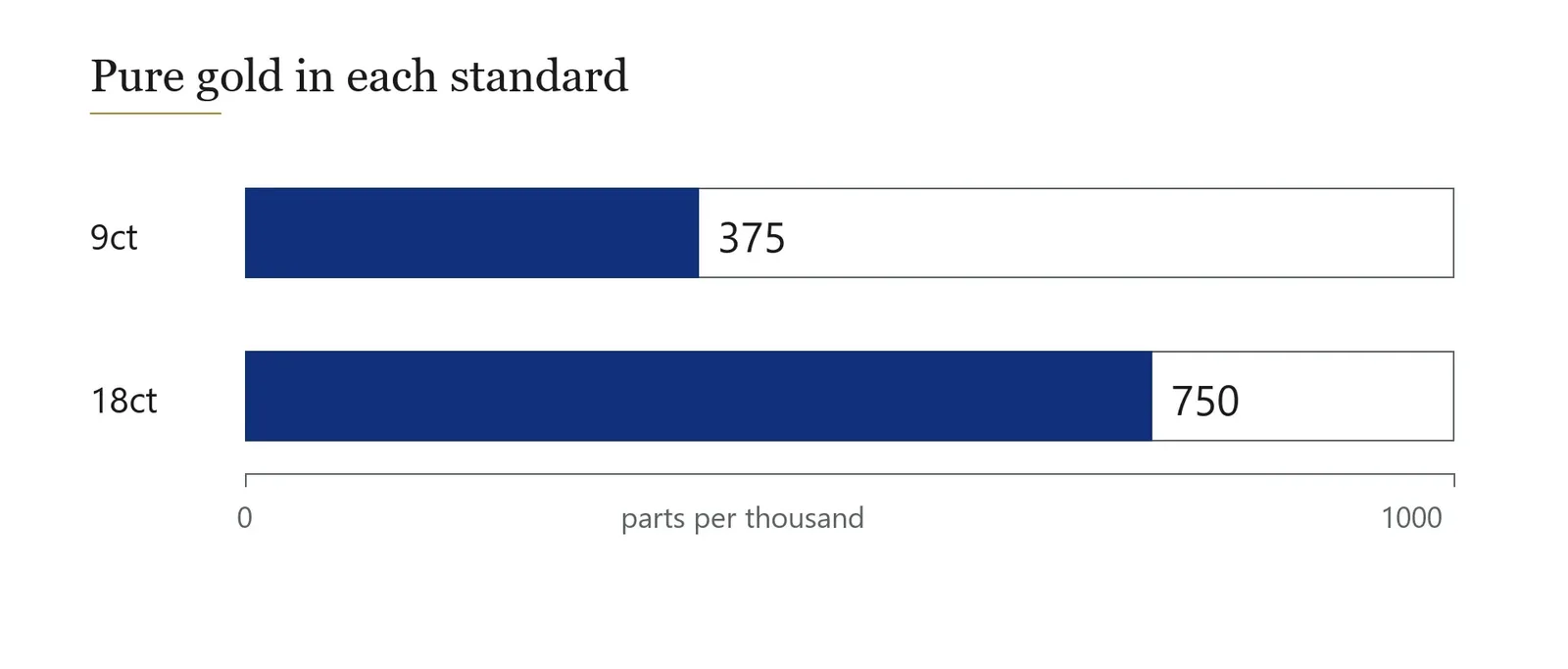
9ct gold is 375 parts per thousand pure gold and 18ct is 750, so 18ct holds twice the gold by proportion. That is what the number and the standard mark state. Which suits an engagement ring depends on the design and the budget, so decide it with a designer, not from the hallmark.

What do 9ct and 18ct actually mean?
They name how much of the alloy is pure gold, counted in parts per thousand. The Hallmarking Act 1973 sets standards of fineness for gold, each with a standard mark, and ties each carat description to its fineness.
| Carat | Parts per thousand pure gold | Standard mark |
|---|---|---|
| 9ct | 375 | 375 |
| 18ct | 750 | 750 |
Carat names: Schedule 1 Part III. Fineness and marks: Schedule 2 Part I.
The same schedule also lists 585, 916.6, 990 and 999, with the marks 585, 916, 990 and 999. Our guide to reading a UK gold hallmark takes you through the full set.
What does the standard mark tell you, and what does it not?
The standard mark states the fineness of the gold: 375 for 9ct, 750 for 18ct.
The parts of the two schedules we read set out fineness, marks and exemptions. None addresses how hard a ring is, what it costs or how long it lasts. Ask the designer about each, and ask for the answer in writing.
Where do the other metals come in?
This piece compares gold content only. For platinum and white gold set against yellow, see platinum, white gold or yellow gold.
How do you decide?
Work from questions, not from the stamp. Put these to the designer before you settle on a gold content:
- What does the design ask of the metal around the stone, and which gold content does the designer advise for that?
- How will the ring be worn, every day or for occasions, and does that change the answer?
- What is the budget, and what does each gold content leave out of it? Ask for the difference in writing, from the designer’s own quote.
- Does the colour of the metal matter to the person who will wear it? Say so at the first conversation, because it can change the options.
- How will the ring be looked after, and can it be resized in this gold content? Our guide to whether an engagement ring can be resized is a good place to start the conversation.
A designer can answer each of these for your ring. A table of fineness cannot.
If you are already planning a commission, the bespoke page explains how a commission works.
How we measured
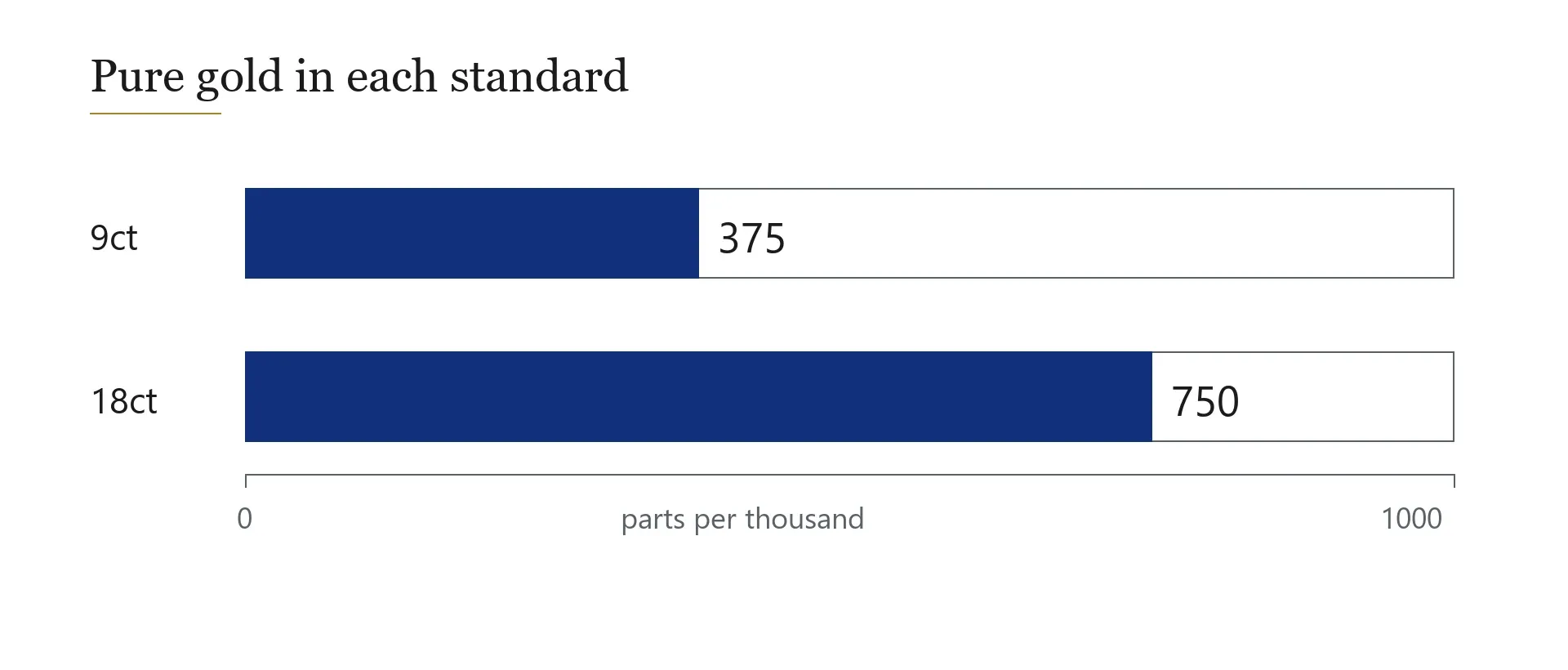
Nothing here was measured on a ring. The two bars in the figure are drawn to scale from two numbers in the Hallmarking Act 1973: 375 and 750 (Schedule 2 Part I), which Schedule 1 Part III ties to 9ct and 18ct. We used no other data. The bars are blue, which is not a metal colour: the Act gives no colour for either standard. What this piece adds is the figure: both bars sit on one scale of 1000, so the gap between the standards is a length you can see, not two numbers to compare.
When this does not apply
This piece covers gold content only, as the Act states it. It does not cover platinum, white gold or other colours of gold, which the linked posts discuss. The right choice depends on the design, the budget and the wearer, so treat the questions above as a starting point for that conversation. The pages we read show the latest revised text of the Act on the date below.
Sources
- legislation.gov.uk (The National Archives), Hallmarking Act 1973, Schedule 2, Part I (standards of fineness and standard marks), published 1973 (Part I as substituted 1 January 1999; page shows latest revised text), opened 11 Nov 2026, https://www.legislation.gov.uk/ukpga/1973/43/schedule/2
- legislation.gov.uk (The National Archives), Hallmarking Act 1973, Schedule 1 (Part II exemptions; Part III carat descriptions and their fineness), published 1973 (page version list shows a latest dated entry of 6 April 2025), opened 11 Nov 2026, https://www.legislation.gov.uk/ukpga/1973/43/schedule/1
Last checked: 11 Nov 2026.