Design your own engagement ring in the order each choice limits the next: how it will be worn, the centre stone, the setting, the metal, then a design you approve before anything is made. At Silux London, a free hour with the designer covers it, and nothing is cast, set or cut until you confirm.
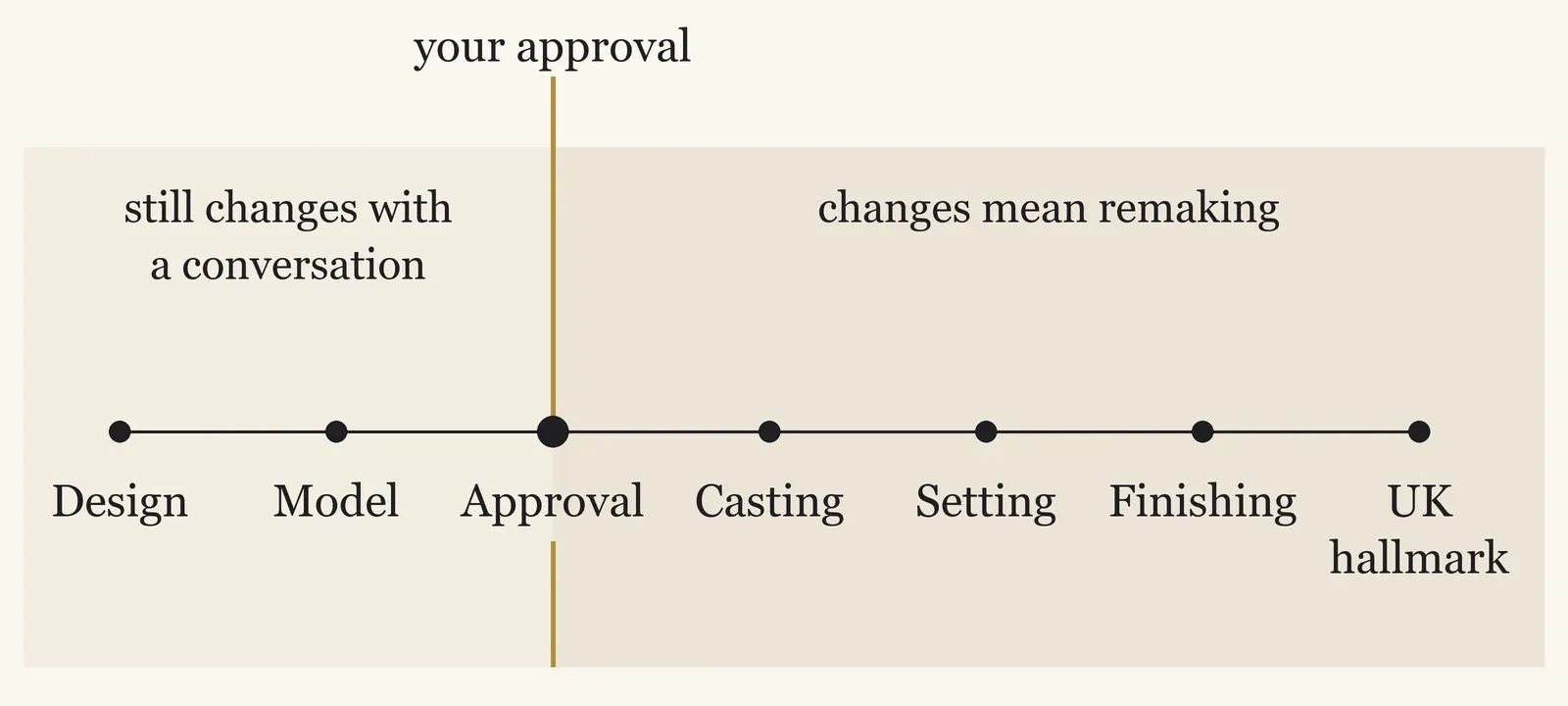
Early choices narrow the later ones. One point on the path is where changing your mind stops being a conversation and starts being a remake.

What should the ring do before it looks like anything?
Start with the wearing, not the picture. Ask four plain questions.
Who will wear it every day? Do they work with their hands, or type all day? Will it sit beside another ring, now or later? And what should it never look like?
These questions decide more than any mood board. A ring for someone who gardens, climbs or lifts at the gym may suit a different shape from one worn to a desk. A ring that must sit flat beside a wedding band needs a different profile from one worn alone.
The “never” question is worth asking. A dislike is a clear instruction, and a designer can work from dislikes as well as favourites. That is why the first step of our design session is a talk about what the piece is for, and what it should never look like, before any image is drawn.
Write your answers down in a few lines. You will use them for every choice that follows.
How big should the centre stone be?
Carat is a weight. It is not a width. The International Gemological Institute (IGI), in its own guide to carat weight, says diamonds of the same weight do not necessarily look the same size. Cut proportions and table size change how large a diamond appears from above.
So two stones of one weight can look different on the hand. One may spread wider across the finger. Another, cut deeper, may hold its weight below the surface where nobody sees it.
For that reason, ask for more than the weight. Ask for the stone’s length, width and depth in millimetres. An IGI grading report gives them: IGI says its report includes length, width and depth in millimetres. Ask whoever supplies your stone for the same three numbers.
If you already own a stone, a family stone or one bought elsewhere, this choice is already made. The setting is then designed around the stone you have, and the questions about wearing still apply.
Our piece on how to approve a ring design before it exists explains why the millimetres belong in writing before you say yes.
Which setting suits the way it will be worn?
The setting is the decision that limits the most. It holds the stone, and it decides how the band is shaped, how high the stone sits and how easily the ring can live with another ring.
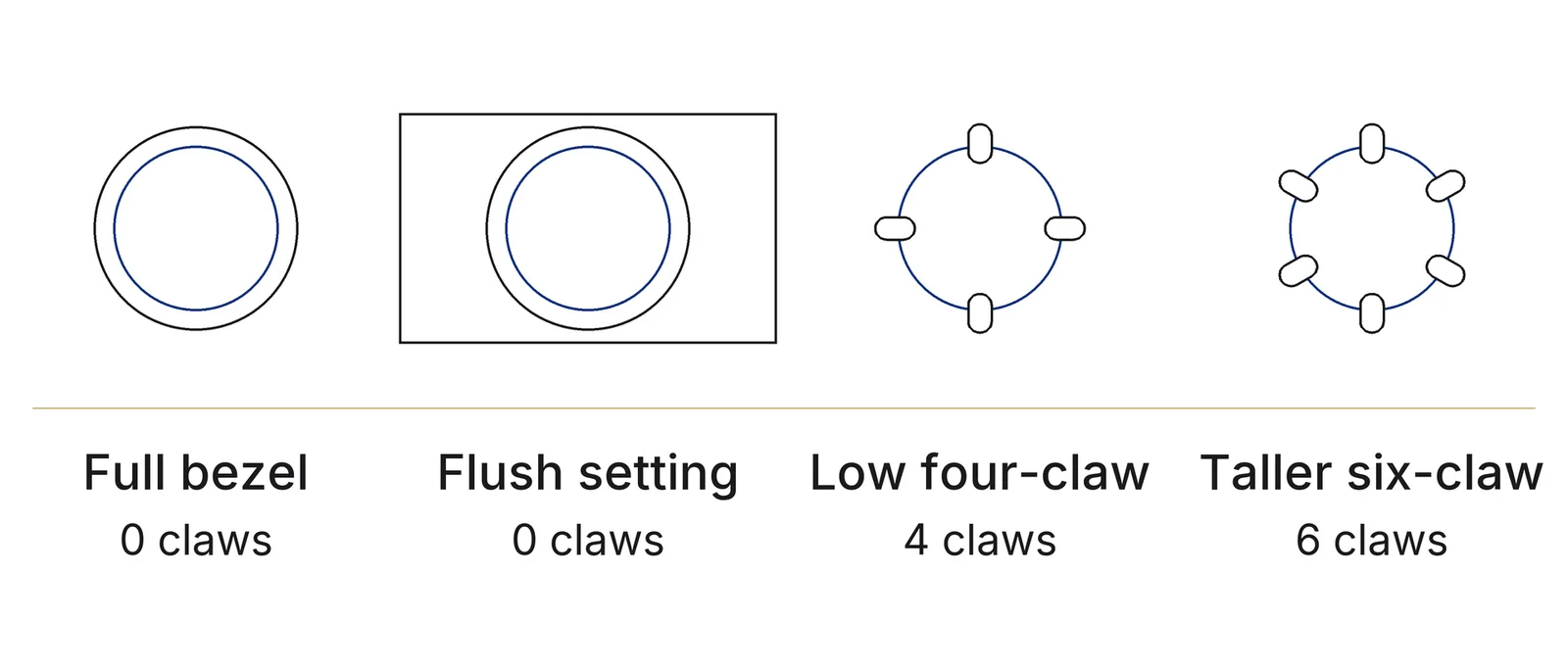
A high setting shows more of the stone and may catch on cuffs and gloves. A low, enclosed setting sits closer to the finger and may protect the edges of the stone, but it shows less of it. Neither is better. Each suits a different set of answers to the questions about how the ring will be worn.
Pick a setting from your answers, not from a picture of a ring you admired. The designer can then show you two or three that fit, and say what each gives up.
We have written the setting styles up in full in engagement ring settings explained. Read it before your session, so the vocabulary is familiar when the designer uses it.
Which metal, and what has the hallmark to do with it?
Gold and platinum are two metals to consider. Within gold, carat is one of the choices.
Carat, for gold, is a statement of purity. The Hallmarking Act 1973 (Schedule 1) sets out the table. Under it, a description as 9 carat is presumed to indicate gold of 375 parts per thousand, and 18 carat is presumed to indicate 750 parts per thousand. In plain terms, the 18ct yellow gold of a classic ring carries a higher share of pure gold than 9ct gold.
18ct yellow gold is the warm, classic choice. Whatever colour you choose, put it in the written specification by name, so that “gold” never stands alone.
Hallmarking is the law’s concern too. The same Act exempts small items by weight: gold under 1 gram and platinum under 0.5 gram. An engagement ring may or may not fall under those weights, so ask the designer which side of the line your ring is expected to sit on. Do not assume.
If wear matters to you, say so in the first conversation. How a metal wears is a question for the designer, not a number to take from a guide.
Will it be worn alone, or beside another ring?
If a wedding band will follow, design the two together. A ring made on its own and a band chosen later may not sit flush. Drawing the two together avoids the gap.
Tell the designer now that a band is likely, even if it is years away. The setting height, the shape of the shank and the width of the band can all be drawn so that a second ring has room to sit beside the first. If you will wear the pair every day, this decision belongs in the first hour, not after the engagement.
Our guide to designing pairs of rings worn together goes through the choices in more detail.
What should you see before you say yes?
Before you approve, ask to see four things.
First, more than one view. A design visualisation from above does not show how high the stone sits. A view in profile does. You should have both.
Second, the stone’s measurements in millimetres, as asked for under the centre stone, written beside the design.
Third, the full specification in writing: the metal and its carat, the stone, the setting, and anything that is particular to your ring.
Fourth, if you would like one, a physical prototype you can hold, try on and turn over. Ask for it before you approve, not after.
If any is missing, ask for it. It is a normal request.
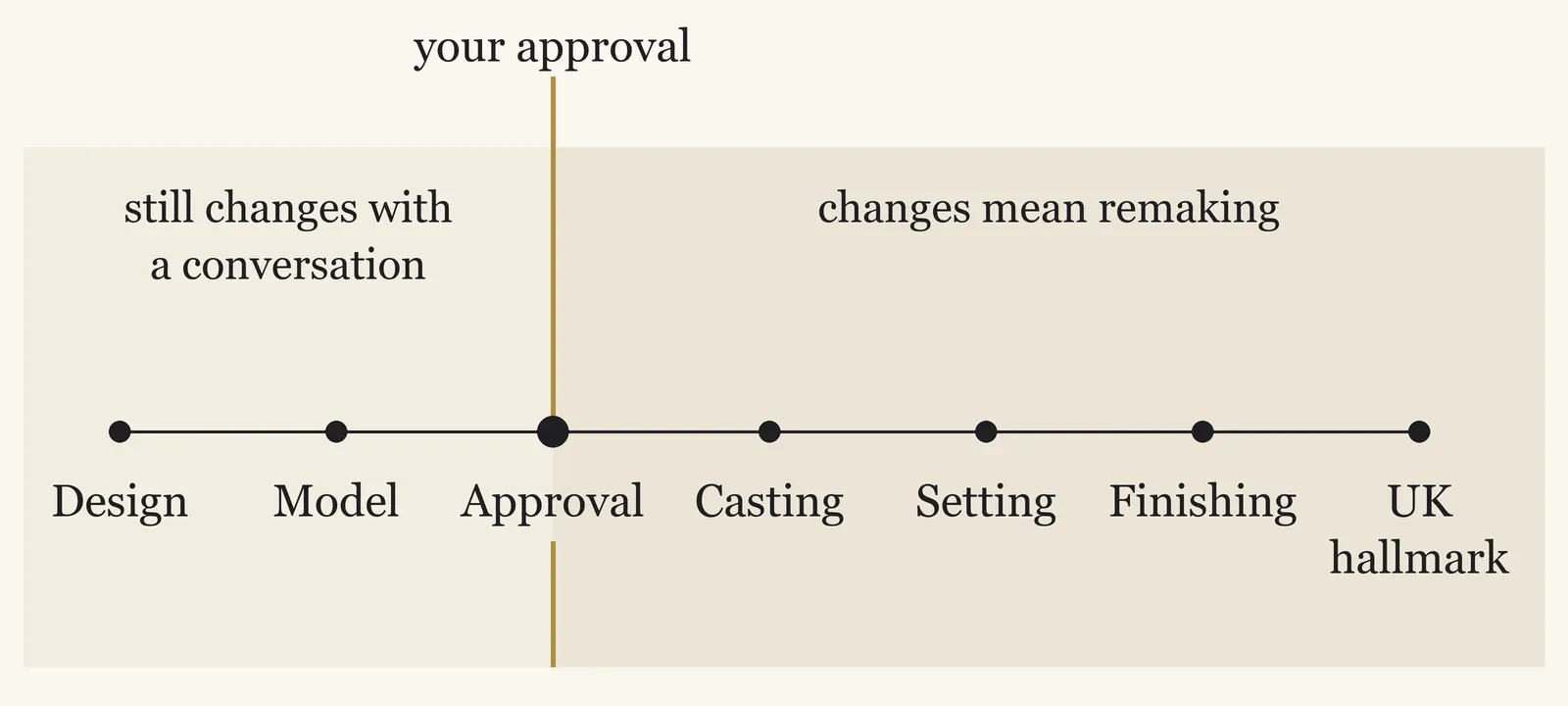
The line on the figure is the point of the whole guide. To its left, a change costs a conversation. To its right, a change means remaking. That is why the stage before it is the one to take slowly. “Model” is the stage where the design is modelled for you to see in three dimensions. Read more in how to approve a ring design before it exists.
What happens in a design session?
The session is an hour with the designer. It is free and private, and you can have it in the Jewellery Quarter in Birmingham or by video call. It runs in four steps.
- You talk. The designer asks what the piece is for and what it should never look like.
- The direction takes shape with you there, from the images you like and the ones you do not.
- You get honest numbers, split across the metal, the centre stone, the design and the making.
- You leave owing nothing.
Whether or not you go further, you keep a written design summary. You are not asked to decide on the day.
Bring your answers about wearing, your questions on stone size in millimetres, a short list of settings and a metal. You can book a design session when you are ready, and the wider service is described on our bespoke page.
What cannot be changed once you approve?
Once you approve, the ring is made to your specification. The law treats that kind of purchase differently, so read this part with care. It is general information, not legal advice, and it does not replace the contract you are given.
For distance contracts the regulations give a right to cancel, with exceptions. The Consumer Contracts (Information, Cancellation and Additional Charges) Regulations 2013 carve out one of them. Regulation 28(1)(b) says the cancellation rules do not apply to the supply of goods that are made to the consumer’s specifications or are clearly personalised. A ring designed with you may be that kind of goods. Whether yours is depends on what is agreed.
The same Regulations place a duty on the seller. Schedule 2, paragraph (o), lists, among the information a trader gives before a contract, that the consumer will not benefit from a right to cancel where regulation 28 leaves none. Look for that statement before you approve, and ask if it is missing.
The practical result is simple. Every decision sits before the approval. After it come the stages in the figure: casting, setting, finishing and, where the law requires it, the UK hallmark. They carry out what you approved. They are not a chance to revise it.
Our article on your rights when buying an engagement ring goes through this in more detail, and how a bespoke ring is made describes the stages after approval.
Where do you start?
With your answers about how the ring will be worn, and a free hour. Everything else follows from them.
How we measured
We took no measurements for this guide. The figure is drawn from the order of stages in the house’s own commission process, so that the point of approval can be seen at a glance. No stone size is given: the grading report for your stone carries its own length, width and depth.
When this does not apply
This path assumes you can approve a design before anything is made. A ready-made ring, or an online builder with fixed templates, has no such stage, so the approval stage may not exist there. If you have a fixed date, tell the designer in the first conversation. Finger size, and whether a ring can be resized later, are not covered here. The legal points are general information, not advice on your own contract.
Sources
- legislation.gov.uk (The National Archives), Hallmarking Act 1973, Schedule 1, updated 6 Apr 2025 (latest version; the Act was enacted 25 Jul 1973), opened 10 Nov 2026, https://www.legislation.gov.uk/ukpga/1973/43/schedule/1
- legislation.gov.uk (The National Archives), The Consumer Contracts (Information, Cancellation and Additional Charges) Regulations 2013, regulation 28, updated 13 Jun 2014 (latest amendment entry), opened 10 Nov 2026, https://www.legislation.gov.uk/uksi/2013/3134/regulation/28
- legislation.gov.uk (The National Archives), The Consumer Contracts (Information, Cancellation and Additional Charges) Regulations 2013, Schedule 2, updated 13 Jun 2014 (latest amendment entry), opened 10 Nov 2026, https://www.legislation.gov.uk/uksi/2013/3134/schedule/2
- IGI (International Gemological Institute), Carat Weight: Understanding the Carat Scale for Diamonds, published 28 Jul 2023, opened 10 Nov 2026, https://www.igi.org/consumer-education/diamond-4cs/carat-weight/
Last checked: 10 Nov 2026.