The bow-tie is a darker band across the middle of an oval. It comes from the stone’s facets and from your own head blocking the light, so every oval shows some. A setting does not change the stone, so judge the stone itself: watch it move, in person or on video. Choose the setting to suit your hand.
Where the evidence is thin, this guide says so. For oval ring designs, go to oval engagement rings.

What is the bow-tie effect, and is it a flaw?
GIA’s guide to oval cut diamonds describes the bow-tie as a darkened, bow-tie shaped area across the centre of the stone. It is an area of contrast, and the cause is blocked light. Part of that light is blocked by the person looking: your head and your shoulders. The closer your face is to the stone, the stronger the effect looks.
So it is not a crack, a chip or an inclusion. It is something the stone’s shape and facets do with light, and something you add by leaning over it.
Two other writers explain the mechanism from their own side of the trade.
Mike Botha, writing for Rapaport Trade, gives the cutter’s view. In fancy shapes, the facets under the stone act as mirrors. The ones angled towards your eye reflect your own face back at you, and that reads as the dark centre. He calls it poor design, not poor workmanship. Cutters respond by changing the angles of the facets underneath, or by rotating the main facets.
Bryan Boyne, for the retailer Whiteflash, gives the buyer’s view. The big central facets under the stone reflect light that arrives from high overhead. When your head is close, it blocks some of that light, and the blocked part shows as darkness.
Is it a flaw? Not in the way a crack is. GIA says that when the bow-tie is subtle and balanced, it can add character and dimension. A heavy one that holds your eye is another matter, and the next section is about telling the two apart.
Does every oval have one, and how much is too much?
GIA says some bow-tie is always there, because of the oval’s shape and faceting. A well-cut oval keeps it small by spreading light evenly across the stone. How much shows still varies, even between stones in the same length-to-width range.
That makes it a matter of degree, not a yes or no. Whiteflash makes the same point. A practical way to apply it: watch the stone move, and ask whether your eye goes to the dark band every time you look. If the band is soft and balanced, and you stop noticing it, that is the character GIA describes. If you cannot stop seeing it, it is too much for you, and for this decision you are the one who counts.
A certificate will not settle the question. GIA gives an overall cut grade to round brilliant diamonds only. For an oval, its report gives polish and symmetry but no cut grade, and GIA’s guide does not say it assesses the bow-tie. So the bow-tie is judged by eye. What a grading report does and does not tell you is covered in its own guide.
Which length-to-width ratio should I choose?
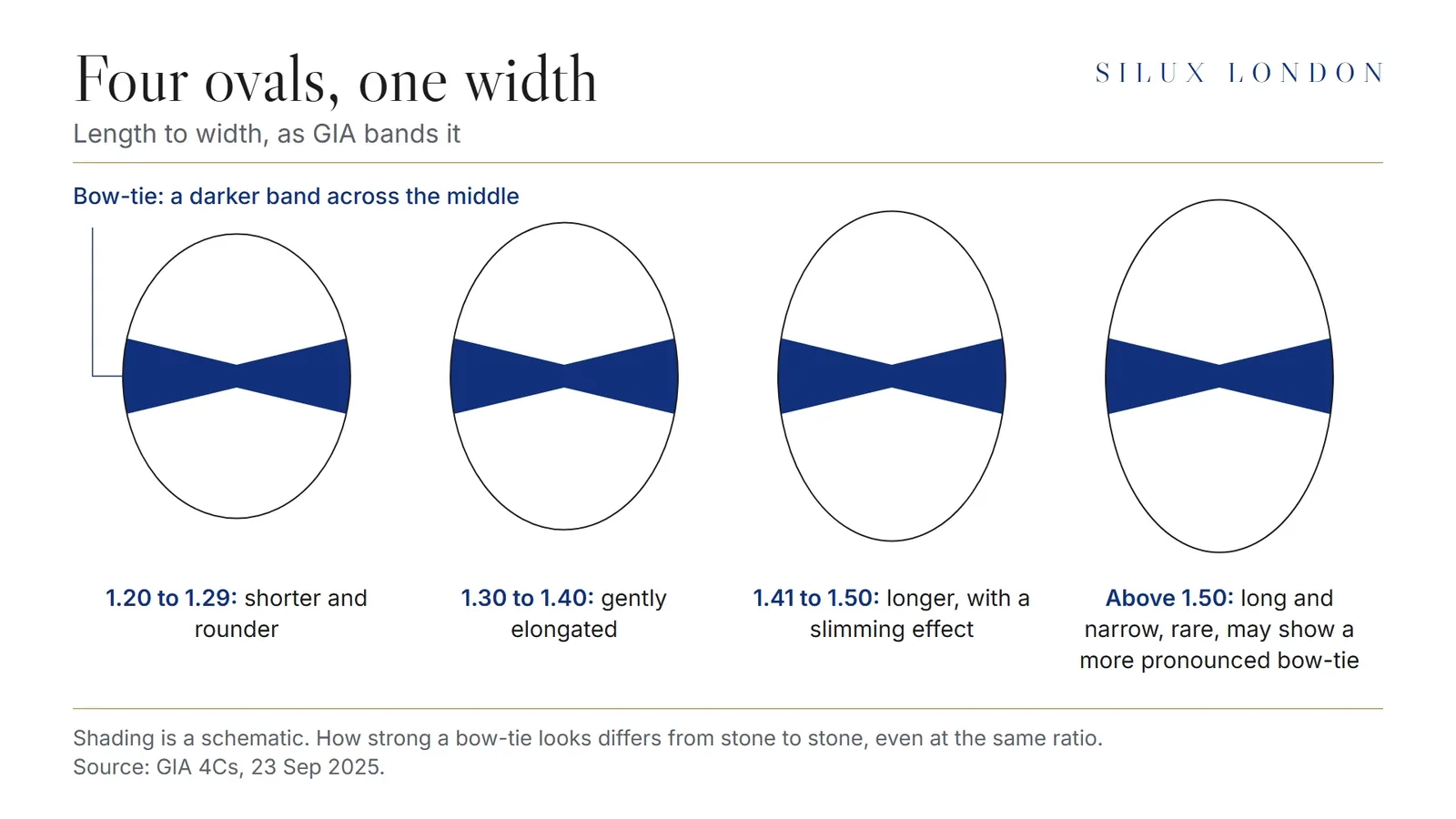
The ratio is the stone’s length divided by its width. At 1.40:1 the stone is one and four-tenths times as long as it is wide. GIA bands it like this:
- 1.20:1 to 1.29:1: shorter and rounder.
- 1.30:1 to 1.40:1: gently elongated.
- 1.41:1 to 1.50:1: longer ovals, with a slimming effect. GIA calls 1.40 to 1.50 the traditional oval and the most popular range.
- Above 1.50:1: long and narrow. Rare, because it is impractical to cut from the crystals, and it may show a more pronounced bow-tie.
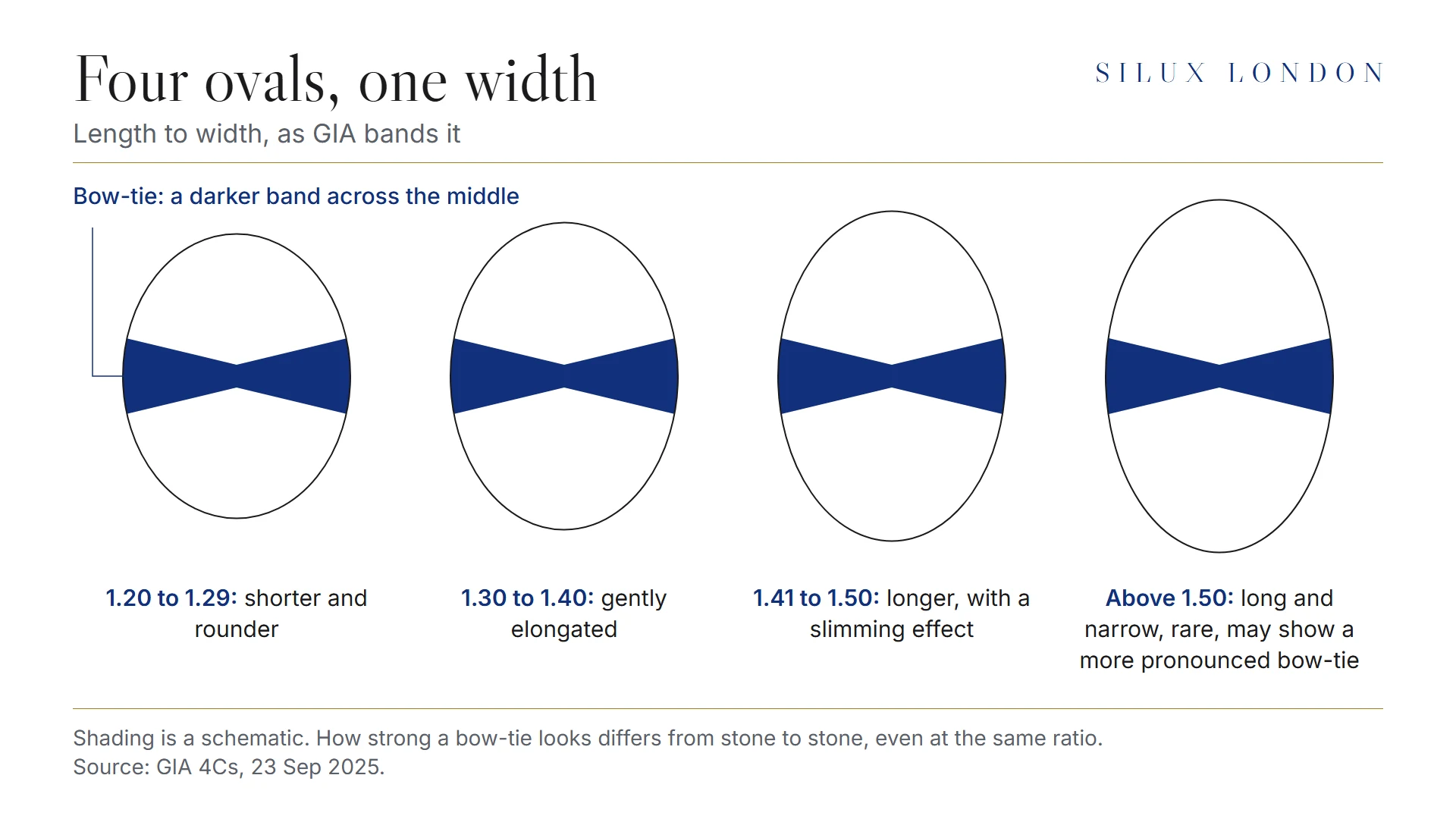
Every oval in the figure carries the same dark band across the middle. The ratio bands tell you how long the stone is, not how strong its bow-tie will be. GIA’s own example is a 1.48:1 oval, inside the traditional range, with a noticeable bow-tie. Above 1.50 GIA warns the effect may be stronger. Below it, the ratio tells you little about the bow-tie, and a lot about how the stone sits on the hand.
On the hand, GIA says an oval’s elongated shape can make fingers look longer and slimmer. It also has more surface area than a round stone of the same carat weight, so it gives the impression of a larger stone. GIA gives no numbers for that, so neither does this guide.
There is no correct ratio. Which diamond shape looks biggest on the hand makes the point that the same ratio can look quite different in a different setting, beside a different band, on a different hand. Choose the ratio you like on a hand, then check the bow-tie of the actual stone.
How do I check a stone before I commit?
Use this list on any oval you are considering.
- See the stone itself, or ask for a video. A still picture can mislead. Whiteflash notes that photos and lighting can exaggerate the bow-tie or hide it, and that a still can make it look worse than it does moving.
- Watch it move. Tilt it through a small range of angles and see what the dark band does. Judge the stone across the movement, not at one angle.
- Keep a normal distance. Hold the stone, or sit, as you would look at a ring on a hand. Close in, your head blocks more light, and the band looks stronger than it will in daily wear.
- Ask about the light. A spotlit tray and a photo lit to flatter can both change the band. If you can, look in more than one light.
- Ask for the report and the proportions, and know their limit. For an oval the report gives polish and symmetry but no cut grade, and GIA’s guide does not say it assesses the bow-tie.
- Ask whether the seller has trade imaging. Rapaport says ASET and Ideal Scope imaging shows the effect. It is a trade tool, so not every seller will have it. If one does, it adds to what your eye tells you.
When two stones are close, choose the one whose band you stop noticing.
Can a setting hide it or reduce it?
A setting holds the stone. It does not recut it. The facets belong to the stone.
GIA’s guide describes what each setting does for an oval:
| Setting | What GIA says it does |
|---|---|
| Solitaire | All the attention goes to the stone. |
| Claw (GIA says prong) | The classic choice. It holds the stone securely, lets in more light and adds sparkle. |
| Bezel | A thin rim of metal round the stone. It protects strongly, looks sleek and modern, and suits an active life and the oval’s curves. |
| Halo | Adds brilliance, makes the stone look larger and emphasises the oval’s shape. |
| Side stones | Echo or contrast the oval. |
| East-west | The oval is set across the finger, which GIA says can make a modest stone look larger. |
GIA ties none of these to the bow-tie. Nothing in its guide says a halo reduces it or a bezel softens it.
A retailer says otherwise. Robinson’s Jewelers, in a guide of 8 January 2026, says the right setting can help minimise a bow-tie’s appearance, that a halo can distract the eye, and that a well-designed bezel can diffuse light. It gives no source and no test.
Treat these claims as opinion. That is not the same as calling them wrong. It means no source read for this guide shows them by test or measurement, so do not choose a setting on a promise about the bow-tie. Choose it for what is supported: the look, the protection and the hand. What each setting commits you to sets out the everyday side of that choice.
How high should the setting sit, and what band fits an oval?
No source read for this guide ties setting height to the bow-tie. So height is a question of wear and comfort here, not of optics, and anyone who says otherwise needs to show you why.
On wear, metal that stands proud of the band is what a sleeve, a glove or a coat pocket finds. The settings guide above explains that for each setting. GIA says the girdle, the stone’s edge, is where the stone is held in the setting, and that a bezel gives excellent protection.
Height also changes how the ring reads from the side. A ring can look balanced from above and sit higher on the finger than expected once it is worn, so ask to see it in profile. The shape guide linked earlier covers this.
On the band, GIA says a broad band looks bold and a thin one looks delicate, and lets a larger centre stone stand out. A band set with stones all the way round is harder to resize later, as the resizing guide explains, so think about the finger in years to come, not only today.
No source gives a height or a width in millimetres for a good oval ring, so this guide gives none. If you are working on a design, ask for the figures in millimetres and compare them against your hand. How to approve a ring design before it exists says what to ask for.
What should I do next?
For an oval, look at the actual stone moving before you commit to it; on a commission the stone is chosen once the design is confirmed, so ask to see it before it is set.
- Decide the shape and the ratio range you like on a hand.
- Choose the setting for its look, its protection and your hand, not for a claim about the bow-tie.
- When the stone is put forward, judge it moving, at a normal distance, in person or on video.
- Ask to see the design drawn before anything is made. The design session is free: a private hour with the designer, in the Jewellery Quarter or by video call, with no card details and no obligation. Your design is then drawn up and sent to you as a design visualisation, and nothing is cut until you have approved the design. Book a design session.
For further reading, see the journal’s guides.
How we measured
The figure is a drawing, not a photo of a stone. The measure is a ratio, length divided by width, so it has no unit. The four ovals are drawn to GIA’s length-to-width bands: all four share one width, so their lengths differ in true proportion, and each is drawn at a ratio inside one band, the fourth above 1.50. The drawn ratios are 1.25, 1.35, 1.45 and 1.55, chosen to sit inside the bands; they are not measurements of any stone. The labels carry GIA’s bands, not the drawn values.
The shading is a schematic. Each oval carries the same darker band across the middle, at the same strength, on purpose. Shading them differently would claim that the ratio sets the strength of the bow-tie, and GIA says visibility varies even within one range. The bands and the wording come from GIA’s guide of 23 Sep 2025. The explanations of cause come from the GIA, Rapaport and Whiteflash pieces listed under Sources, and nothing here was measured on a particular stone.
When this does not apply
This guide is about the bow-tie on oval stones, and its sources describe diamonds. Other fancy shapes can show a dark centre too, and Rapaport writes about fancy cuts in general, but the bands and the advice here are for ovals. The evidence on settings is thin: no source read for this guide shows, by test or measurement, that a setting changes the bow-tie, in either direction. GIA’s bands are as published on 23 Sep 2025 and may change. Nothing here grades, values or advises on a particular stone. Your eye, on the actual stone in the actual light, is the test.
Sources
- GIA 4Cs, Oval Cut Diamond Guide, published 23 Sep 2025, opened 7 Nov 2026, https://4cs.gia.edu/en-us/blog/oval-cut-diamond-guide/
- Whiteflash, Bryan Boyne, Mastering Oval Diamond Selection: How to Avoid the Bowtie Effect, published 2 Sep 2024, opened 7 Nov 2026, https://whiteflash.com/diamond-education/oval-diamond-bowtie-guide
- Rapaport Trade, Mike Botha, How to Deal With Bow Ties in Fancy Cut Diamonds, published 19 Oct 2020, opened 7 Nov 2026, https://rapaport.com/trade/blog/how-to-deal-with-bow-ties-in-fancy-cut-diamonds/
- Robinson’s Jewelers, Maya Thompson, Oval Diamond Bow-Tie Effect: What to Accept vs. Reject, published 8 Jan 2026, opened 7 Nov 2026, https://robinsonsjewelers.com/blogs/news/oval-diamond-bow-tie-effect-what-to-accept-vs-reject-your-guide-to-a-dream-stone
Last checked: 7 Nov 2026.